The Protect Our Neighbors Act, introduced by Representative Lateefah Simon (D-CA), would fundamentally change how the federal government handles longstanding deportation cases, granting effective amnesty to those who were able to evade deportation. Under current immigration law, final removal orders generally remain enforceable regardless of how much time has passed. The Democrats’ proposal would establish a ten-year expiration period, with provisions allowing immigration judges to renew orders under certain circumstances.
The legislation could become another flashpoint in the immigration battle between President Donald J. Trump and the incoming Democrat-controlled Congress.
A Ten-Year Clock on Deportations.
The proposed legislation would establish a mechanism under which final removal orders expire after ten years, subject to judicial renewal. Migrants seeking permanent residency under the legislation would have to satisfy additional eligibility requirements, including continuous physical presence, restrictions concerning criminal convictions, and documentation relating to federal taxes.
Qualifying applicants would also face an application fee capped at $1,200. The proposal would not automatically grant citizenship or green cards to everyone with an expired deportation order. Instead, it would allow qualifying individuals to apply for permanent residency.
More Than a Million Deportation Orders Remain Outstanding.
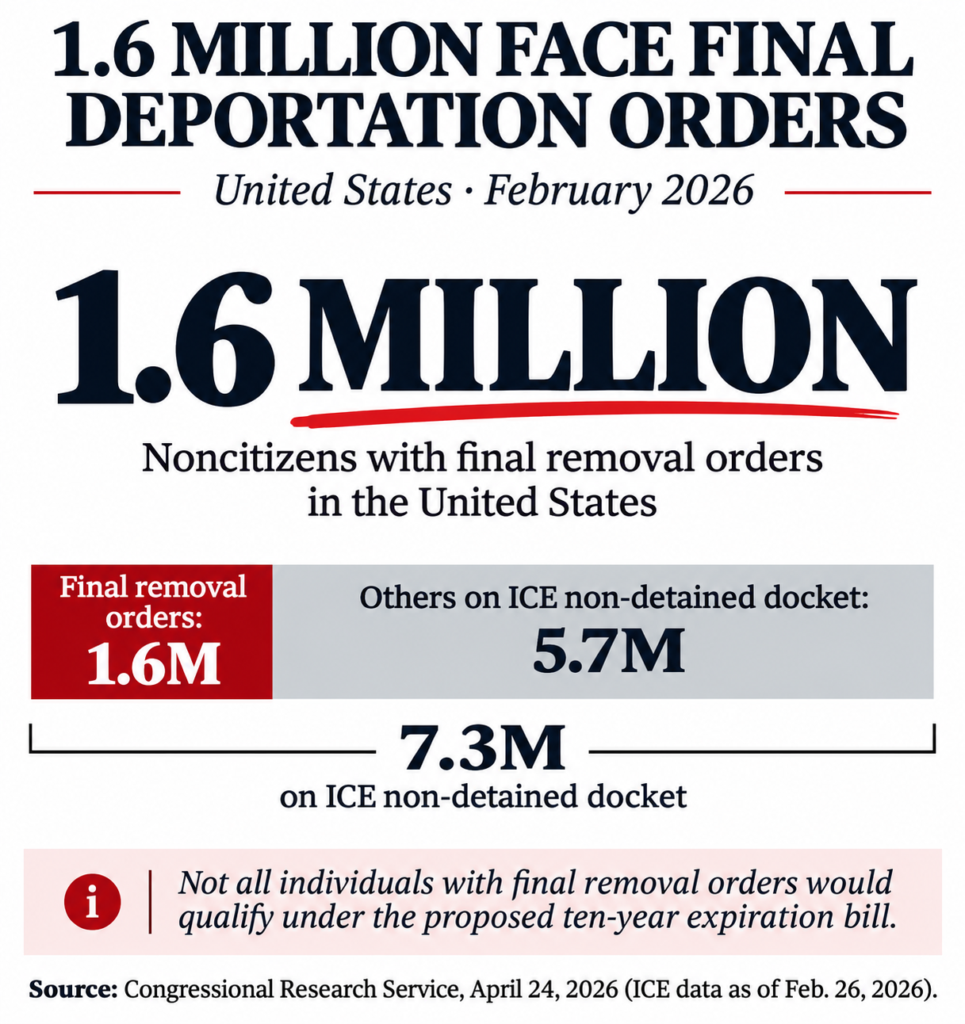
The potential scale of the proposal is considerable, although the number of immigrants who would actually qualify remains unclear. According to Immigration and Customs Enforcement’s fiscal year 2024 annual report, the agency’s non-detained docket contained more than 7.6 million migrants, including approximately 1.43 million with final removal orders.
By February 2026, the number of migrants with outstanding final removal orders had reportedly reached approximately 1.6 million, according to congressional reporting.
Not every outstanding order is more than ten years old, however, and not every migrant would satisfy the proposed eligibility requirements. It is unclear as to how many illegals would benefit overall.
A Reward for Ignoring Deportation Orders.
Under the proposal, an immigration judge could renew an expired order only if the government demonstrated that significant reasons for the delay existed beyond administrative or funding problems and that renewal served the public interest based on new evidence.
That restriction could prevent the government from relying on its own administrative backlogs to justify enforcement years later. However, critics could argue that it effectively penalizes federal authorities for failing to execute deportation orders while allowing some migrants to benefit from remaining in the country.
This could create a ten-year deadline that would encourage individuals to remain in the United States after their immigration cases have been decided.
A New Immigration Battle in Congress.
The proposal arrives as Democrats prepare to take control of both chambers of Congress in January 2027, potentially giving the legislation a stronger chance of receiving hearings and passing in the House and Senate.
While President Trump has expressed openness to negotiating immigration legislation, he has not endorsed the Protect Our Neighbors Act. President Trump could veto the legislation if it passes through Congress, and it is unlikely that the Democrats could get enough Republicans to support it to override a veto.
The danger is that final court orders could become temporary obstacles rather than binding judgments. For Democrats, the legislation offers a way to protect illegals from being deported entirely. This would encourage more illegals to come to the U.S. and purposely overstay and evade deportation.