
Spain has become one of Europe’s fastest-growing economies, fueled by a massive influx of immigrants under socialist Prime Minister Pedro Sánchez. However, behind the economic figures lie stagnant wages, soaring housing costs, and millions of Spaniards struggling to benefit from their country’s supposed economic miracle.
A new analysis published Thursday reveals that immigration accounted for approximately half of Spain’s economic growth between 2022 and 2025, as well as more than two-thirds of employment gains. The findings come just ten days before Spain’s November 29 snap election, when voters could replace Sánchez’s Socialist government with a conservative coalition promising tighter immigration controls.
While economists and investors warn that restricting immigration could undermine Spain’s expansion, other economic indicators suggest the country’s remarkable growth has delivered considerably less prosperity to ordinary Spaniards than the figures imply.
Immigration Is Driving Spain’s Economic Expansion.
Spain’s economy expanded by 2.6 percent in 2025, approximately twice the eurozone average, with the government forecasting another 2.6 percent increase in 2026.
According to figures, the number of foreign workers in Spain has increased by more than 1.2 million since 2022. Foreign-born residents now account for approximately 14 percent of the population.
The Bank of Spain estimates immigration contributed approximately 1.7 percentage points of economic growth between 2022 and 2025. However, a substantial portion of this expansion reflects the addition of workers and consumers rather than improvements in the productivity or earnings of existing residents. While Spain’s GDP has risen by approximately 15 percent since late 2021, the country’s immigration-dependent economic model poses significant political and economic challenges.
Spanish Workers Have Yet to Recover Their Lost Purchasing Power.
Perhaps the clearest evidence of Spain’s uneven economic recovery comes from the Organization for Economic Cooperation and Development’s 2026 Employment Outlook. Despite years of headline growth, Spanish real wages have remained two percent below their first-quarter 2021 levels, even after increasing by two percent over the preceding year.
The OECD warned that Spain was among the developed economies experiencing the largest declines in inflation-adjusted wages since the pandemic. It also projected real wages would stagnate through 2026 and 2027.
Unemployment remains another persistent problem. Spain’s unemployment rate stood at 10.3 percent in May 2026, more than double the OECD average of 4.9 percent. The country’s employment rate was also 4.8 percentage points below the OECD average.
While Spain has successfully expanded its workforce, the economic benefits have not translated into equally impressive improvements in individual purchasing power.
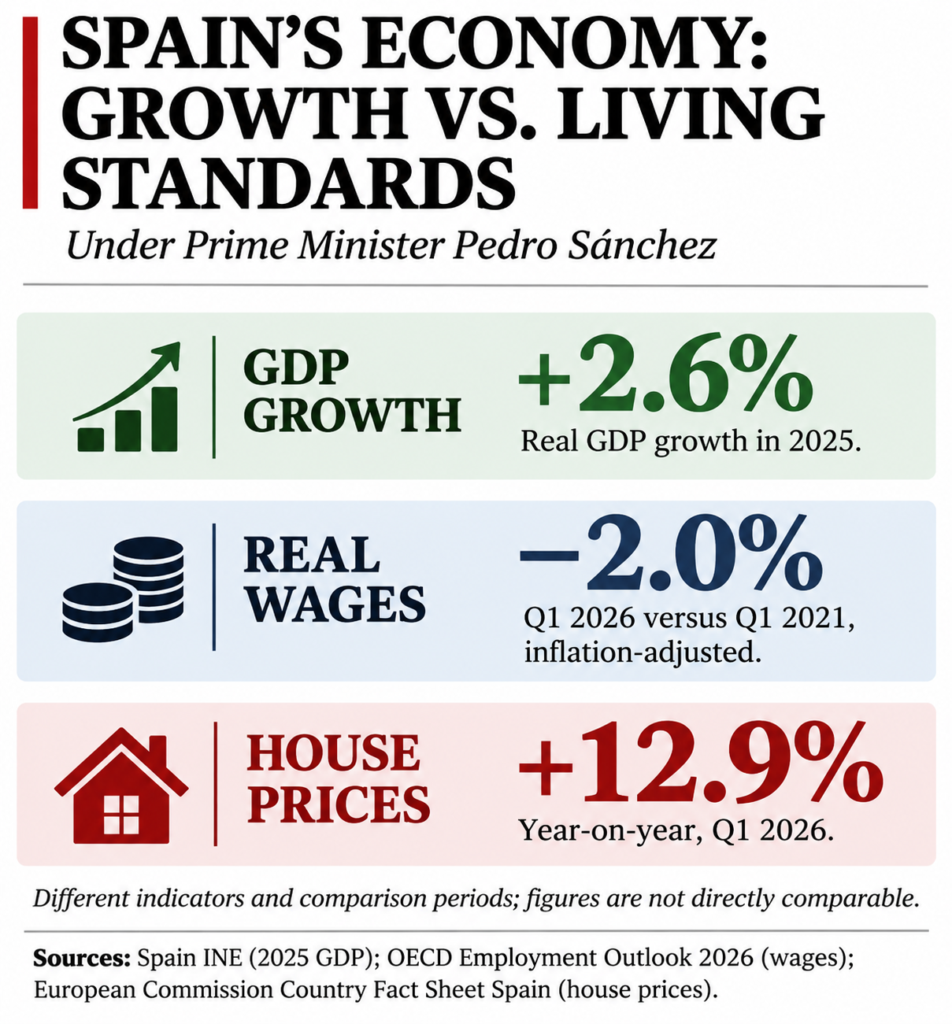
A Housing Crisis Is Undermining Living Standards.
Housing has become another major weakness in Spain’s economic success story. The country faces an estimated shortage of 750,000 homes. Rapid population growth has increased demand for housing, particularly in major cities already struggling with inadequate housing construction.
Additional demand from mass migration has compounded existing problems involving limited supply, construction bottlenecks, and restrictions on residential development. The political consequences have become increasingly visible. Sánchez called the November election following nationwide housing protests and parliamentary resistance to his proposed housing measures.
The disconnect between rising national output and declining housing affordability has left many young Spaniards unable to achieve financial independence, despite the country’s expanding economy.
Spain’s Immigration Model Faces an Electoral Reckoning.
The November 29 election could fundamentally change Spain’s approach to immigration. Opinion polls suggest the center-right People’s Party (PP), led by Alberto Núñez Feijóo, could form a government with the populist-right Vox party, led by Santiago Abascal.
The People’s Party advocates selective immigration to address genuine labor shortages while opposing uncontrolled arrivals. Vox proposes significantly tougher restrictions, including increased deportations, ending new migrant regularizations, and prioritizing Spanish citizens in access to public services.
Vox also argues that substantial tax reductions, lower public spending, and reduced bureaucracy would encourage domestic economic growth. Nicolás López, head of equity research at Singular Bank, argues that immigration has encouraged an expansion of lower-skilled employment, suggesting that tighter controls would not necessarily damage financial markets.
The economic consequences would also depend on whether a new government restricts illegal immigration, legal labor migration, or both.
For Sánchez, immigration has helped sustain a headline economic success story. For his opponents, the challenge is to demonstrate that Spain can improve productivity, wages, and living standards without relying so heavily on continued population growth.
Ultimately, Spain’s election is becoming a referendum on a fundamental economic distinction: a country can become economically larger without making its average resident substantially wealthier.