A federal jury in New York has convicted Chinese telecommunications giant Huawei and three subsidiaries following a three-month criminal trial, finding the firms guilty of secretly aiding Iran’s regime, defrauding American financial institutions, laundering money, and systematically stealing trade secrets from American tech companies.
Returned in the Eastern District of New York on Tuesday, the verdicts cover Huawei’s parent company, Chinese affiliate Huawei Device Co. Ltd., and American units Futurewei Technologies Inc. and Huawei Device USA Inc. Federal prosecutors demonstrated that the defendants ran a decades-long criminal enterprise aimed at expanding Huawei’s global telecommunications footprint through fraud and corporate theft.
“No person or company is above the law,” Attorney General Todd Blanche stated following the verdict. “For decades, Huawei and three of its subsidiaries conducted their business in the United States on the basis of lies and theft. Thanks to the work of the FBI and our federal prosecutors, those who engaged in these criminal activities will be held accountable.”
National Security Threat.
Justice Department Criminal Division chief Tysen A. Duva declared that Huawei “built its global empire on a foundation of fraud, theft, and deception,” adding: “Huawei’s crimes threatened the U.S. financial system, took advantage of American companies that compete honestly in the global telecommunications market, and undermined our national security. Today’s verdict sends an unmistakable message: America will defend its businesses, protect its workers, and safeguard its national security against corrupt foreign corporations that lie, cheat, and steal to get ahead.”
Acting Principal Deputy Assistant Attorney General for National Security M. Scott Proctor echoed that warning, stating Huawei “violated our laws, empowered our enemies, and harmed our national security,” while Eastern District of New York U.S. Attorney Joseph Nocella Jr. noted the convictions mark “a step towards accountability for Huawei’s criminal activities, which includes yearslong collaboration with sanctioned entities in Iran, repeated lies to banks, and blatant thefts from U.S. technology companies.”
FBI Counterintelligence and Espionage Division Assistant Director Roman Rozhavsky added that the outcome serves as “a stark reminder that the Chinese government continues to pose a serious threat to our economic and national security,” proving that “no company is too big, too powerful, or too well connected to exploit the U.S. and its citizens and expect to escape American justice.”
Secretly Building Iran’s Surveillance State and Lying to Banks.
Trial evidence revealed that Huawei and its affiliates supplied Tehran with turnkey infrastructure to expand mobile networks and build an internet backbone across the Islamic Republic. Huawei also partnered with Iranian regime officials and Zaeim—an arm of Iran’s intelligence apparatus—to monitor and censor internet traffic, while providing surveillance cameras used by Tehran to track domestic protesters.
Operating inside Iran through a covert subsidiary named “Skycom,” Huawei repeatedly misled journalists, American officials, and major banks, falsely claiming it had curtailed Iranian operations in 2011, had never aided Tehran’s military or intelligence services, complied fully with U.S. sanctions, and merely partnered with Skycom rather than owning it outright. Relying on those misrepresentations, Huawei secured billions of dollars in financing alongside access to U.S.-dollar clearing channels essential to competing internationally.
Decades of Industrial Espionage Against American Firms.
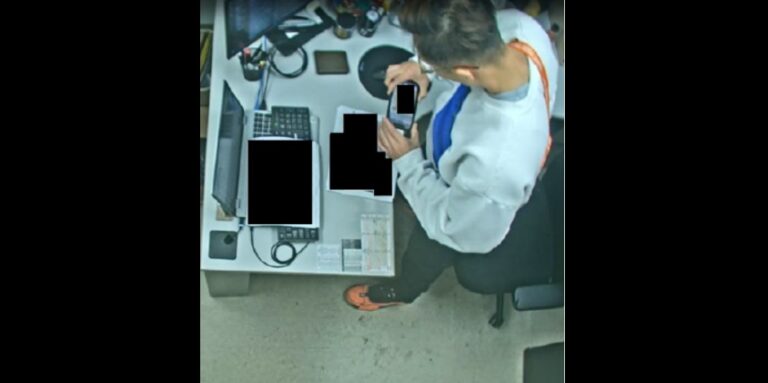
Alongside sanctions evasion, Huawei ran a sustained conspiracy to pilfer proprietary designs, source code, and manuals from American competitors and business partners. At T-Mobile, Huawei signed a non-disclosure agreement with the deliberate intent to break it, photographing and measuring T-Mobile’s touchscreen-testing robot, “Tappy,” before a Huawei staffer smuggled a robotic component out of T-Mobile’s restricted lab inside a backpack.
To replicate Cisco router software, regarded as the “crown jewel” of Cisco’s engineering, Huawei programmers lifted proprietary code and clumsily attempted to scrub their tracks by spelling Cisco backward as “ocsic” inside the surviving developer notes. In another scheme, a Huawei operative caught snapping photos of restricted Fujitsu hardware wore a counterfeit badge identifying his employer as “Weihua.”
When U.S. firm CNEX refused to partner directly with the Chinese giant, Huawei recruited a university academic to enter a research arrangement with CNEX without disclosing his Huawei backing, funneling confidential data and direct access to CNEX’s proprietary hardware back to China. Similarly, after obtaining confidential antenna designs from American manufacturer Quintel under a non-disclosure agreement, Huawei promptly filed its own patent application incorporating Quintel’s technology, even attaching a confidential slide Quintel had shared.
Jurors convicted Huawei and its three subsidiaries on multiple counts, including conspiracy to steal trade secrets, bank fraud, wire fraud, conspiracy to commit wire and bank fraud, conspiracy to defraud the United States, money laundering conspiracy, and both substantive and conspiracy violations of the International Emergency Economic Powers Act (IEEPA).
The companies face steep criminal fines, asset forfeiture, and restitution when sentenced on September 14, 2027.