




One of Britain’s largest trade unions, which is a major funder and founder of the left-wing Labour Party, is demanding that employers train British workers before importing foreign labor, in a potentially significant challenge to the country’s longstanding reliance on mass immigration.
The National Pulse brings you the latest research and analysis every week. To support Raheem J. Kassam and his team, please JOIN THE NATIONAL PULSE or MAKE A DONATION today. We are 100% reader-funded.
Gary Smith, general secretary of the GMB union, has called for restrictions on companies sponsoring overseas workers unless they can demonstrate substantial investment in training the domestic workforce. Smith singled out Britain’s shipbuilding industry, where major defense contractors, including BAE Systems and Babcock, have recruited hundreds of migrant workers from countries such as the Philippines and South Africa to do jobs as welders, electricians, and fitters.
Although Smith says he supports immigration in principle, he argues that employers should not be allowed to use foreign recruitment as an alternative to paying competitive wages and developing British talent.
Britain Imports Workers While Domestic Training Falls Behind.
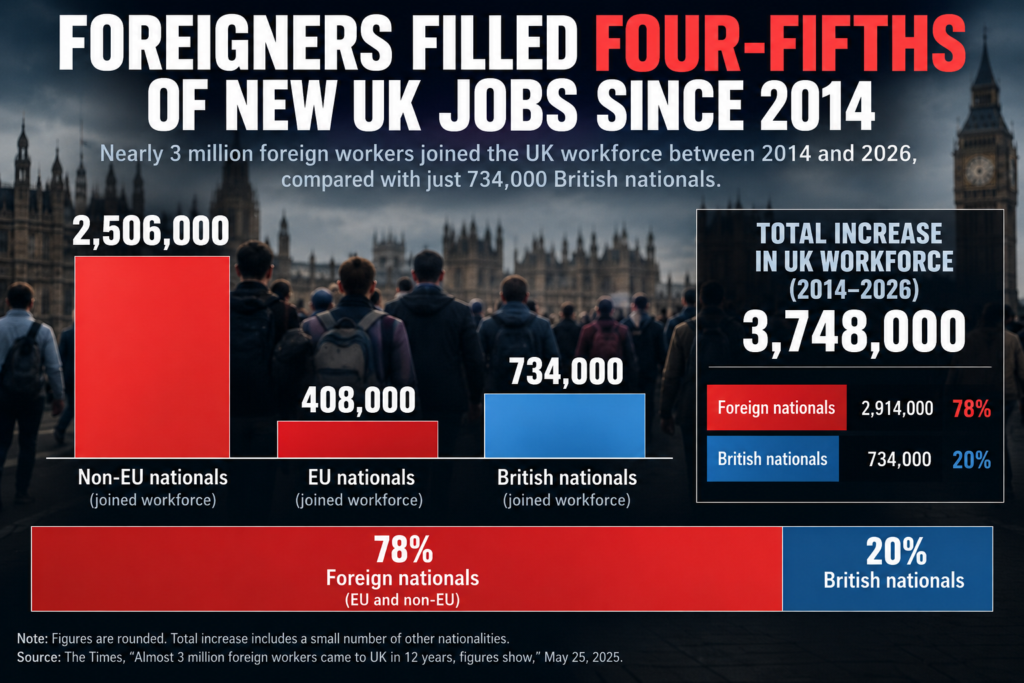
According to research, nearly three million foreign workers joined the British workforce between 2014 and 2026, accounting for approximately four-fifths of the overall increase in employment during that period. Of the approximately 3.7 million additional workers, around 2.5 million were non-EU nationals, while 408,000 came from EU countries. Employment among British nationals increased by approximately 734,000.
Department for Education statistics that apprenticeship starts in England declined from approximately 509,000 in 2015/16 to around 339,000 in 2023/24, a reduction of roughly one-third. Starts did recover to approximately 353,500 in 2024/25, but remained substantially below their 2015/16 level.
This means that employers often report shortages of skilled tradesmen, as the country trains fewer apprentices than it did a decade ago. Smith’s proposed approach would require companies to demonstrate that they are investing in British workers before turning to overseas recruitment.
Studies Show Mass Immigration Depresses Workers’ Wages.
A 2015 Bank of England working paper by Stephen Nickell and Jumana Saleheen found that immigration had a small negative effect on average British wages, with the largest impact concentrated among semi-skilled and unskilled service workers. Their research estimated that a 10-percentage-point increase in the immigrant share relative to native workers in those occupations was associated with approximately a 2 percent reduction in wages.
Similarly, a 2013 study by economists Christian Dustmann, Tommaso Frattini, and Ian Preston found that immigration reduced wages among native British workers below the 20th percentile of the earnings distribution. The research identified the greatest negative effects among lower-paid workers, although it also found modest positive effects among higher-paid workers.
American research has produced comparable findings, where in a 2003 paper published in the Quarterly Journal of Economics, Harvard economist George Borjas estimated that a ten percent immigration-induced increase in labor supply could reduce the wages of competing workers by approximately three to four percent.
The studies demonstrate that mass immigration can impose measurable costs on particular groups of workers, especially those facing direct labor-market competition.
For employers, recruiting from a larger international labor pool can provide an alternative to increasing wages or financing expensive training programs. For workers competing in affected occupations, this means they may have to compete with people willing to work for less and many who are, on paper, already trained.
Trump’s Economic Nationalism Model for Prosperity.
The debate in Britain is one that has already been had in the United States, and nearly a decade ago, saw President Donald J. Trump enact a populist-nationalist economic policy. Trump entered the White House in January 2017, promising to revive American manufacturing, protect domestic industries, restrict certain forms of immigration, and encourage companies to invest in American workers.
His administration pursued these objectives through the 2017 Tax Cuts and Jobs Act, tariffs on imported steel and aluminum, deregulation, and restrictions on employment-based immigration.
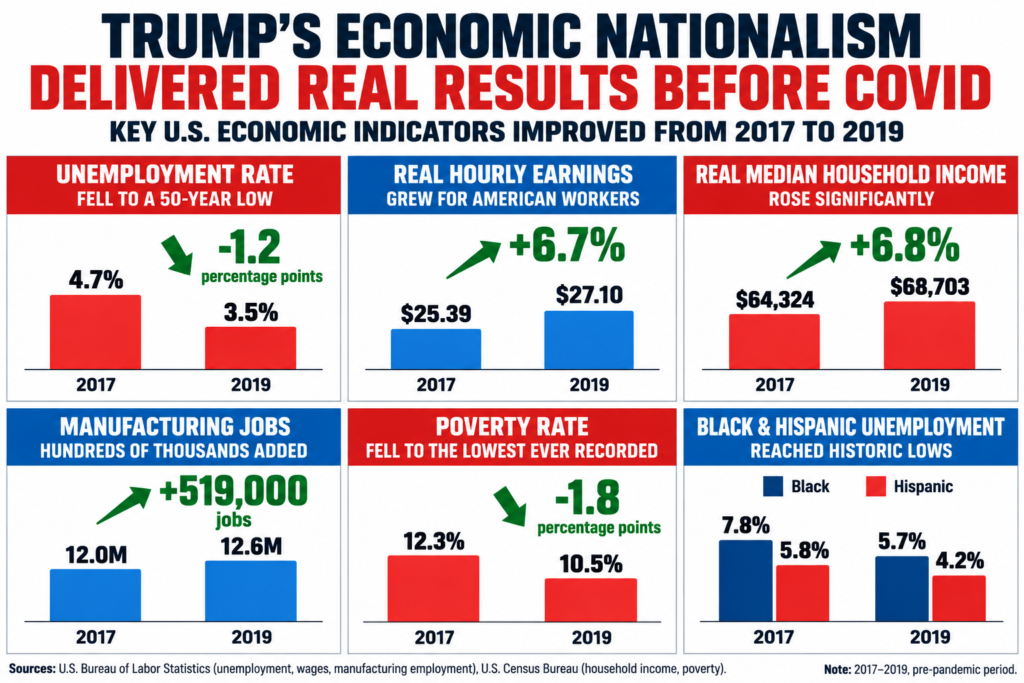
The American economy recorded several notable improvements during the three years preceding the COVID-19 pandemic. According to the Bureau of Labor Statistics, the unemployment rate fell from 4.7 percent when Trump entered office to just 3.5 percent in February 2020, matching the lowest level since 1969.
Manufacturing employment also increased during the first two years of his presidency, with hundreds of thousands of industrial jobs added before the sector began weakening in 2019. American workers experienced real wage gains during the expansion, while unemployment among Black and Hispanic Americans reached historically low levels.
Household incomes also rose substantially. The U.S. Census Bureau reported that real median household income increased by 6.8 percent between 2018 and 2019, reaching $68,703 in its original published estimate. Meanwhile, the official poverty rate declined to 10.5 percent in 2019, the lowest recorded since the Census Bureau began publishing such statistics in 1959. Around 4.2 million fewer Americans were living in poverty in 2019 than in 2018.
The period provides a key example of what a populist-nationalist economic policy can accomplish in just a few short years.
Could Economic Nationalism Unite Britain’s Left and Right?
Trade unions historically emerged to defend domestic workers against low wages, poor conditions, and employers’ ability to weaken collective bargaining. Those objectives can overlap with economic-nationalist demands for tighter labor immigration rules, stronger apprenticeships, and greater investment in domestic industries.
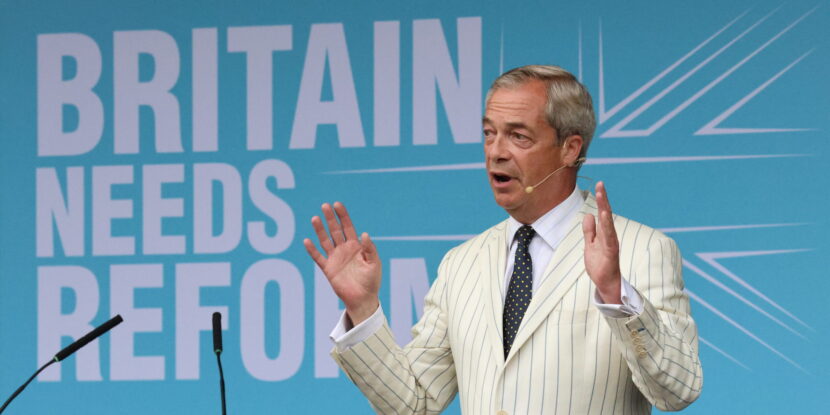
Reform UK, led by Nigel Farage, has made reducing immigration a central political priority. Smith’s proposals approach the issue from a different direction, focusing on employers’ responsibilities to train workers and maintain competitive wages.
GMB, a founder of the Labor Party in the 1920s, is unlikely to begin supporting Farage and Reform UK, but Smith’s comments indicate that they may force Labour itself to start adopting a more nationalist economic stance.
The resulting debate within the Labour Party could prove particularly significant in industrial communities where traditional Labor loyalties coexist with growing support for immigration restrictions, and could potentially fracture Labour.
Putting British Workers First.
It is clear that Britain needs skilled welders, electricians, engineers, construction workers, and shipbuilders. What is not clear is whether it is sustainable to keep importing workers, rather than training them at home. The evidence from wage research demonstrates that immigration can create downward pressure on earnings in particular occupations. Britain’s apprenticeship figures reveal a lack of commitment from companies and government to really invest in skilled labor, making the shortages worse.
The challenge for politicians in Britain in the coming years will be how to address these deep-seated issues. While foreign labor may boost corporations’ bottom lines, most voters are British.
To help Raheem J. Kassam and his team keep delivering top-quality news and analysis, please JOIN THE NATIONAL PULSE or MAKE A DONATION today.
Image by Alecsandra Dragoi / Home Office.
Join Pulse+ to comment below, and receive exclusive e-mail analyses.