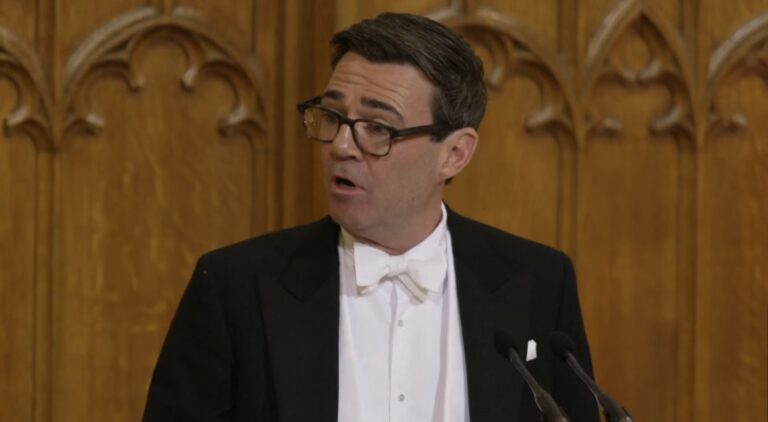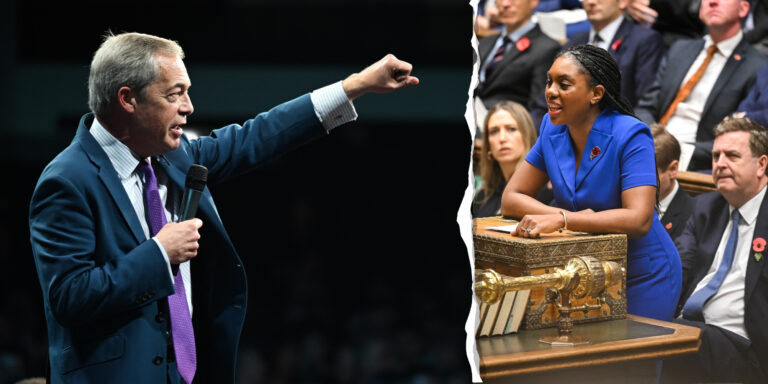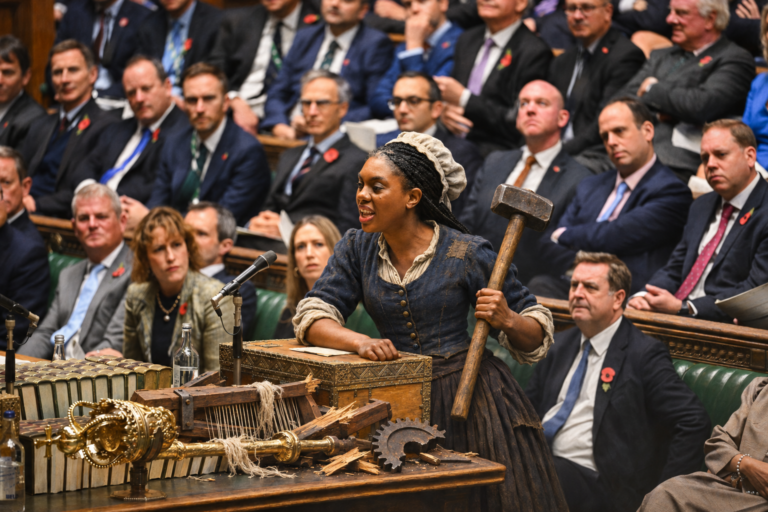
Britain’s unelected Prime Minister, Andy Burnham, is set to sign a food-and-farming deal at a Brussels summit on Friday that reportedly forces Britain pay to rebuild the European Union’s border checks if a future government walks away from the deal. EU diplomats call it the “Farage clause,” but ordinary Britons should find it illegitimate because it is designed to bind a future Parliament that has not yet been elected. It is also brazen foreign election interference, because it effectively allows Brussels to put a price on Britons electing a Eurosceptic government.
The clause is reportedly hidden deep in the 200-page sanitary and phytosanitary (SPS) agreement, the text of which has been settled for signature. It was reported late on Monday that the clause is in that text and would force Britain to pay compensation if a future government backed out. The legal wording has not yet been published.
“The Government has confirmed it will sign up to what’s being called the ‘Farage Clause’ in its EU reset,” Reform UK MP Danny Kruger wrote on Monday.
What Brussels Wants.
According to the draft first reported in January, compensation would cover the costs of setting up “the infrastructure and equipment, initial recruitment and training, in order to set up the necessary border controls”, a bill that could run “to billions of pounds”. The National Pulse has previously reported that Brussels wanted the clause to punish Britain if Reform UK won power.
EU diplomats have been open about whom it targets. One EU diplomat described it as “a safety provision to provide stability and a deterrent for Farage and co”, adding: “The EU wants an agreement long term, and not only until 2029, should a change happen at the next election.”
Hamish Falconer, the EU relations minister and a key negotiator with Brussels, made clear on Sunday that there could well be an exit clause. He said it was “reasonable” to consider that a future Conservative or Reform government might undo the deal: “The EU is worried about that and you can see why.” Both parties have said they would reverse it.
Labour has done this before. The May 2025 fisheries deal, also called a “Farage clause”, extends EU boats’ access to British waters to 2038 and lets Brussels take punitive measures on British exports if that access is restricted early.
Binding a Parliament Not Yet Elected.
The rule that no Parliament may bind its successor exists so that each Parliament answers to the voters who elected it. Parliament, in A.V. Dicey’s classic statement, has “the right to make or unmake any law whatever”. Burnham’s government cannot forbid a future Parliament from leaving the deal, so it has agreed to make leaving expensive instead. A future Parliament would keep its right to unmake the arrangement, but only after paying Brussels for the privilege. That is doing indirectly what the constitution forbids directly, and it is directly putting the cost on British taxpayers in the most cynical move to date by Burnham’s government.
Treaty-making is a prerogative power that the Supreme Court has said is “not reviewable by the courts“. Under the 2010 ratification rules, a Commons vote against a treaty does not kill it, because a minister can restart the 21-day clock again and again, and those rules were switched off entirely for the Withdrawal Agreement and the Trade and Cooperation Agreement.
The clause may well be “lawful” in international law, but that is exactly what makes it dangerous. The Vienna Convention lets a treaty set its own terms for leaving. Reform UK’s chief adviser on global affairs, Alan Mendoza, put it best: “It may well be legal but it’s not cricket.” The courts have said in terms that a government may “breach, repudiate or terminate” a treaty, so no judge would stop a future government walking out. The clause cannot prevent a departure. Its only function is to make voters and parties think twice before they choose one.
A Price on the Vote.
Even the deal’s supporters admit this. Ian Bond of the Centre for European Reform, who backs the reset, called the clause “a completely pointless idea” because a Farage government “simply will not pay”. His think tank’s paper concedes that “the EU will only give it a significantly better deal once it is sure that Reform UK will not gain power”. The Institut Jacques Delors describes a “retaliation clause” and says France supports it.
The Government has said the clause works both ways and that exit terms are routine in trade deals. Both sides would sign it, but only one side demanded it, named the party it fears, and timed it for the next general election. A foreign power setting the cost of a British election result in advance is foreign election interference, whatever the treaty lawyers call it.
Imagine a relationship with a break-up fee. You took down your fence because your partner asked you to. Your partner’s family then drew up an agreement saying that if you ever leave, you have to pay to rebuild the fence and to hire new people to fill your void. It is an asinine and insulting proposition on the very face of it.
Cheaper to Break.
The exit bill would be a one-off payment, and there is no official estimate of its size. It has been reported as “multimillion-pound” and as running into billions. The EU’s entire Brexit Adjustment Reserve, which covered all Brexit disruption and not just food checks, was €5.4bn (£4.7bn).
Staying in costs money every year. Britain’s Erasmus+ contribution for 2027 alone will be about £570m. An “appropriate financial contribution” for the SPS and emissions trading deals has been agreed in principle, but ministers told Parliament last month that the details of any SPS payments “remain subject to ongoing negotiations“. Five EU leaders want a British cohesion contribution linked to access to the EU electricity market, and Norway pays roughly €391m a year.
Assume Britain keeps paying about £570m a year for Erasmus+ plus a Norway-sized cohesion levy of about £340m, at €1 to £0.87. That is roughly £910m a year before the undisclosed SPS and emissions fees, or £9.1bn over a decade. If the exit bill matched the entire £4.7bn reserve, a government that left and paid it would be ahead after about five years. A £500m bill would equal about seven months of those payments.
That assumes a Eurosceptic government quits the paid reset programmes as a package, and gives up the gains the Government claims, up to £5.1bn a year from the SPS deal by 2040. As The National Pulse has reported, Burnham’s own figure for the whole package is 0.4 per cent of GDP, a tenth of the 4 per cent Brexit “hit” he cites. Refusing to pay could also invite EU retaliation, because Brussels’ draft negotiating mandate demands “the possibility of cross-retaliation”. Even so, measured in payments to Brussels, breaking the deal and paying the bill is cheaper than staying in.
Lord Lilley leads a Lords debate on removing SPS checks on Thursday, and Burnham is due to sign on Friday. A clause that charges British voters for the government they choose is illegitimate, and Burnham’s Government should refuse to sign it.