Britain’s output per hour grew faster than any other G7 economy except the United States over the ten years to 2025, according to official figures published on Tuesday, a day after Prime Minister Andy Burnham told the City that Brexit “has meant a 4% hit to the British economy.”
On the Office for National Statistics’ own index, output per hour rose 12.7% in Britain between 2015 and 2025, against 16.9% in the United States, 6.5% in Germany, 5.7% in Canada, 2.4% in France, and a 0.1% fall in Italy.
“In the 10 years to 2007, 10 years to 2017, and 10 years to 2025, productivity growth in the UK was consistently second among this group. In each period, the only nation with faster growth was the US,” the statisticians wrote.
The ONS said Britain’s record since 1997 “suggests that productivity growth over the past three decades has been stronger than previously perceived,” though “it is still materially lower than that observed in the US.”
The figures come from a new “component approach,” which draws hours and jobs from more sources than the old Labour Force Survey method. That method had been overestimating hours worked and so underestimating productivity growth. Cliodhna Taylor, the ONS head of productivity statistics, wrote that average annual growth between 2009 and 2019 now stands at 1.3%, up from 0.7%. Output per hour in July to September was 2.5% higher than a year earlier.
The 4% Claim.
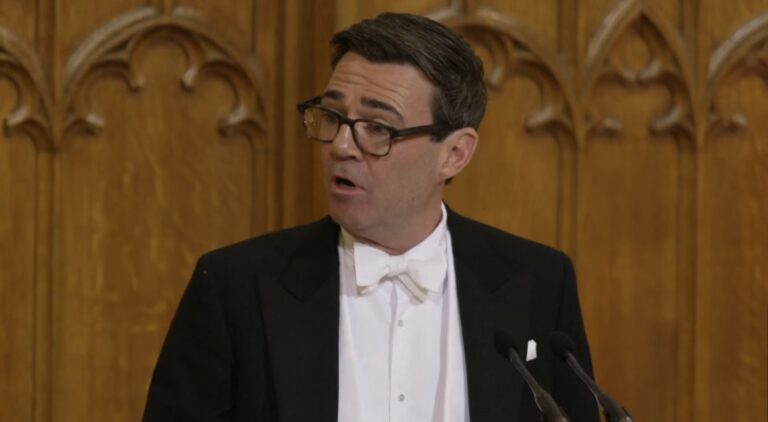
At the Lord Mayor’s Banquet at the Guildhall on Monday, Burnham said: “To be frank, we have lost more than we have gained in the last 10 years. The hard Brexit we were given is not good enough for Britain.” He added: “Taken as a whole, the OBR says Brexit has meant a 4% hit to the British economy. Others put it higher at up to 8% of GDP.” He did not name a source for the 8%.
The Office for Budget Responsibility’s own analysis says the Trade and Cooperation Agreement “will reduce long-run productivity by 4 per cent relative to remaining in the EU.” That is a long-run forecast against a Remain path, phased in over 15 years, not a measured loss to today’s economy.
Independent economist Julian Jessop wrote on Tuesday that the new estimates “blow another hole in claims that Brexit has hamstrung UK productivity,” adding: “I would add that there is no sign of a Brexit effect in these charts either.”
Simon French, chief economist at Panmure Liberum and a former Treasury economist, called the data “a rather awkward data backdrop to the UK-EU summit.” He said it showed British productivity had “accelerated away from comparable EU economies” since the 2016 vote, and that it “must call into question the validity of the (widely cited) NBER estimate that Brexit triggered a 3%-4% reduction in UK productivity.”
The National Pulse has previously reported that Burnham used the same speech to concede that Friday’s deal could add up to 0.4% to GDP.
Burnham goes to Brussels on Friday presenting a long-run forecast as a loss already suffered, while the official record ranks British productivity growth second in the G7.