




Monday, February 23, 2026

Argentina’s Milei Stabs Trump in the Back on Chinese EVs.

PULSE POINTS

WHAT HAPPENED: Argentina’s President Javier Milei, a supposed ally of the Trump administration, appears to have done an about-face, cozying up to the Chinese Communist Party (CCP) and opening his country to a huge number of electric vehicles imported from China.

👤WHO WAS INVOLVED: Javier Milei, Chinese electric vehicle companies like BYD, U.S. President Donald J. Trump, U.S. Treasury Secretary Scott Bessent, U.S. automakers, and the Chinese Communist Party (CCP).

📍WHEN & WHERE: A shipment of 5,800 BYD-made electric and hybrid vehicles arrived in Argentina earlier this week.

🎯IMPACT: The opening of Argentina to a flood of Chinese goods is a stunning rebuke to the U.S. after President Donald J. Trump signed a $20 billion currency swap deal that stabilized the South American nation’s currency last October, ahead of critical elections for Milei’s government.

IN FULL

Argentina’s President Javier Milei, a supposed ally of the Trump administration, appears to have done an about-face, cozying up to the Chinese Communist Party (CCP) and opening his country to a large number of electric vehicles imported from China. Under Milei, Argentina has reversed a number of import restrictions, especially on cheap Chinese-made automobiles, with a Chinese cargo ship delivering a stunning 5,800 BYD-made electric and hybrid vehicles earlier this week.

The opening of Argentina to a flood of Chinese goods is a stunning rebuke of the U.S., where President Donald J. Trump signed a $20 billion currency swap deal that stabilized the South American nation’s currency last October, ahead of critical elections for Milei’s government. Notably, the Argentine currency crisis was primarily the result of a panic sparked by corruption allegations within Mielei’s own La Libertad Avanza party, which prompted investors to flee the peso.

In response to the crisis, the U.S. Treasury Department took emergency measures to help stabilize  Argentina’s economy and currency, as the country under Milei has been considered a staunch regional ally. Despite criticism from Democrats and some conservatives who viewed the aid as a bailout for a foreign nation, Trump‘s Treasury Secretary Scott Bessent stated at the time, “Argentina now has the opportunity to embrace economic freedom, and our stabilization agreement is a bridge to a better economic future for Argentina, not a bailout.”

Earlier this year, the Treasury Department announced that Argentina had repaid the funds it drew from the $20 billion currency swap. Still, President Milei effectively created a carve-out for Chinese electric vehicles, which are so cheap that they fall below Argentina’s $16,000 tariff threshold, unlike U.S. autos.

While Argentina’s under-maintained electric grid—for the moment—prevents total Chinese domination of its electric vehicle market, if improvements are made—possibly with Chinese financing—China is poised to run the table.

Join Pulse+ to comment below, and receive exclusive e-mail analyses.
show less
show more

Argentine Commission Alleges President Milei Was Involved in Crypto Scam.

PULSE POINTS

WHAT HAPPENED: A congressional commission in Argentina accused President Javier Milei of involvement in a cryptocurrency fraud.

👤WHO WAS INVOLVED: President Javier Milei, his sister Karina Milei, and investors in the $LIBRA cryptocurrency.

📍WHEN & WHERE: The report was published on November 19, 2025, in Argentina.

💬KEY QUOTE: “The world wants to invest in Argentina. $LIBRA.” – Javier Milei

🎯IMPACT: Hundreds of millions of dollars were lost by investors, and legal complaints have been filed.

IN FULL

An Argentine congressional panel has issued a new report accusing President Javier Milei of engaging in a cryptocurrency scam after promoting $LIBRA, which resulted in a significant loss for investors. Notably, the investigation names both President Milei and his sister, Karina Milei.

Released by the Chamber of Deputies—which is controlled by parties in opposition to Milei’s government—the report states that “the facts analyzed would be compatible with an alleged fraud” and that “political responsibility” rests with Milei and his sister. Notably, the crash in $LIBRA’s value occurred in February of this year, with observers describing it as a rug pull scam that resulted in $251 million in losses.

In the lead-up to $LIBRA’s launch, there were rumors of bribes and payouts involving those close to Milei himself. Individuals who have been accused of perpetrating rug-pull crypto schemes in the past were involved, notably Hayden Davis, an American cryptocurrency marketer.

President Milei maintains that he was unaware of any of the $LIBRA project details and that he was relatively uninvolved. He did promote the cryptocurrency on X (formerly Twitter), authoring a post stating: “The world wants to invest in Argentina. $LIBRA.”

The cryptocurrency is currently the subject of legal proceedings and the Chamber of Deputies report has been sent to prosecutors. The scandal was part of a broader series of corruption allegations that rocked Argentina earlier this year and set off a currency crisis, which required the United States Treasury Department to step in and provide stability through a monetary bailout.

Image by Casa Rosada.

Join Pulse+ to comment below, and receive exclusive e-mail analyses.
show less
show more

Trump Secures Historic Trade Agreements with Western Hemisphere Allies.

PULSE POINTS

WHAT HAPPENED: President Donald J. Trump announced new trade deals with El Salvador, Argentina, Ecuador, and Guatemala to enhance market access and strengthen supply chains.

👤WHO WAS INVOLVED: President Donald J. Trump, the governments of El Salvador, Argentina, Ecuador, and Guatemala, and U.S. exporters and manufacturers.

📍WHEN & WHERE: Announced late Thursday, November 13, 2025, in Washington, D.C.; agreements to be finalized in upcoming weeks.

🎯IMPACT: The agreements will expand U.S. exports, strengthen bilateral trade partnerships, and create opportunities for American workers and producers.

IN FULL

Late Thursday, President Donald J. Trump announced three critical trade agreements with key western allies, El Salvador, Argentina, Ecuador, and Guatemala. The Trump White House contends these trade deals will provide greater market access and streamline trade with some of America’s key strategic partners in the Western Hemisphere.

According to the agreements, the four Central and South American nations will reduce non-tariff barriers, increasing market opportunities for U.S. exporters. The Trump administration notes that El Salvador—for instance—has agreed to  accept U.S. motor vehicle safety standards and Food and Drug Administration (FDA) certificates for medical devices, while Argentina will improve market access for American goods such as medicines and machinery. Guatemala will facilitate digital trade and protect labor rights, and Ecuador will reduce tariffs on agricultural products and adopt stronger environmental protections.

These measures are designed to support U.S. farmers, ranchers, small businesses, and manufacturers while protecting national security and strengthening supply chains. Separately, the U.S. secured rare earth mineral agreements with Argentina after providing the nation with a fiscal aid package designed to stabilize its currency.

In the coming weeks, the United States and the partner nations will finalize the agreements for signature. These deals will also include provisions for Most Favored Nation tariff treatment on certain goods and the removal of reciprocal tariffs on textiles and apparel under existing trade agreements with El Salvador and Guatemala.

Join Pulse+ to comment below, and receive exclusive e-mail analyses.

show less
show more

Trump Admin Signs $20 Billion Deal to Stabilize Argentina.

PULSE POINTS

WHAT HAPPENED: The U.S. signed an “economic stabilization agreement” with Argentina’s central bank, involving a $20 billion currency swap.

👤WHO WAS INVOLVED: Treasury Secretary Scott Bessent, President Donald J. Trump, and Argentina’s President Javier Milei.

📍WHEN & WHERE: Announced Tuesday, October 21, 2025, in the United States and Argentina.

💬KEY QUOTE: “We do not want another failed state in Latin America, and a strong, stable Argentina as a good neighbor is explicitly in the strategic interest of the United States.” – Secretary Bessent

🎯IMPACT: The agreement aims to stabilize Argentina’s currency and economy, heading off a potential broader regional economic crisis.

IN FULL

On Tuesday, U.S. Treasury Secretary Scott Bessent confirmed that the Trump administration has entered into an “economic stabilization agreement” with Argentina’s central bank. The agreement is a key element of President Donald J. Trump’s effort to aid Argentina with a multibillion-dollar rescue plan.

The agreement, announced by Argentina’s central bank on Monday, involves a $20 billion currency swap designed to support the Argentine peso, as the nation approaches important midterm elections. These elections are crucial for the political future of President Javier Milei, a key South American ally of the Trump administration.

Earlier this month, President Trump and Secretary Bessent pledged substantial support to stabilize Argentina’s economy and currency. The Treasury Department has already taken steps to purchase Argentine pesos directly as part of this effort.

Despite criticism from Democrats and some conservatives who view the aid as a bailout for a foreign nation, Bessent stated, “Argentina now has the opportunity to embrace economic freedom, and our stabilization agreement is a bridge to a better economic future for Argentina, not a bailout.” He emphasized the strategic importance of a stable Argentina for the United States.

“We do not want another failed state in Latin America, and a strong, stable Argentina as a good neighbor is explicitly in the strategic interest of the United States,” Bessent added. Without American fiscal support, the Argentine currency crisis has the potential to spread across Latin America, throwing the region into economic turmoil—a strategic concern for the Trump White House.

In addition to the currency swap, Bessent is working on securing an additional $20 billion in financing from private lenders or sovereign wealth funds—though this financing plan has not yet been finalized.

Join Pulse+ to comment below, and receive exclusive e-mail analyses.

show less
show more

What’s the Deal With Argentina? And Why Are We Bailing Them Out?

PULSE POINTS

WHAT HAPPENED: Argentine President Javier Milei’s government teeters on the brink as his country faces a significant currency crisis, kicked off by several major corruption scandals and a flight of investors from the Argentine peso—despite a $20 billion U.S. rescue package.

👤WHO WAS INVOLVED: Javier Milei, U.S. President Donald J. Trump, and U.S. Treasury Secretary Scott Bessent.

📍WHEN & WHERE: The currency crisis has ravaged Argentina for over a month, with new meaures announced by Bessent on Thursday, October 9, 2025.

💬KEY QUOTE: “The [U.S. Treasury] has concluded 4 days of intensive meetings with [Argentina’s Economic Minister Luis Caputo] and his team in DC. We discussed Argentina’s strong economic fundamentals, including structural changes already underway that will generate significant dollar-denominated exports and foreign exchange reserves.” — Secretary Bessent.

🎯IMPACT: A possible Argentine peso devaluation would likely set off a new inflation crisis, threatening to derail Milei’s government. Critical midterm elections will take place on October 26, 2025, with leftist parties working to retake control from Milei’s party, La Libertad Avanza.

IN FULL

Argentine President Javier Milei‘s government teeters on the brink as his country faces a significant currency crisis, kicked off by several major corruption scandals and a flight of investors from the Argentine peso. On Wednesday, short-term interest rates in the South American country surged to over 80 percent, worsening the peso crisis.

In late September, U.S. President Donald J. Trump authorized a $20 billion bailout for Argentina, overseen by U.S. Treasury Secretary Scott Bessent. However, with the peso crisis deepening, Bessent revealed that Treasury Department staff are intervening far more in the Argentine economy than previously thought.

“The [U.S. Treasury] has concluded 4 days of intensive meetings with [Argentina’s Economic Minister Luis Caputo] and his team in DC. We discussed Argentina’s strong economic fundamentals, including structural changes already underway that will generate significant dollar-denominated exports and foreign exchange reserves,” Bessent wrote in a post on X (formerly Twitter). He continued: “Argentina faces a moment of acute illiquidity. The international community—including [The International Monetary Fund (IMF)]—is unified behind Argentina and its prudent fiscal strategy, but only the United States can act swiftly. And act we will.”

“Additionally, we have finalized a $20 billion currency swap framework with Argentina’s central bank. The U.S. Treasury is prepared, immediately, to take whatever exceptional measures are warranted to provide stability to markets,” Bessent added, referring to the $20 billion rescue package first revealed in September.

However, thus far, President Milei’s efforts to bring the crisis under control appear to be having little effect in heading off a potential devaluation. In recent weeks, Milei has reinstated some foreign exchange controls and authorized the selling of dollars in the futures market. However, many financial analysts now believe the peso’s current exchange rate is unsustainable.

A peso devaluation would likely set off a new inflation crisis, threatening to derail Milei’s government. Critical midterm elections will take place on October 26, 2025, with leftist parties working to retake control from Milei’s party, La Libertad Avanza.

While Milei has largely been successful in reining in the out-of-control inflation experienced under the country’s previous socialist governments, dropping from a peak of around 300 percent to just 33 percent in October 2025, the austerity measures enacted have kept the poverty rate elevated. In the first half of 2023, Argentina’s poverty rate sat at around 40 percent. That jumped to nearly 53 percent in the first half of 2024 before falling back to around 40 percent in the second half of the year.

The currency crisis and a renewed inflation crisis could send poverty soaring once again.

Image by Gage Skidmore.

Join Pulse+ to comment below, and receive exclusive e-mail analyses.

show less
show more

Argentina Declassifying Nazi Archives Amid Lingering Hitler Escape Rumors.

PULSE POINTS:

What Happened: Argentina’s president has decided to declassify documents related to Nazis who settled in Argentina after World War II, as well as archives from the nation’s military dictatorship period.

👥 Who’s Involved: Argentine President Javier Milei, U.S. Senator Steve Daines, and Cabinet Chief Guillermo Francos are central to this decision. Nazi figures like Adolf Eichmann and Josef Mengele are mentioned, as well as author Abel Basti.

📍 Where & When: The declassification effort is taking place in Argentina, announced after a meeting with U.S. officials and coinciding with Argentina’s National Day of Memory, Truth, and Justice.

💬 Key Quote: Guillermo Francos stated, “These files concern Nazis who sought refuge in Argentina and were protected for many years. These are historical documents that should be accessible to the public.”

⚠️ Impact: The decision raises questions about historical transparency and might either confirm or debunk rumors of Adolf Hitler’s escape to Argentina, challenging mainstream historical narratives.

IN FULL:

Argentina will release classified files concerning Nazi fugitives and the military dictatorship that followed World War II. President Javier Milei has ordered the publication of these documents after meeting with U.S. Senator Steve Daines. This initiative aligns with a global push for governmental transparency.

Cabinet Chief Guillermo Francos announced that the law applies to all Nazi-related files within state agencies, including once-secret financial audits. “These files concern Nazis who sought refuge in Argentina and were protected for many years. These are historical documents that should be accessible to the public,” Francos noted.

Argentina became a haven for an estimated 5,000 Nazis after the war, including Waffen SS officers Adolf Eichmann and Dr. Josef Mengele. Rumors that Hitler, who, according to Soviet accounts accepted by the Western Allies, committed suicide in Berlin in 1945, actually escaped to Argentina have persisted for decades. Historian Abel Basti has spent years outlining this theory in books like Hitler in Argentina, arguing the dictator possibly fled through Berlin’s Tempelhof Airport en route to South America.

Reports from the Federal Bureau of Investigation (FBI), released by the U.S. National Archives through its ‘Hunting Hitler’ series, describe rumors of Hitler escaping to Argentina.

Milei’s move comes as part of broader declassification policies, including a recent U.S. release related to President John F. Kennedy’s assassination.

Records from Argentina’s period of military rule from 1976 to 1983 will also be declassified as part of the disclosure.

Image by Jared Enos.

show less

PULSE POINTS:

show more

DOGE-Style Efficiency Cuts Deliver Argentina’s First Budget Surplus in 123 Years.

In just one year, President Javier Milei has transformed Argentina’s economic landscape, slashing the national budget deficit to zero for the first time in 123 years. This is a historic milestone in his presidency, which began on December 10, 2023.

Milei took over an economy crippled by rampant inflation, where supermarkets had to adjust prices daily. However, with his aggressive cutbacks to the size of the state, often symbolized by his wielding a chainsaw, Milei has steered the country back toward fiscal stability.

Argentinian inflation plummeted from a staggering 200 percent in 2023 to a mere 2.7 percent by October 2024. This dramatic reduction was celebrated by Milei in a recent broadcast, in which he stated, “The deficit was the root of all our evils—without it, there’s no debt, no emission, no inflation. Today, we have a sustained fiscal surplus, free of default, for the first time in 123 years.”

Milei describes his decisive actions as “the greatest adjustment in history.” He contrasts his approach with past, socialistic policy, “A year ago, a degenerate printed 13 percent of GDP to win an election, fueling inflation. Today, monetary emission is a thing of the past.”

GOVERNMENT EFFICIENCY.

Within weeks of taking office, he sold two private jets owned by a state-owned oil company, as part of a drive to end “political privileges” for state officials. He also reduced the number of government vehicles and chauffeurs by half, and delivered more systemic reforms—for instance, the number of government departments has been cut from 18 to eight, and some 30,000 bureaucrats have been terminated.

Milei’s achievement in eliminating a century-long deficit within a year has not gone unnoticed. Tech mogul Elon Musk took to X to commend Milei, recognizing his bold economic reforms and their tangible results.

Musk and former Republican presidential primary candidate Vivek Ramaswamy will head an organization dubbed the Department of Government Efficiency, or DOGE, to try to achieve similar savings across the federal government.

Image by Casa Rosada.

show less
In just one year, President Javier Milei has transformed Argentina's economic landscape, slashing the national budget deficit to zero for the first time in 123 years. This is a historic milestone in his presidency, which began on December 10, 2023. show more

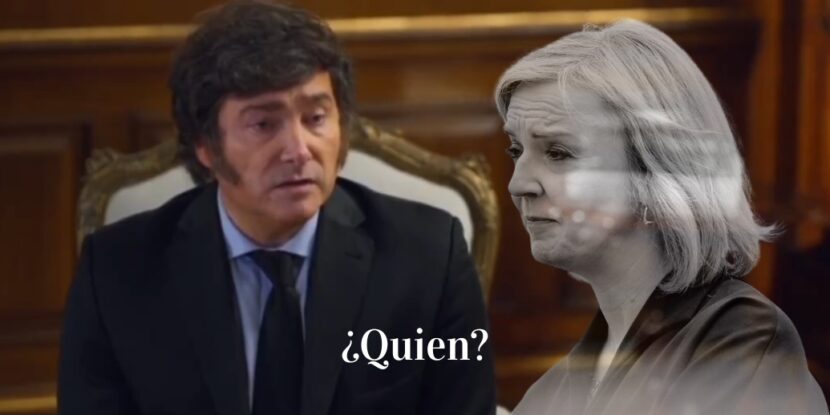
‘Who?’ – Argentina’s Milei Does Not Know Who British Superfan, Grifting Ex-PM Liz Truss Is. 

Liz Truss, the former British prime minister posing as an anti-woke crusader in the United States, claims Argentina’s President Javier Milei is her favorite Conservative Party leader, despite the fact he is not a member of the Conservative Party. Nor British. Milei, when asked for his thoughts on the ex-premier, however, did not even know who she is.

“Liz Truss recently said that you were her favorite conservative leader. Do you admire her?” Milei was asked during a recent interview.

Milei, looking perplexed, could only answer, “Who?”

Being told she was the previous British prime minister did not appear to kindle any memories. “I do not have elements to give an opinion,” he said, indicating he is not at all familiar with Truss.

Truss is the shortest-reigning prime minister in British history. Having been ousted within months, she has attempted to reinvent herself as a culture warrior and champion of libertarian-style economics. However, as a government minister for around a decade, she frequently empowered woke civil servants and advanced woke ideology, particularly as Minister for Women and Equalities.

By background, she was initially a Liberal Democrat. She was also a fierce opponent of Brexit when European Union loyalism was the official position of the Conservative leadership, but claimed to have undergone a Damascene conversion after they lost the EU referendum.

show less
Liz Truss, the former British prime minister posing as an anti-woke crusader in the United States, claims Argentina's President Javier Milei is her favorite Conservative Party leader, despite the fact he is not a member of the Conservative Party. Nor British. Milei, when asked for his thoughts on the ex-premier, however, did not even know who she is. show more

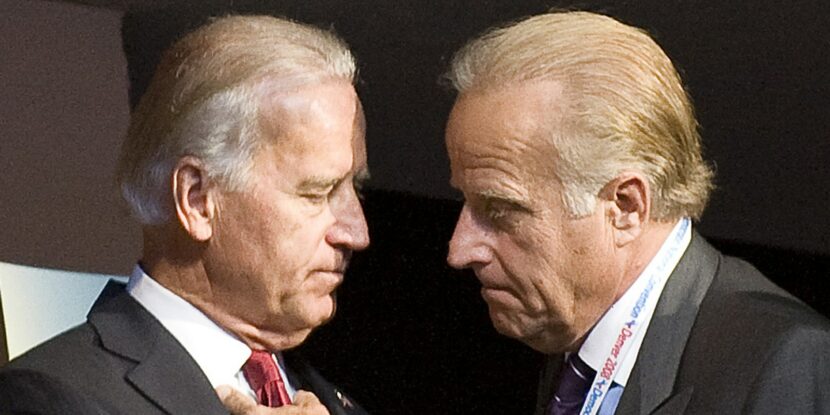
James Biden Confirms Chinese Origin of $40K Check He Wrote To His Brother, President Joe Biden.

James Biden, the brother of President Joe Biden, acknowledged during his recent impeachment inquiry testimony that he had written a $40,000 check to former Vice President Joe Biden in 2017 using funds obtained from a company with alleged links to the Chinese government. During the February 21st interview with Members of Congress, James Biden admitted that the funds originated from Beijing-controlled CEFC China Energy.

Bank records subpoenaed for the investigation showed just $46.88 remaining in James Biden’s bank account before he received a $50,000 payment, days before the $40,000 check went to his brother Joe. The source of the $50,000 was traced back to Lion Hall Group, an entity owned by James Biden. His lawyer, Paul Fishman, argued that tracing the exact origin of the money was complicated due to its fungible nature.

Evidence was presented that, between November 2022 and July 2023, James Biden received $840,000 in four separate transfers from Argentinian businessman Jose Luis Manzano. According to Biden, the amount was paid for half of his stake in Manzano’s holdings in Argentinian natural gas company Metrogas. Manzano had tasked James Biden with managing an effort to attract Mexican billionaire Carlos Slim to invest in Argentina’s 4G network. Slim ultimately declined Biden’s investment offer.

The impeachment inquiry testimony also shed light on additional international business schemes by James Biden. He disclosed that in 2018, he made a $200,000 loan repayment to Joe Biden using funds obtained from financially distressed rural hospital company Americore. James Biden said he used the loan from his brother to secure investment from Qatar for infrastructure projects, including hotel construction in Miami.

show less
James Biden, the brother of President Joe Biden, acknowledged during his recent impeachment inquiry testimony that he had written a $40,000 check to former Vice President Joe Biden in 2017 using funds obtained from a company with alleged links to the Chinese government. During the February 21st interview with Members of Congress, James Biden admitted that the funds originated from Beijing-controlled CEFC China Energy. show more

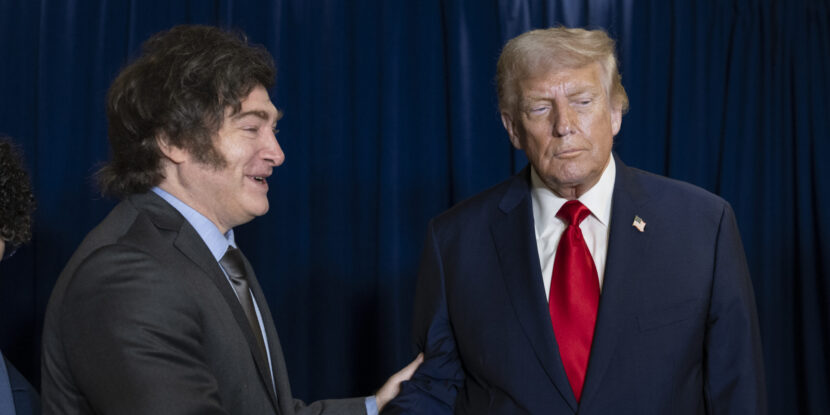
Trump To Visit Javier Milei In Argentina.

Former President Donald Trump will visit Argentina’s newly-elected libertarian populist President Javier Milei in Buenos Aires following a conversation between the two, the latter’s press team has announced. The dates of the visit are, however, yet to be made public.

The 45th President publicly congratulated Milei for his success in the Argentinian elections earlier this week despite initially being considered an outsider and wildcard candidate.

Trump told him, “A very congratulations to Javier Milei on a great race for President of Argentina. The whole world was watching, and I am very proud of you. You will turn your country around and truly make Argentina great again: Congratulations.”

In response, Milei thanked the former President on X (formerly Twitter) on Wednesday evening and suggested Trump’s presidency was an example for all of us who defend the ideas of freedom and I hope to meet him soon… LONG LIVE F*CKING FREEDOM.”

show less
Former President Donald Trump will visit Argentina's newly-elected libertarian populist President Javier Milei in Buenos Aires following a conversation between the two, the latter's press team has announced. The dates of the visit are, however, yet to be made public. show more