The Trump administration has unveiled a historic collection of UFO files, including images from Apollo missions, as part of a transparency initiative.
PULSE POINTS
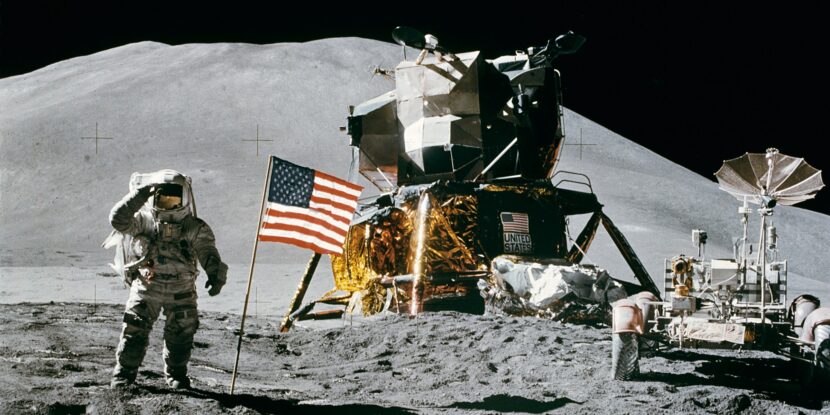
❓ WHAT HAPPENED: The Trump administration has released a significant trove of declassified files on Unidentified Anomalous Phenomena (UAP), including images from theApollo 12 and Apollo 17 missions. The materials include unresolved cases where the government has been unable to determine the nature of the observed phenomena.
📺 DETAIL: The Pentagon said the cases remain “unresolved” because investigators lacked sufficient data to determine the nature of the phenomena, while officials encouraged private sector experts to analyze the material. The release is being coordinated through a new interagency effort involving the White House, NASA, the FBI, the Department of Energy, and the Office of the Director of National Intelligence, with additional files expected to be published on a rolling basis. Trump administration officials described the move as part of a push for maximum transparency after years of public skepticism surrounding government handling of UFO reports. Some lawmakers, including Rep. Tim Burchett (R-TN), said more disclosures are expected in the coming weeks.
💬 KEY QUOTE: “Under this Administration, we will pursue the truthand share our findings with the American people.” – Department of War
🎯 IMPACT: This initiative marks a major step toward transparency on UFOs, allowing the public to review previously classified information and draw their own conclusions. It also reflects a shift from previous administrations’ secrecy on the issue, aligning with President Trump’s directive for open access to government-held UAP data.
The White House has tasked the FBI with investigating a series of mysterious deaths and disappearances involving scientists tied to sensitive national security programs, including nuclear projects.
PULSE POINTS
❓ WHAT HAPPENED: President Donald J. Trump has directed the Federal Bureau of Investigation (FBI)to investigate potential connections between recent disappearances and deaths of U.S. scientists involved in space and defense projects. The White House announced the effort amid growing concerns about the mysterious circumstances surrounding at least 10 cases.
📺 DETAIL: Among the most notable cases is retired Air Force General William “Neil” McCasland, who went missing in New Mexico after leaving home without his phone or watch. Several other Americans tied to high-level research in aerospace, national security, and advanced technology have also died or disappeared in recent years in questionable circumstances. The White House said the FBI will lead a coordinated inquiry to determine whether there is any link between the cases, with Trump promising that “no stone will be unturned” and the public will receive answers.
💬 KEY QUOTE: “I hope it is random, but we are going to know in the next week and a half… Hopefully, coincidence… but some of them were very important people, and we are going to look at it.” – President Donald J. Trump
🎯 IMPACT: The investigation could uncover potential threats to national security and provide clarity on whether foreign actors are targeting American scientists. The clustering of cases involving individuals with access to classified or sensitive information has raised alarm among lawmakers and fueled speculation about links to UFO research and national security secrets.
Join Pulse+ to comment below, and receive exclusive e-mail analyses.
show less
The White House has tasked the FBI with investigating a series of mysterious deaths and disappearances involving scientists tied to sensitive national security programs, including nuclear projects.
The U.S. is accelerating efforts to deploy nuclear reactors in space, aiming to secure space superiority against China and Russia and to make permanent human presence in Earth’s orbit and on the Moon a reality.
PULSE POINTS
❓ WHAT HAPPENED: The White House has unveiled a detailed plan to prioritize the development of nuclear reactors for use in space, with the goal of deploying them on the Moon and in orbit by 2030, allowing a more permanent human presence in space. The initiative, led by the Office of Science and Technology Policy, assigns specific roles and deadlines to federal agencies, marking a shift from theoretical proposals to actionable steps.
📺 DETAIL: Building on a 2025 announcement from NASA about a lunar reactor, the new guidelines emphasize a dual-track strategy where NASA and the Department of War will run parallel programs to develop low- and mid-level power reactors. The initiative also seeks partnerships with private-sector innovators to ensure the U.S. maintains its leadership in space exploration, commerce, and defense. Near-term goals include deploying orbiting reactors by 2028 and lunar reactors by 2030.
💬 KEY QUOTE: “Nuclear power will make sustained human presence in space possible. We will survive the lunar night, endure Martian sandstorms, and venture into the stars.” – Michael Kratsios, Director of the Office of Science and Technology Policy.
🎯 IMPACT: NASA stated last month that it plans to build a lunar base in three distinct phases, with the base expected to be permanently habitable by 2032. The goal is part of a series of missions that began earlier this month with the Artemis II mission, which successfully saw the first orbital manned flight around the moon in decades. The plan positions the U.S. as the leader in space nuclear power, a critical component for long-term missions and for maintaining military and technological superiority amid growing competition from China and Russia.
📺 FLASHBACK: During his first term in 2020, President Donald J. Trump issued an executive order prioritizing space superiority, laying the groundwork for this initiative. The directive aimed to deploy space-based nuclear reactors by 2030, a goal now being actively pursued under the current framework.
Join Pulse+ to comment below, and receive exclusive e-mail analyses.
show less
The U.S. is accelerating efforts to deploy nuclear reactors in space, aiming to secure space superiority against China and Russia and to make permanent human presence in Earth's orbit and on the Moon a reality.
❓WHAT HAPPENED: NASA announced Artemis II, humanity’s first lunar mission since 1972, aiming for a quick lunar flyby and return.
👤WHO WAS INVOLVED: Astronauts Reid Wiseman, Victor Glover, Christina Koch, and Jeremy Hansen will participate in the mission.
📍WHEN & WHERE: The mission is expected to launch in April, with a 10-day journey to and from the moon.
🎯IMPACT: The mission sets the stage for future lunar exploration and eventual settlement.
IN FULL
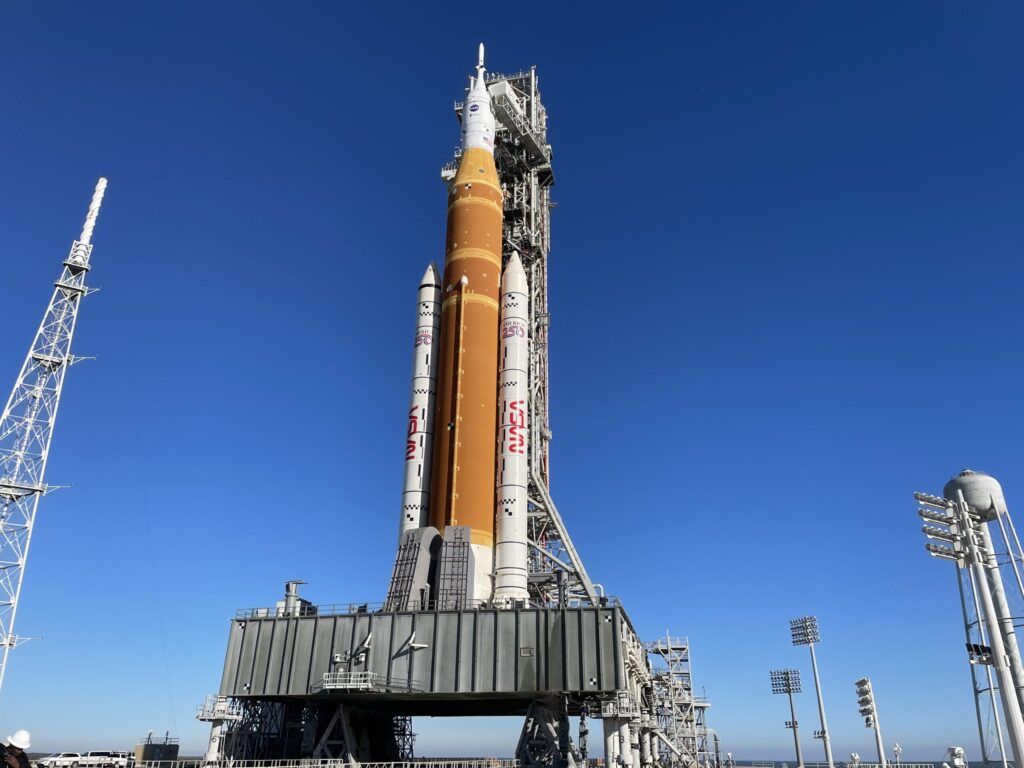
NASA’s return to lunar exploration is poised to begin with the Artemis II mission, which is currently sitting on the launch pad in Cape Canaveral, Florida. As of Wednesday morning, the superheavy rocket that will carry Artemis II into space is fueling and barring any issue—such as leaks—the launch will occur during a 2-hour window beginning at 6:24 PM this evening.
Artemis II will see a crew of four astronauts, three Americans and a Canadian, execute an orbital flyby of the moon, traveling thousands of miles through the void of space before returning to Earth. The entire mission is expected to last just under 10 days, though it will not include a lunar landing or extended orbit.
The Artemis II crew includes Reid Wiseman, Victor Glover, Christina Koch, and Jeremy Hansen. Koch, who holds the record for the longest single spaceflight by a woman, and Glover, the first Black astronaut to live aboard the International Space Station, are joined by Hansen, a Canadian rookie astronaut, and Wiseman, the mission commander and a retired Navy captain.
Notably, the mission will utilize NASA‘s Space Launch System (SLS) rocket, which is more powerful than the Saturn V rocket used during the Apollo missions. However, the SLS has faced challenges, including hydrogen leaks that delayed previous tests. The Artemis II mission has also experienced delays due to similar technical issues.
Once launched, the crew will practice docking maneuvers before heading towards the moon. Their journey will follow a free-return trajectory, a method that uses gravity to minimize fuel use. On flight day six, the Orion spacecraft used in the mission will reach its farthest point from Earth, surpassing the distance record set by Apollo 13. The crew will then return to Earth, splashing down in the Pacific Ocean near San Diego.
The National Pulse previously reported that Artemis II is the first stage of a long-term NASA plan to not only return to the moon but also establish permanent human habitation on the lunar surface.
❓WHAT HAPPENED: The National Aeronautics and Space Administration (NASA) has announced plans to build a base on the moon and launch a nuclear-powered spacecraft to Mars beginning in 2028.
👤WHO WAS INVOLVED: NASA Administrator Jared Isaacman, aerospace companies, international space agencies, and Congress representatives.
📍WHEN & WHERE: Announced on March 24, 2026, at a NASA event.
💬KEY QUOTE: “The moon base will not appear overnight. We will invest approximately $20 billion over the next seven years and build it through dozens of missions.” – Jared Isaacman
🎯IMPACT: The plans aim to advance lunar exploration and establish a human presence on the moon, with significant investment over the next seven years.
IN FULL
The National Aeronautics and Space Administration (NASA) announced it is developing the Space Reactor-1 Freedom, a nuclear-powered robotic spacecraft that will begin traveling to Mars in late 2028. Additionally, the agency laid out new, detailed plans to construct a research base on the surface of the moon, with permanent human habitation anticipated by the middle of the next decade.
“We are calling today’s event Ignition because it represents the start of a transformative journey for NASA,” the agency’s administrator, Jared Isaacman, said at the announcement on Tuesday. He added, “The moon base will not appear overnight. We will invest approximately $20 billion over the next seven years and build it through dozens of missions.”
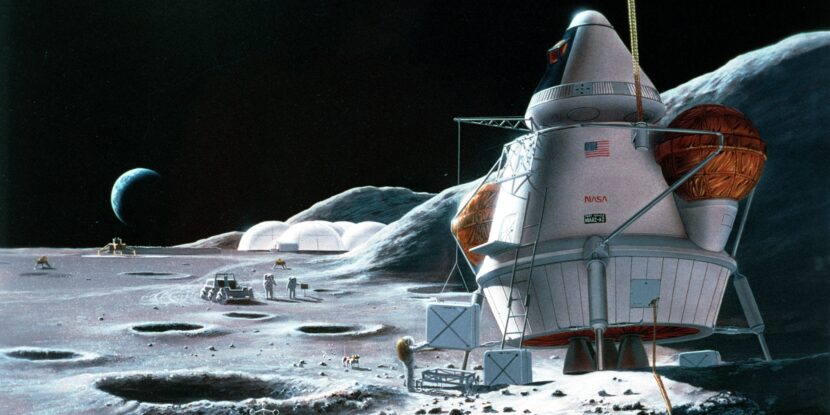
While NASA has long floated the idea of establishing a permanent lunar presence, Tuesday’s announcement was the first time the agency laid out an explicit timeline for the project. According to Isaacman, the lunar base will be established in three phases over the next ten years, with the initial steps already underway with NASA’s Artemis missions. By 2029, Issacman said the agency will have established an initial human presence on the moon, with “semi-habitable infrastructure.” According to the timeline, by 2032, permanent infrastructure will be in place, enabling continued human habitation.
Aside from the agency’s moon ambitions, Issacman also detailed plans for the launch of its nuclear-powered, robotic spacecraft, called Space Reactor-1 Freedom. NASA is currently working toward the unmanned spacecraft’s launch in late 2028, beginning its journey to Mars.
🌕NASA Administrator Jared Isaacman says that America and mankind may soon have a permanent base on the Moon.
The planned Moonbase will go through three stages, culminating in a structure permanently habitable by astronauts. pic.twitter.com/3n3s1l5LBV
❓WHAT HAPPENED: A NASA spacecraft weighing approximately just over half a ton is set to reenter Earth’s atmosphere after nearly 14 years in orbit.
👤WHO WAS INVOLVED: NASA, U.S. Space Force, and scientists monitoring the Van Allen Probe A.
📍WHEN & WHERE: Reentry is expected around 7:45 PM ET on March 10, 2026, with a 24-hour uncertainty.
💬KEY QUOTE: “The risk of harm coming to anyone on Earth is low—approximately 1 in 4,200.” – NASA.
🎯IMPACT: With most debris likely to land in oceans, the risk to human life is minimal at approximately 0.02 percent.
IN FULL
An over half-ton National Aeronautics and Space Administration (NASA) satellite, the Van Allen Probe A, will make an uncontrolled descent through the Earth’s atmosphere this evening after nearly 14 years in orbit. The probe is expected to undergo reentry at around 7:45 PM ET, though the U.S. space agency cautions this estimate carries a 24-hour margin of uncertainty.
Importantly, NASA stressed that much of the Van Allen Probe A will burn up in the upper atmosphere, meaning the Earth will not be impacted by the entire half-ton satellite. Still, there are components of the probe that are likely to survive reentry and reach the planet’s surface. Notably, as over 70 percent of the Earth is covered by ocean, the likelihood of these surviving pieces striking land is low.
“The risk of harm coming to anyone on Earth is low—approximately 1 in 4,200. NASA and Space Force will continue to monitor the re-entry and update predictions,” the agency said in a statement.
Initially launched into orbit on August 30, 2012, from Cape Canaveral, Florida, the Van Allen Probe A was part of a twin satellite mission to study the Van Allen radiation belts. Notably, the radiation belts—named after scientist James Van Allen—are crucial for shielding Earth from cosmic radiation and solar storms. The mission, originally planned to last two years, extended to nearly seven years, producing significant scientific discoveries before the probes exhausted their fuel in 2019.
NASA had initially calculated that the satellite would not return to Earth until 2034. However, an unexpectedly active solar cycle accelerated its descent. The sun’s solar maximum phase, confirmed in 2024, heightened space weather activity, expanding Earth’s upper atmosphere and increasing drag on orbiting objects. Meanwhile, the twin spacecraft, Van Allen Probe B, remains in orbit and is not expected to reenter Earth’s atmosphere until at least 2030.
Despite an estimated 5,400 tons of space debris impacting the Earth over the last 40 years, only one person has ever been struck, Lottie Williams of Tulsa, Oklahoma, in 1997. She was unharmed.
Join Pulse+ to comment below, and receive exclusive e-mail analyses.
CAPE CANAVERAL, Fla.—The National Pulse traveled with Secretary of War Pete Hegseth on Monday for an in-depth look at what has quietly become a priority for the Trump administration and the final frontier of American innovation.
In Cape Canaveral and Titusville, Florida, the Trump White House—through partnerships with some of the biggest names in the technology industry—is working to “Make Space Great Again,” with a revival of NASA and its mission capabilities, and a robust Space Force presence working with private industry on the development of commercial and national security space flight.
The moves come after decades in which America took its eye off the ball on space matters.
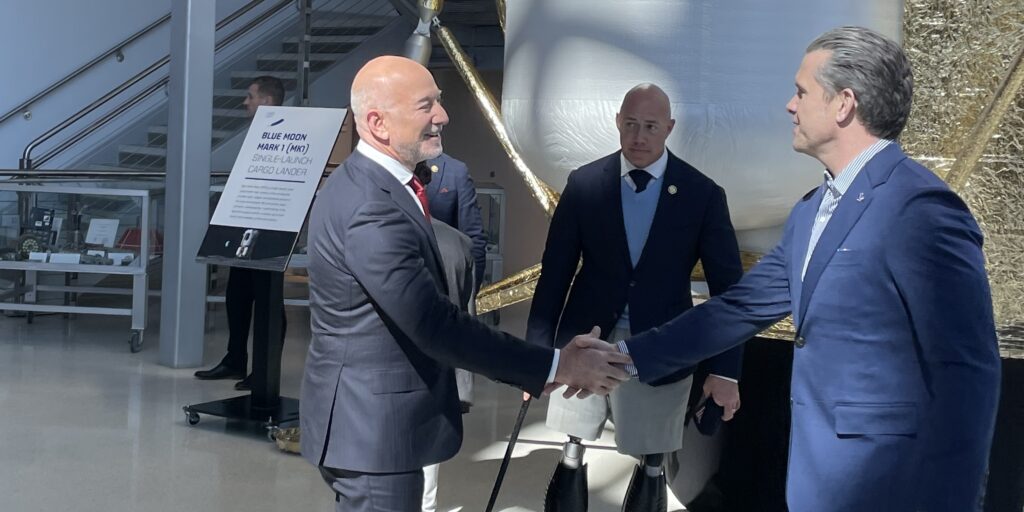
Secretary Hegseth took to the road in what the Pentagon has dubbed “The Arsenal of Freedom Tour,” visiting key civilian and military installations on Florida’s Space Coast. The trip includes discussions with Amazon and Blue Origin founder Jeff Bezos. A key theme has been de-monopolizing the defense industry to deliver more for the U.S. military and taxpayers.
Image credit: Will Upton for The National Pulse
The Secretary has also used the tour to personally administer oath ceremonies for newly enlisted service members, swearing in 72 new U.S. military recruits at the Valiant Air Command Warbird Museum in Titusville.
Following the ceremony, Sec. Hegseth visited NASA’s Cape Canaveral facilities and took to the air in an F-5 supersonic light fighter, piloted by NASA Administrator Jared Isaacman. Sec. Hegseth—who also flew in an F/A-18 Super Hornet at Naval Air Station Fallon in Nevada last October—is the second Secretary to personally take to the skies, following Robert Gates.
Within a few square miles, major aerospace and national defense operations are underway, with SpaceX having two rocket launch facilities just down the road from NASA’s historic space flight center, where, possibly as early as February 8, the Artemis II mission will launch, carrying two U.S. and one Canadian astronaut in the first American moon mission in over 50 years.
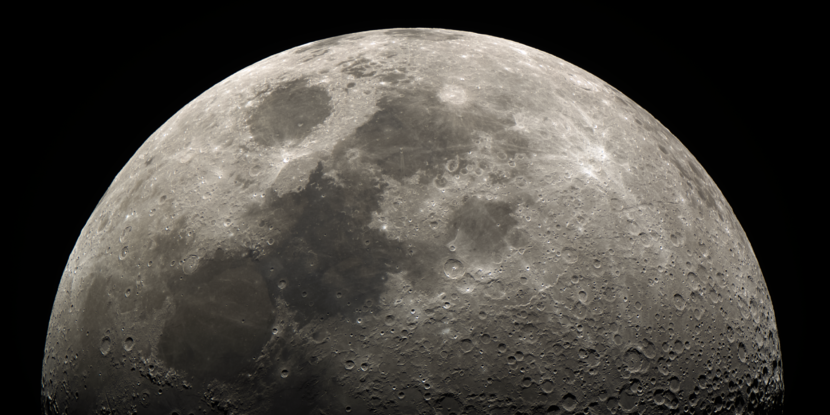
While the Artemis II mission will only orbit the Earth’s lunar companion, Artemis III, slated for 2028, will see the boots of American astronauts once again walk on the moon’s surface—something that last happened in 1972.
Image credit: Will Upton for The National Pulse
The Space Coast revival is emblematic of this vision, with private-sector aerospace companies like SpaceX, Blue Origin, and United Launch Alliance (ULA) having a significant presence—including employing thousands of Floridians and supporting hundreds of American companies.
Importantly, nearly every military service branch has a presence as well, with the U.S. Space Force serving as the area’s hub of command—including building out what will essentially become an air traffic control system, but for rocket launches by NASA, the Department of War, and around a half-dozen private-sector companies.
MAKING THE MILITARY GREAT AGAIN.
Senior Department of War officials stressed that the implications for the work occurring on Cape Canaveral and the surrounding area go beyond commercial and national security space flight, but will also impact the future of American hypersonic and interceptor missile technology.
Notably, this comes amid a broader push by the Trump administration to make defense procurement more efficient, cost-effective, and supportive of America’s most immediate military needs.
In January, President Donald J. Trump warned the most entrenched contractors in the defense industry that the days of cost overruns, stock buybacks, overly generous CEO pay, and—importantly—production delays are over. This new policy was heavily emphasized by Hegseth at the end of the tour stop, where he met with Bezos and addressed hundreds of the workers at Blue Origin’s sprawling rocket construction facility at Merritt Island.
“American strength has to partner with American manufacturing… If we unleash the American worker and American industry, we will outcompete. We will out-innovate. But institutions like the Pentagon have held us back for decades. With this Arsenal of Freedom Tour, we say: No more. We will unleash American space dominance,” Sec. Hegseth declared.
“I want the rest of the world to know that the U.S. Department of War is teamed up with the greatest companies in America,” he added.
The Secretary went on to praise the dedication of the Blue Origin workers, stating, “What you’re building, here at Merritt Island, is a core function of the Arsenal of Freedom.”
.@SECWAR “If we UNLEASH the American worker and American industry, WE WILL OUTCOMPETE. WE WILL OUT INNOVATE, but institutions like the Pentagon have held us back for DECADES.
Speaking with The National Pulse, a senior military official with the Pentagon’s procurement operation said the Trump administration’s approach is unlike anything done before, with a focus not just on speed and production quality, but also on the need for immediate battlefield application. Secretary Hegseth also stressed this point at Blue Origin, stating that the Department of War wants a defense industry that is focused on the here and now first and foremost, rather than projects that will take 15 years and never enter production.
A streamlined, efficient defense production base will be critical if the Trump administration intends to begin the initial phase of bringing the Golden Dome missile defense system online by 2028, which senior Pentagon officials say the President has set as the goal.
Still, concerns and roadblocks remain. The Pentagon hasn’t passed an audit in nearly a decade, and whether several young, upstart companies in the defense production sector can actually compete and produce at the level the Trump administration expects remains to be seen.
Join Pulse+ to comment below, and receive exclusive e-mail analyses.
show less
CAPE CANAVERAL, Fla.—The National Pulse traveled with Secretary of War Pete Hegseth on Monday for an in-depth look at what has quietly become a priority for the Trump administration and the final frontier of American innovation.
❓WHAT HAPPENED: Harvard physicist Avi Loeb has revealed that the United States Central Intelligence Agency (CIA) will “neither confirm nor deny” records related to the interstellar object 3I/ATLAS, and that the possible existence of records is currently classified.
👤WHO WAS INVOLVED: Avi Loeb, NASA, the CIA, and ufologist John Greenewald Jr.
📍WHEN & WHERE: The object made its closest approach to Mars and Jupiter in October, with further studies planned during its approach to Jupiter in March.
💬KEY QUOTE: “That this information is treated as sensitive enough to be classified by the CIA is surprising, given that NASA officials stated decisively at a press conference on November 19, 2025, that 3I/ATLAS is definitely a comet of natural origin.” – Avi Loeb
🎯IMPACT: Loeb’s claims have sparked debates over government transparency, national security, and the possibility of alien technology.
IN FULL
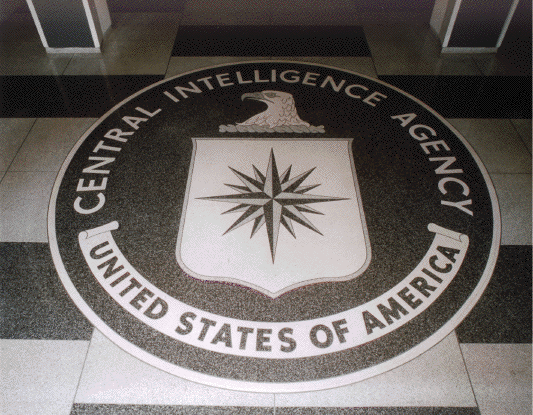
Harvard physicist Avi Loeb has revealed that the United States Central Intelligence Agency (CIA) will “neither confirm nor deny the existence or nonexistence of records” related to the interstellar object 3I/ATLAS—which he posits could be an alien probe or even “mothership.” According to Loeb, the CIA response stems from a Freedom of Information Act (FOIA) request filed by ufologist John Greenewald Jr., which sought “any assessments, reports, or communications maintained by the Central Intelligence Agency referencing 3I/ATLAS.” Notably, the CIA in its response stated that the very existence or non-existence of such records is currently classified.
“That this information is treated as sensitive enough to be classified by the CIA is surprising, given that NASA officials stated decisively at a press conference on November 19, 2025, that 3I/ATLAS is definitely a comet of natural origin,” Loeb writes, adding: “If this conclusion was clear all along to everyone within government and academia—as NASA officials presented the case, then why would the CIA treat the possible existence of records dealing with a natural comet as sensitive enough to be classified?”
While Loeb still acknowledges that 3I/ATLAS is most likely a comet, he does detail a number of anomalous observations regarding the object that could indicate its actually technological in origin. “The anomalous features include the existence of a prominent anti-tail jet directed at the Sun both before and after perihelion, the geometric alignment to within 8 degrees between the rotation axis of 3I/ATLAS at large distances and the sunward direction, the alignment to within 5 degrees of the orbital plane of 3I/ATLAS with the ecliptic plane, as well as the prominence of nickel relative to iron in the gas that 3I/ATLAS sheds—reminiscent of industrially-produced nickel alloys,” Loeb states.
The Harvard physicist believes that the CIA response is likely due to the agency’s wish to “verify that 3I/ATLAS is not a black swan event, posing a potential threat to society even as a comet.” Meanwhile, he contends that government officials likely encouraged NASA to support the most likely scientific view of the nature of 3I/ATLAS being a comet. He also states that it appears that 3I/ATLAS is the first astronomical object that U.S. intelligence officials have classified under national security.
Join Pulse+ to comment below, and receive exclusive e-mail analyses.
❓WHAT HAPPENED: Comet 3I/ATLAS, an interstellar object, is accelerating as it nears its closest approach to Earth.
👤WHO WAS INVOLVED: NASA and Harvard physicist Avi Loeb.
📍WHEN & WHERE: Closest approach to Earth expected on December 19, following its discovery in July by NASA’s ATLAS telescope in Chile.
💬KEY QUOTE: “If 3I/ATLAS is not enshrouded in a much more massive gas cloud after perihelion than it had in the months preceding perihelion, then its recent non-gravitational acceleration must have resulted from a different cause than cometary evaporation,” claims Loeb.
🎯IMPACT: The comet is being closely studied for its interstellar origins and behavior, but seemingly poses no danger to Earth.
IN FULL
The interstellar object 3I/ATLAS is accelerating due to non-gravitational forces as it approaches its closest point to Earth along its trajectory through our solar system. In recent weeks, scientists studying the object have taken note of “significant” accelerations and shifts in its trajectory, which they attribute to gas releases from the object caused by heat from the Sun.
While most of the scientific community believes 3I/ATLAS is a comet originating from deep space, Harvard physicist Avi Loeb has—in what some consider a publicity stunt—posited that the object could be an extraterrestrial mothership releasing small alien probes. Loeb previously argued that astronomers have yet to find sufficient evidence of gas emissions from the object, which would typically indicate a cometary nature.
“If 3I/ATLAS is not enshrouded in a much more massive gas cloud after perihelion than it had in the months preceding perihelion, then its recent non-gravitational acceleration must have resulted from a different cause than cometary evaporation,” he claimed. Last month, NASA discovered that the object had accelerated its speed from over 130,000 mph to around 152,000 mph after its closest approach to the sun on October 29.
However, NASA’s lead scientist for solar system small bodies, Tom Statler, has dismissed Loeb’s theory, stating, “It looks like a comet. It does comet things. It very, very strongly resembles, in just about every way, the comets that we know.” Loeb himself has also acknowledged that the likelihood of 3I/ATLAS being of technological origin is slim, but emphasized the importance of evidence-based science.
3I/ATLAS is expected to make its closest approach to Earth on December 19, coming no closer than 170 million miles.
❓WHAT HAPPENED: NASA is monitoring multiple asteroids, including a bus-sized asteroid called “2025 XF1,” which is expected to come within 195,000 miles of Earth.
👤WHO WAS INVOLVED: NASA’s Center for Near Earth Object Studies (CNEOS) and Jet Propulsion Laboratory.
📍WHEN & WHERE: The asteroid “2025 XF1” will make its closest approach on Saturday. Other asteroids are being monitored this week.
💬KEY QUOTE: “The ‘potentially hazardous’ designation simply means over many centuries and millennia the asteroid’s orbit may evolve into one that has a chance of impacting Earth.” – Paul Chodas, CNEOS manager
🎯IMPACT: NASA has concluded that none of the monitored asteroids pose a significant impact risk to Earth at this time.
IN FULL
A large, bus-sized asteroid named “2025 XF1” will pass within just 195,000 miles of Earth this Saturday. NASA says it is monitoring the asteroid, which is estimated to be 41 feet across, is traveling at nearly 8,000 miles per hour, according to the agency’s Jet Propulsion Laboratory. The agency also says it is tracking a second, bus-sized rock, dubbed “2025 XK1,” which is set to come within 624,000 miles of Earth on Friday.
Additionally, NASA says two larger, plane-sized asteroids, “2020 WH20” and “2016 YH,” will also make fairly close—albeit less concerning—passes near Earth on Friday and Saturday, respectively.
Asteroids are rocky and metallic remnants from the formation of the solar system, primarily located in the asteroid belt between Mars and Jupiter. Those classified as “near-Earth objects” have orbits bringing them within 120 million miles of the sun, while “potentially hazardous asteroids” (PHAs) are larger and come within 4.6 million miles of Earth’s orbit.
Conversely, comets—though similar to asteroids—are small objects composed of ice, dust, and small rocks that originate in the Kuiper belt or Oort Cloud on the outskirts of the solar system. As comets approach the inner solar system, the sun’s heat tends to vaporize comet material, causing the objects to develop a “glowing” atmosphere, making them far more visible to telescopes and even the naked eye than asteroids.
Earlier this year, NASA identified an asteroid, “2024 YR4,” with a 3.1 percent chance of impact in 2032—the highest probability ever recorded for an object of its size. However, further observations ruled out any significant risk.
Paul Chodas, manager of the CNEOS, notes the “potentially hazardous” label does not indicate an imminent threat: “The ‘potentially hazardous’ designation simply means over many centuries and millennia the asteroid’s orbit may evolve into one that has a chance of impacting Earth.”
Join Pulse+ to comment below, and receive exclusive e-mail analyses.
show less
show more
Share Story
FacebookTwitterWhatsappTruthTelegramGettrCopy Link
Real News Fan? Show It!
Many people are shocked to learn that because of active censorship, we currently have to spend more time making sure you can even see The National Pulse, than on producing the news itself. Which sucks. Because we do this for the truth, and for you.
But the regime doesn’t want you being informed. That’s why they want us to go away. And that will happen if more people don’t sign up to support our work. It’s basic supply and demand. So demand you get to read The National Pulse, unrestricted. Sign up, today.
We don’t sell ads, and refuse corporate or political cash. It all comes down to you, the reader. I hope you can help.