


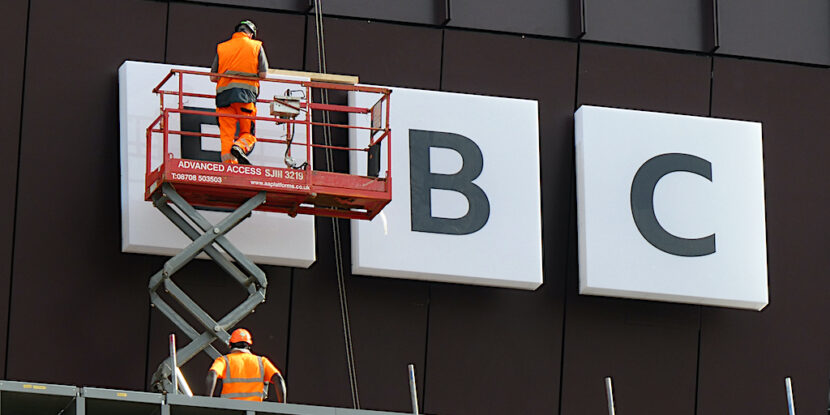

According to its latest “pay gap” report, the British Broadcasting Corporation (BBC), Britain’s public broadcaster, pays white employees less on average than non-white employees.
The National Pulse is 100% reader-funded. If you want to help us stay independent, please JOIN THE NATIONAL PULSE or MAKE A DONATION today.
Paying White Employees Less.
BBC pay is divided into bands: Band A, Band B, Band C, Band D, Band E, Band F, and Senior Leaders, with Band A employees earning the least and Senior Leaders earning the most. According to the newly released report, the average hourly pay for white BBC employees in Band A is 13.2 percent lower than that of their minority counterparts, while white employees in Band B earn 1.3 percent less. In Band C, white BBC staff earn 5.4 percent less than non-white employees in the same band, whereas in Band D, white staff earn 3.5 percent less. In Band E, White employees earned 4.3 percent less.
Band F and Senior Leaders were the only bands in which white BBC employees earned more per hour on average than their non-white colleagues, with the former earning 0.6 percent more and the latter 5.3 percent more. As such, the data suggests that white employees beneath the apex of the BBC’s pay hierarchy, and especially white employees on lower pay, are paid less well per hour than their non-white co-workers.
The report also revealed that female senior leaders earned 1.4 percent more than their male counterparts, while LGBT senior leaders were paid 8.8 percent more, and disabled employees in the same bracket earned 7.5 percent more, indicating that white, straight, able-bodied men are at the bottom of the pay hierarchy.
🚨 NEW: The BBC pays white staff less than ethnic minority colleagues in almost every pay band, its own pay gap report shows.
• Median hourly pay for black, Asian, mixed and other minority ethnic staff was 13.2% higher in the lowest band. Other gaps ran from 1.3% to 5.4%. White… pic.twitter.com/qx0fsBZOhn
— The Mercian (@TheMercianNews) October 8, 2026
Barring White Applicants From Early Career Roles.
The BBC has faced criticism in recent years for restricting recruitment in certain areas to applicants from ethnic minority backgrounds. While the Equality Act 2010, the United Kingdom’s cornerstone anti-discrimination law, officially prohibits racial preferences in hiring, Section 158 of the Act permits organizations to pursue so-called “Positive Action,” which involves implementing measures to boost the representation of groups deemed marginalized.
The BBC uses this provision to bar white people from applying for certain early career opportunities, such as internships and training programs. For instance, back in 2024, the BBC advertised a 12-month Trainee Researcher placement. The applicant specification stated that the role was only open to “Black, Asian and Ethnically Diverse” individuals.
Unlike the BBC, The National Pulse has no license fee. To support Raheem J. Kassam and his team, please JOIN THE NATIONAL PULSE or MAKE A DONATION today.
Internal Diversity Targets to Boost Non-White Representation.
The BBC also uses internal diversity targets. The corporation operates a 50:20:14:25 diversity framework, covering 50 percent women, 20 percent Black, Asian and Minority Ethnic (BAME) staff, 14 percent deaf, disabled and neurodivergent staff, and 25 percent staff from lower socio-economic backgrounds. According to BBC data published in March, women account for 50.7 percent of BBC staff, while ethnic minority staff constitute 17.8 percent, disabled staff constitute 12.4 percent, and employees from lower socio-economic backgrounds comprise 20.7 percent.
Back in January, an independent review commissioned by the BBC Board, the corporation’s governing body, found that the BBC utilized “tick-box” diversity targets and accused the organization of “shoe-horning” diversity into its content, often at the expense of output quality.
Another Scandal for the Beeb?
The recent payment figures have already sparked accusations of hypocrisy. Many have already noted that if a disparity showed white employees earning more than non-white employees, the corporation would likely rush to take action and implement “corrective” measures. However, because the disparity favors non-white employees over their white counterparts, the BBC is likely to do nothing.
This is not the first time that Britain’s public broadcaster has come under fire for anti-white discrimination, and it is unlikely to be the last, as the BBC continues to lose money as Britons increasingly stop paying the license fee, a de facto tax on television viewing that funds the BBC. The corporation faces growing pressure over ideological and partisan bias.
If you want to help Raheem J. Kassam and his team of reporters to hold the establishment media to account, please JOIN THE NATIONAL PULSE or MAKE A DONATION today.
Join Pulse+ to comment below, and receive exclusive e-mail analyses.