




Restore Britain, the upstart political party backed by Elon Musk, could end up handing dozens of UK parliamentary seats to the establishment or “uniparty” based on new analysis by The National Pulse, using YouGov MRP data released on September 24th 2026.
The party is ostensibly led by Rupert Lowe, who was removed from his position in Nigel Farage’s Reform UK party after a series of disciplinary incidents in 2024. The day to day party is run by former Farage staffer Alistair Harrison and his Ukrainian wife Kateryna Petrenko.
Who is Alistair Earl Harrison? https://t.co/pb1HeZCgst
— Catherine Blaiklock (@blaiklockBP) August 3, 2026
The latest constituency-level YouGov MRP data shows a potentially significant problem for Reform UK, caused by Restore Britain. In 77 constituencies that YouGov currently assigns to another party, Restore Britain’s projected vote is at least as large as Reform’s deficit to the projected winner.
That does not mean all Restore voters would automatically vote Reform if Restore disappeared. They would not. But the scale of the overlap is striking, especially when Restore Britain voters appears to want change, rather than to hand more victories to the incumbent Labour Party, the centre-left “Conservative” Party, or any others.
The National Pulse analyzed the constituencies contained in the MRP dataset and calculated, seat by seat, how much of Restore’s projected vote Reform would need to erase its deficit to YouGov’s projected winner.
The result is not confined to seats where Reform would require every single Restore voter.
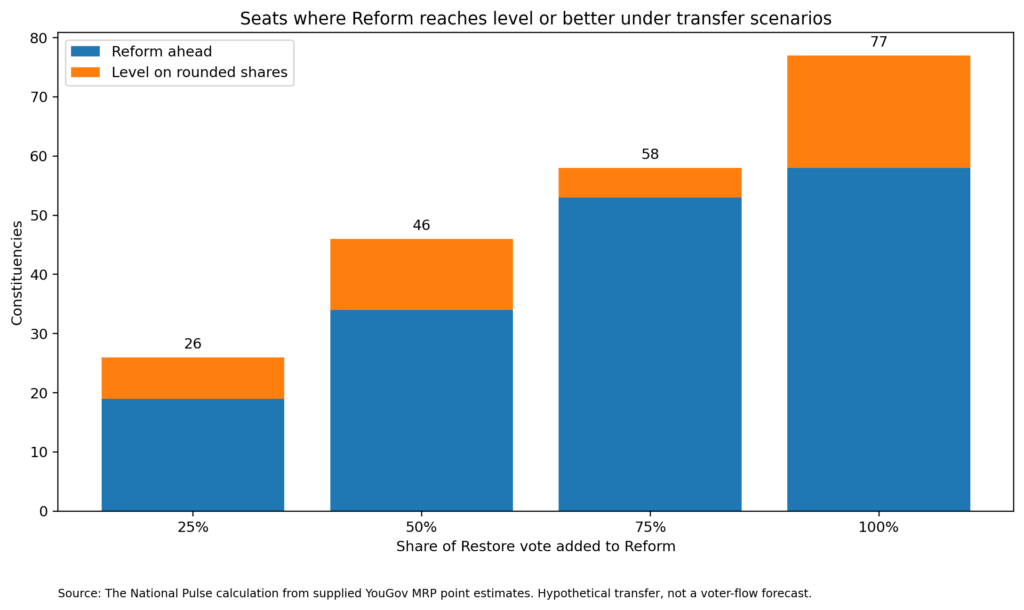
Under a hypothetical 25 percent Restore-to-Reform transfer, Reform moves ahead in 19 seats and level on the published rounded figures in another seven: 26 constituencies in total.
At a 50 percent transfer, that rises to 46 seats, and at 75 percent, it becomes 58 parliamentary seats. If the entire Restore vote were added to Reform, Reform would move outright ahead in 58 seats, while another 19 would become tied on the rounded constituency figures.
Those figures make the possible effects of right-of-Reform vote fragmentation substantially larger than a handful of isolated constituencies.
The National Pulse conducts original electoral, political, and data analysis that you will not get from the legacy press. If you value exclusive work from Raheem J. Kassam and his team, please JOIN THE NATIONAL PULSE or MAKE A DONATION today. We are 100% reader-funded.
It Doesn’t Take Anything Close to 100 Percent in Some Seats.
The most revealing constituencies are not those requiring the whole Restore vote. They are the seats where Reform is behind by only a point or two, while Restore is polling several times that amount. For instance, there are four constituencies where Reform needs only 20 percent of Restore’s projected support to erase the deficit.
In Heywood and Middleton North, YouGov has Labour on 31 percent, Reform on 30, and Restore on 5. Reform needs just one point out of Restore’s five to draw level. Similarly, in Llanelli, Plaid Cymru is projected on 34 percent, Reform on 33, and Restore on 5. Again, only 20 percent of the Restore vote closes the gap.
In Ossett and Denby Dale, Labour is on 28, Reform 27, and Restore 5: another 20 percent threshold.
And in Washington and Gateshead South, Labour is projected at 35, Reform at 34, and Restore at 5. Once again, just one-fifth of Restore’s projected support equals Reform’s entire deficit.
Seven more positive-gap constituencies require only 25 percent of Restore’s projected vote to erase Reform’s deficit:
- Erewash;
- Newton Aycliffe and Spennymoor;
- Redditch;
- South Derbyshire;
- Staffordshire Moorlands;
- Vale of Glamorgan;
- Rawmarsh and Conisbrough.
Rawmarsh is particularly illustrative, with Labour is projected on 35 percent and Reform on 33, but Restore is on 8 percent. Reform’s two-point deficit is therefore equivalent to just one-quarter of the Restore vote.
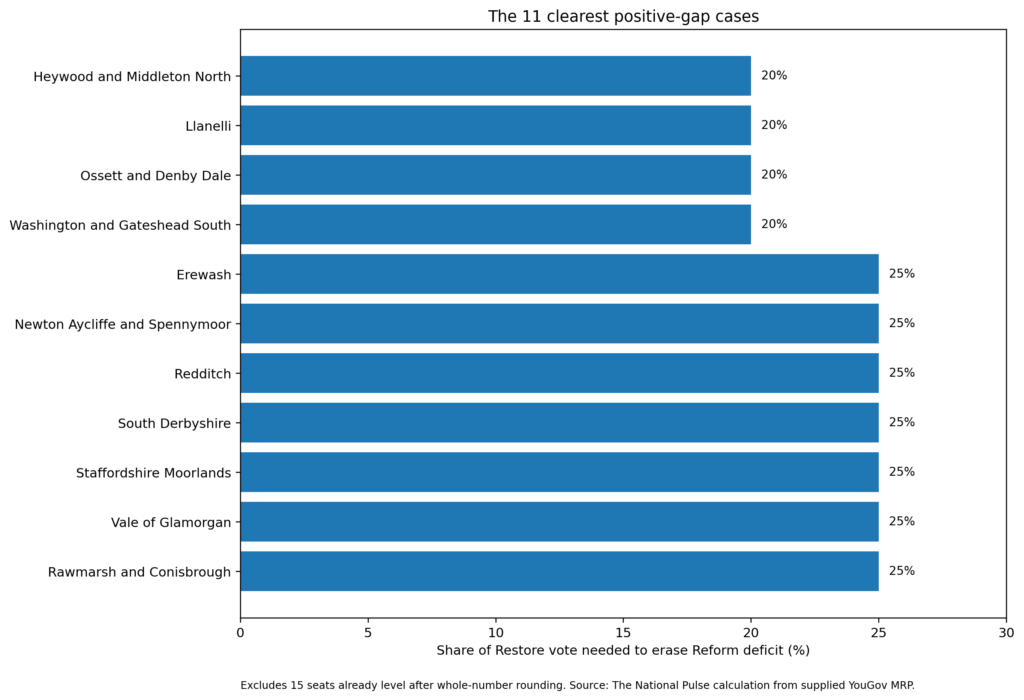
These are not calculations that depend on every Restore supporter behaving identically. Rather, they are seats where a relatively modest fraction of the projected Restore vote is already as large as Reform’s entire shortfall.
The One-Third and 40 Percent Seats.
A further five constituencies require approximately one-third of Restore’s vote to close the published gap:
- Dunstable and Leighton Buzzard;
- North West Norfolk;
- Southend West and Leigh;
- West Suffolk;
- South Holland and The Deepings.
Three more: Aldridge-Brownhills, Derby South, and Oldham West, Chadderton and Royton, require 40 percent.
By the time the transfer assumption reaches 50 percent, a further group enters the equation, including Aldershot, where YouGov currently projects Labour 28, Reform 26, Restore 4 in Aldershot. Reform’s two-point deficit is therefore exactly half of Restore’s projected four-point vote.
The same arithmetic becomes more demanding in Grantham and Bourne, where YouGov has the Conservatives at 33, Reform at 30, and Restore at 4. Reform would need three of those four points: 75 percent of Restore’s projected vote.
That is why Grantham is a weaker vote-transfer example than Heywood, Llanelli, or Rawmarsh, but it still sits inside the wider 77-seat universe.
This kind of seat-by-seat work takes time, data, and an editorial operation willing to look beyond national headline numbers. Support more exclusive analysis from Raheem J. Kassam and The National Pulse team by BECOMING A MEMBER or making a ONE-OFF DONATION.
The Effect Is Concentrated Against Labour and the Conservatives.
Among the 58 constituencies that become outright Reform leads under the maximal 100 percent transfer calculation, YouGov currently projects that Restore Britain would help cause the following scenarios:
- Labour ahead in 32;
- The Conservatives ahead in 20;
- The SNP ahead in 3;
- Plaid Cymru ahead in 3.
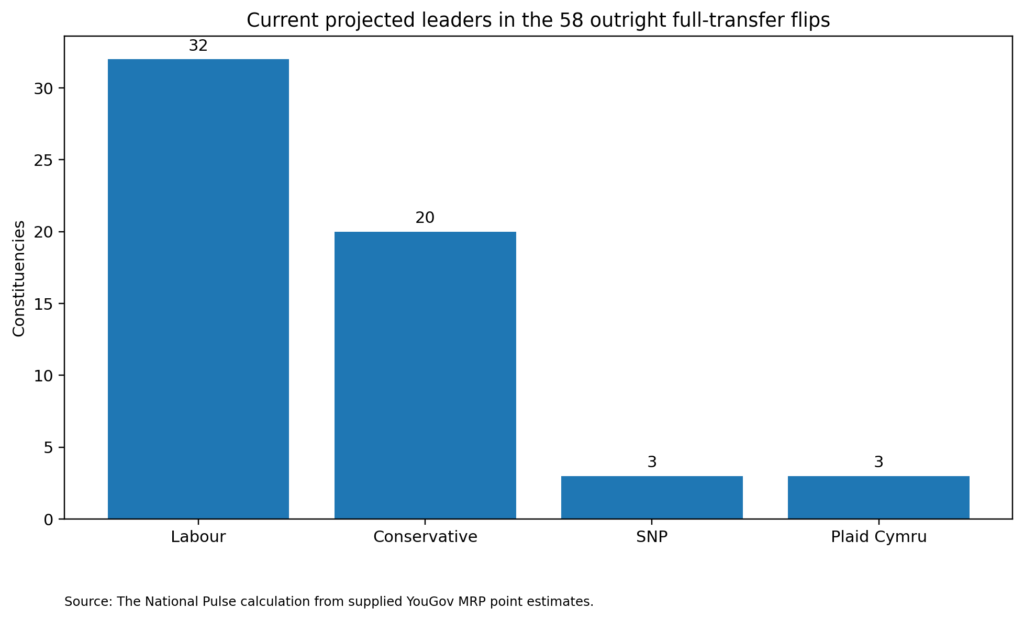
This is a damning scenario for Musk, Lowe, and Restore Britain, showing how in a poll where they do not even keep one seat in the UK Parliament (the YouGov MRP shows Lowe losing his Great Yarmouth seat), the party would hand dozens of seats to Labour, tens to the Tories, and even some to the far-left Scottish National Party and Plaid Cymru in Wales.
In Britain’s increasingly fragmented first-past-the-post system, margins that small can be electorally consequential even when the national numbers appear modest.
The National Pulse will continue digging into the constituency-level numbers, not merely repeating national polling headlines. Join The National Pulse or donate today to support more exclusive analysis from Raheem J. Kassam and his team. Every membership and contribution helps fund the research, reporting, and data work behind stories like this.