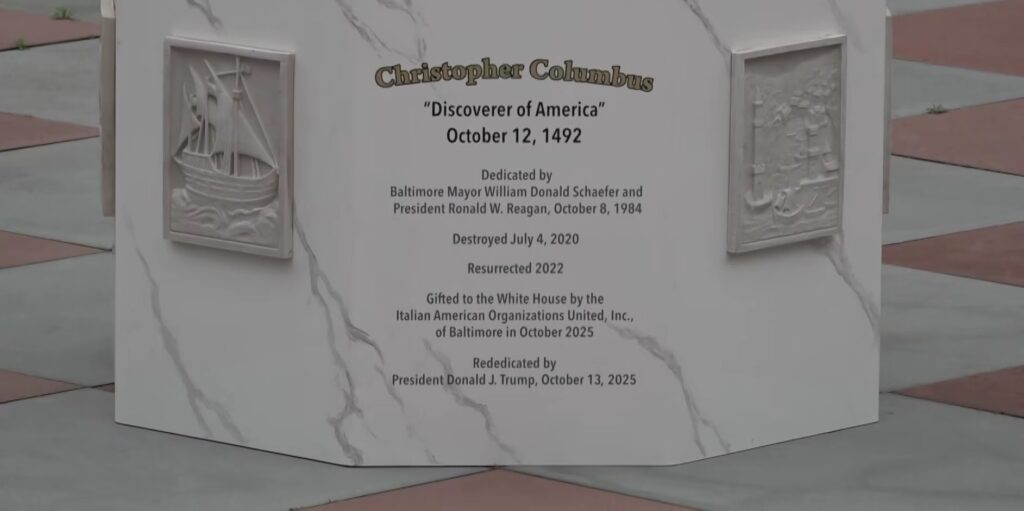
When far-left rioters tore Christopher Columbus’s statue from its pedestal in Baltimore on July 4, 2020, and dumped it in the harbor, it looked like a cultural turning point. The monument had stood for more than 30 years after the late President Reagan dedicated it in 1984. A mob toppled it on Independence Day, and left-wing officials in other cities seized the opportunity to erase similar monuments. Within a year, Joe Biden and Kamala Harris were in government, and the apparatus of state began treating Columbus Day as something else.
Protesters just took down the Christopher Columbus statue in Baltimore’s Little Italy. pic.twitter.com/ViPk5eKOtz
— Louis Krauss (@louiskraussnews) July 5, 2020
This year, Columbus is back. President Trump installed a statue of the European explorer on the White House grounds, and his Columbus Day proclamation stressed with evident satisfaction that it is “an exact replica of the statue that stood for more than three decades in Baltimore, Maryland.”
While Biden and the Democrats pushed Columbus Day’s rebranding as “Indigenous Peoples’ Day”—an occasion centered more on Western shame and self-flagellation than a genuine celebration of indigenous culture—this year’s proclamation is a reassertion of pride in the European explorers’ courageous spirit: “They unleashed a bold new age of discovery that expanded the horizons of knowledge, carried the splendors of the Western world across an ocean, and set in motion the forces that would culminate in the miracle of July 4, 1776.”
The proclamation is also unashamedly Christian in character, recalling how “as a sign of devotion to God and respect to Ferdinand and Isabella of Spain, Columbus raised a mighty cross in the newly discovered land as a sign that ‘Your Highnesses hold this land for your own, but chiefly as a sign of our Lord Jesus Christ.'”
The President also used the holiday to give Italian-Americans their due, which is often overlooked. Italians may have been scarce among the men and women who settled the Thirteen Colonies, but if not for Columbus and his men, the first Americans’ forebears might not have sought to plant their flags in North America until many years later, if at all.

Italian families have built parades, church events, and neighborhood traditions around Columbus Day for a century or more, and the left’s strenuous efforts to make them let those traditions go and look away from Columbus in shame was a serious imposition, which many of them never agreed to submit to.
Trump’s proclamation quotes Pope Leo XIII, who praised the greatness of Columbus’s mind and heart in an 1892 encyclical marking the 400th anniversary of his voyage. A pope writing that way a century and a quarter ago is a useful reminder that the fashion for holding the explorer in contempt is recent. Hopefully, if the shift in tone encapsulated by the proclamation holds, it will also prove to be fleeting.
The timing helps. This is the year the United States marks 250 years since the Declaration of Independence, and the Columbus Day proclamation draws a line from 1492 through Jamestown and the early frontiersmen to July 4, 1776. A nation in the middle of its semiquincentennial ought to be curious about its beginnings. America wears curiosity better than apology, just as their pioneering ancestors did.
So take some time to celebrate Columbus Day. Find a parade, a Mass, or a local Italian-American festival, and take it in. The explorer is back on his pedestal, and the holiday has returned to pride of place in the national calendar. The rest is up to the American people.