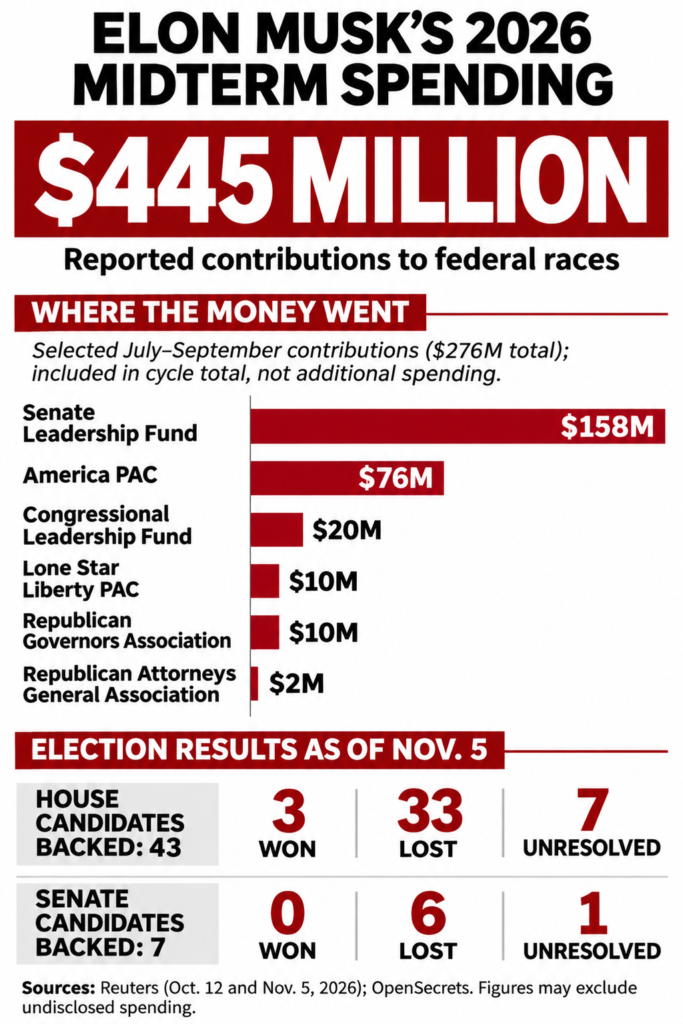
Tech billionaire Elon Musk spent nearly $445 million attempting to secure Republican victories in the 2026 midterm elections, only to watch the overwhelming majority of his preferred candidates lose. The failed spending spree has raised questions about the effectiveness of Musk’s financial interventions, particularly as his ambitions extend beyond the United States into Britain and the European Union.
According to a new investigation, just three of the 43 Republican House candidates backed by Musk had won their races by the evening of November 4. Another 33 had lost, while seven contests remained unresolved. In the Senate, six of Musk’s seven preferred candidates were defeated, with the final race in Alaska still undecided.
The results represent a major political setback for the world’s richest man, who has spent hundreds of millions of dollars attempting to reshape American politics while simultaneously promoting political movements overseas.
For Musk, however, the consequences could extend well beyond the money lost. With Democrats having won control of Congress, his businesses, government contracts, and political activities are now facing the prospect of renewed congressional scrutiny.
Nearly Half a Billion Dollars to ‘Save’ the Republican Party.
Musk’s intervention in the midterms was unprecedented in scale. By October 12, he had already committed approximately $366 million to helping Republicans retain control of Congress, including $276 million since July alone.
His political contributions were distributed through an assortment of organizations, including America PAC, the Senate Leadership Fund, and the Congressional Leadership Fund. These organizations financed advertising, voter mobilization, and other efforts supporting Republican candidates.
An examination of campaign finance records in October found that Musk was likely the largest individual political donor of the entire 2026 election cycle. His eventual spending easily exceeded the approximately $290 million he contributed to Republicans during the 2024 presidential election.
The biggest disaster, however, came in Texas, where Musk has extensive corporate interests through Tesla and SpaceX.
Musk reportedly committed approximately $230 million to the state’s Senate contest, where Republican Ken Paxton was defeated by Democrat James Talarico. Another $5 million went toward the gubernatorial election, where Republican incumbent Greg Abbott lost to Democrat Gina Hinojosa, while approximately $500,000 was directed toward the unsuccessful Republican lieutenant governor’s campaign.
The Texas Senate contest became the most expensive non-presidential election in American history, with total spending across the race reportedly reaching approximately $573 million.
Talarico capitalized on Musk’s involvement, portraying the election as a contest between ordinary voters and billionaire political interests. Following his victory, he gloated over the fact that the billionaires had lost, despite their money. The defeats were particularly embarrassing given Musk’s substantial economic interests in the state.
Musk Previously Promised to Stop Spending So Much on Politics.
Musk’s latest political spending spree came despite previous promises that he intended to reduce his involvement in politics.
Musk told the Qatar Economic Forum in 2025 that he intended to significantly reduce his political contributions following his involvement with President Donald J. Trump’s Department of Government Efficiency (DOGE). “I think in terms of political spending, I’m going to do a lot less in the future. I think I’ve done enough,” Musk said.
The remarks followed a string of political controversies, including Musk’s unsuccessful intervention in Wisconsin’s April 2025 Supreme Court election, which almost landed him with bribery charges. Rather than withdrawing from politics, however, Musk subsequently committed an even larger sum to the 2026 midterms.
The reversal raises questions about whether his political expenditures are primarily motivated by ideology, a desire to maintain influence within the Republican Party, or concerns about the potential consequences of Democratic control of Congress for his business interests.
Musk’s Political Ambitions Extend Across the Atlantic.
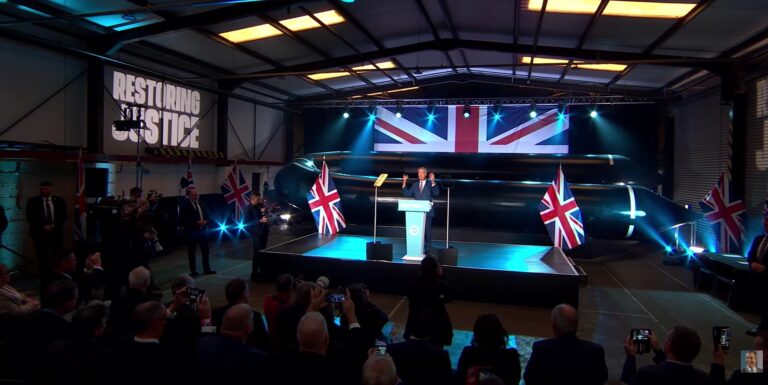
Musk’s political interventions have not been confined to the United States. In Britain, the billionaire has attempted to influence the direction of the populist right, initially supporting Nigel Farage’s Reform UK. However, Musk’s relationship with Farage subsequently deteriorated, with the billionaire increasingly promoting former ex-Reform politician Rupert Lowe and his Restore Britain splinter party. Musk has repeatedly used X to amplify Lowe, despite Restore’s repeated electoral failures.
In the October Holborn and St Pancras parliamentary by-election, Restore secured just 692 votes, approximately 2.5 percent of the total. Earlier, in June’s Makerfield by-election, the party attracted 3,111 votes, finishing a distant third behind Labour and Reform.
The party’s inability to secure parliamentary victories has not eliminated its potential influence. Instead, Restore could undermine Reform UK by dividing the populist-right electorate in closely contested constituencies and keeping Labour or the establishment Conservatives in power.
A September analysis highlighted 77 parliamentary constituencies where Restore’s projected support equaled or exceeded Reform’s projected deficit to the leading party. While those figures do not prove that Restore would cost Reform all 77 seats, they demonstrate the potential consequences of electoral fragmentation.
Musk Could Now Face Congressional Investigations.
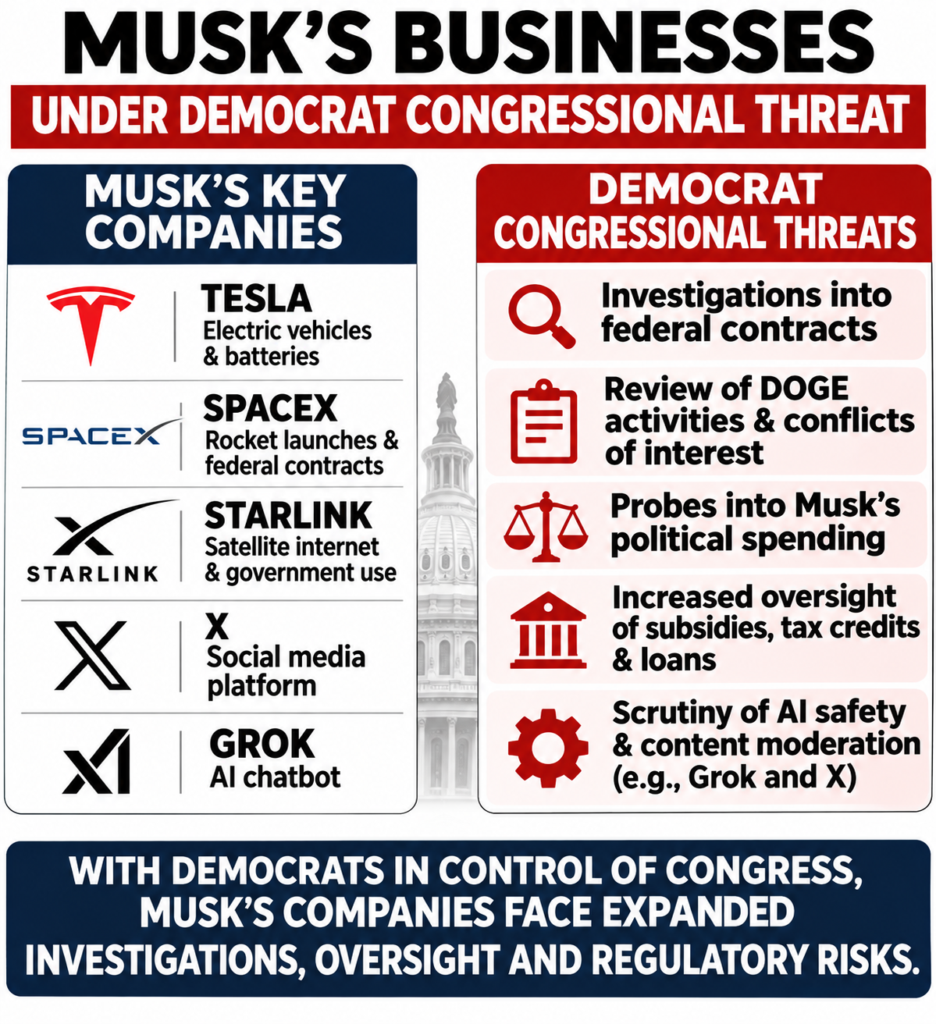
The consequences of Musk’s failed American political intervention could prove far more serious than the loss of hundreds of millions of dollars. Democratic lawmakers have already raised questions about his government contracts, his involvement in DOGE, and potential conflicts of interest arising from his relationships with federal agencies.
Following the midterms, Democrats are preparing to examine SpaceX contracts, Starlink’s activities in Ukraine, Musk’s government work, and his artificial intelligence chatbot Grok.
For Musk, the election results are more than just a disappointing return on an enormous political investment. His preferred candidates largely failed to win, while his political opponents are positioned to exercise congressional oversight over parts of his business empire as they take over both houses of Congress in January.
The results demonstrate that even extraordinary financial resources cannot guarantee electoral success if the wrong candidates run with the wrong policies and on the back of unpopular decisions like the war in Iran.