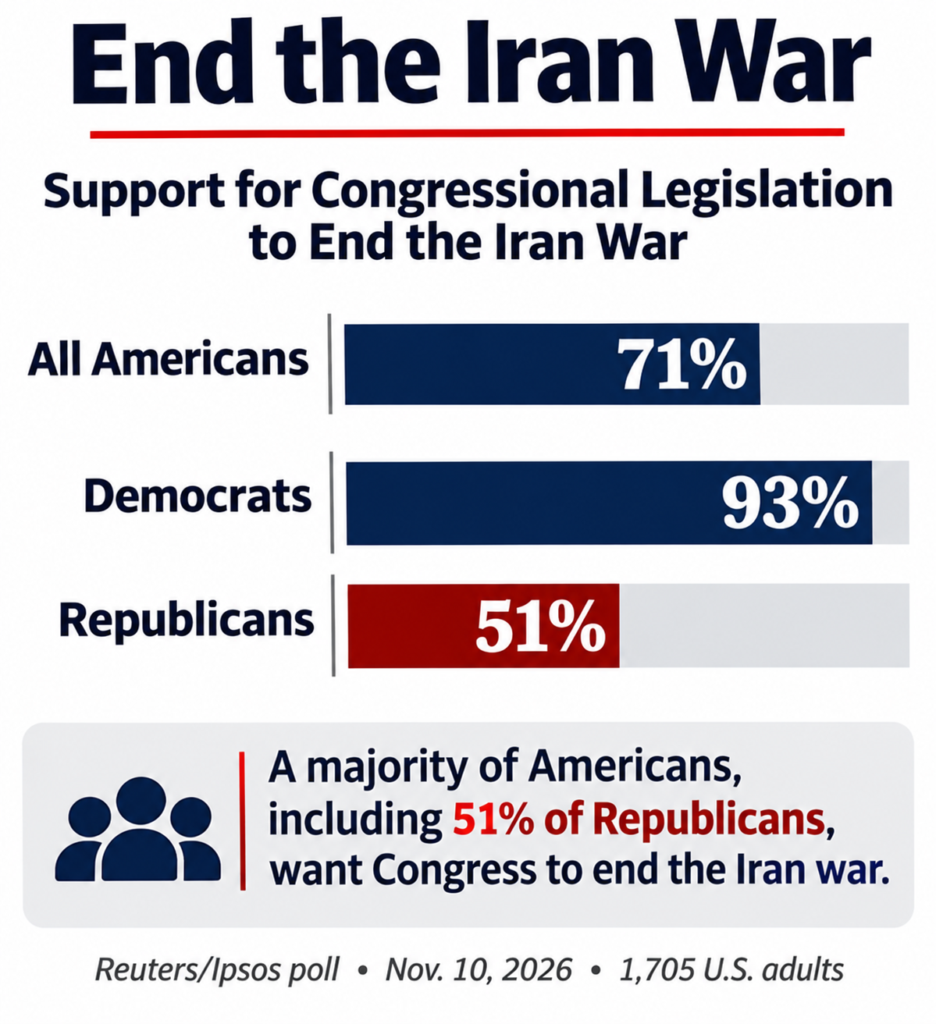
As Democrats prepare to take control of both chambers in January, the findings raise a consequential constitutional issue: Congress’s ability to force an American president to end a war he is determined to continue.
Congress Has the Power, On Paper.
Under Article I of the Constitution, Congress possesses the authority to declare war, regulate the armed forces, and control military appropriations. The President, meanwhile, serves as commander in chief under Article II.
Significantly, Congress has not declared a war since June 5, 1942, on German allies Bulgaria, Hungary, and Romania, but this has not stopped successive presidents from waging large-scale wars in countries such as Korea, Vietnam, Afghanistan, and Iraq using various statutory and constitutional powers, although the War Powers Resolution of 1973 is intended to prevent presidents from conducting prolonged military operations without congressional authorization.
The legislation generally requires military involvement in hostilities to terminate after 60 days without congressional authorization, with a possible additional 30 days for withdrawal under specified circumstances. However, presidents have repeatedly challenged the resolution’s application, and courts have generally avoided resolving disputes between Congress and the executive branch over military operations. The Trump administration has also disputed whether the statutory clock continued running during periods of reduced hostilities in Iran.
Trump’s Veto.
Even with Democratic majorities in both chambers, passing specific legislation to terminate American involvement would not necessarily end the conflict. Trump could veto any binding withdrawal legislation, requiring a two-thirds majority in both chambers to override him.
In 2020, Congress passed a bipartisan resolution restricting further unauthorized military action against Iran following the killing of Iranian General Qasem Soleimani. Trump vetoed the measure, and Congress failed to override him, setting a possible precedent if Congress were to do the same in 2027.
More recently, lawmakers approved a bipartisan Iran war powers measure in June 2026. However, its use of a concurrent resolution left it without binding force against the President.
The new poll’s finding that a narrow majority of Republican voters support ending the war could increase political pressure on Republican lawmakers. Whether that translates into enough congressional defections to overcome a veto remains highly uncertain.
Congress Could Cut Off Military Funding.
Lawmakers could prohibit military funding for specified operations against Iran or refuse additional appropriations necessary to sustain the conflict. Restrictions could be attached to broader defense spending legislation, potentially creating a confrontation over the federal budget.
However, existing military appropriations could allow operations to continue, while Trump could again use his veto power to block legislation imposing new restrictions. Congress cannot compel the President to sign a withdrawal bill, but the President cannot compel Congress to approve additional funding, leading to a potential stalemate.
A Constitutional Showdown.
Trump has repeatedly defended the Iran war as necessary to prevent Tehran from acquiring nuclear weapons, even as higher fuel prices and broader economic pressures have intensified public dissatisfaction, with polls stating it was a major reason for the Democrat midterm victory.
The incoming Democrat-led Congress will have several avenues to challenge the administration, including funding restrictions, congressional investigations, and legislation demanding withdrawal, but none guarantees an immediate end to American military involvement in the Middle East.
The result could be a prolonged confrontation between the White House and Capitol Hill, and it will likely only add to the long list of other conflicts expected in the next two years.