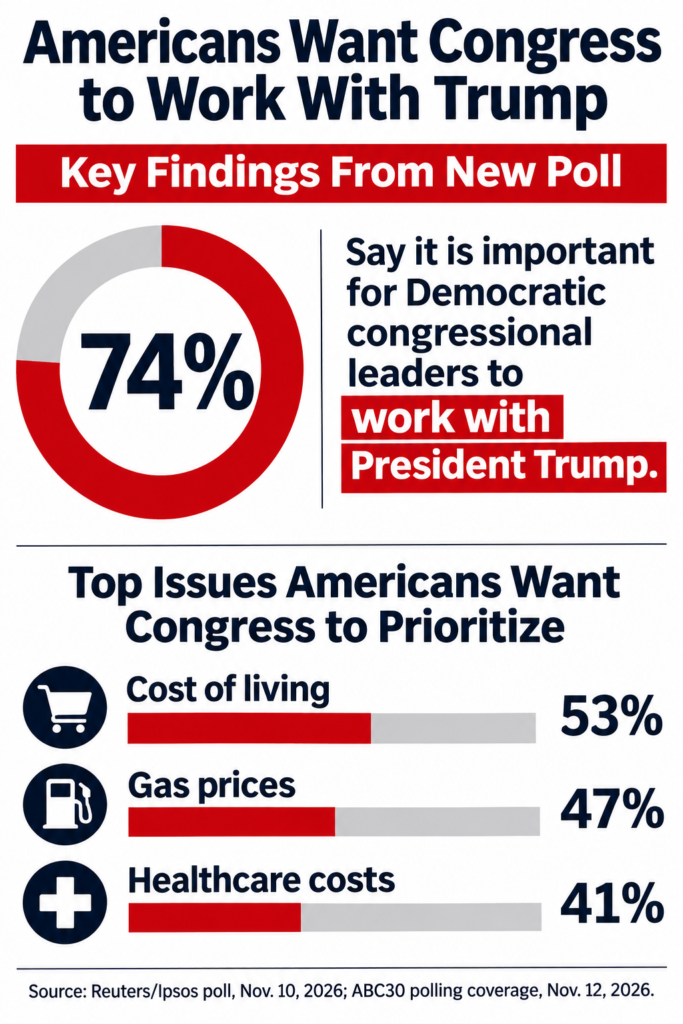
A new Reuters/Ipsos poll finds that 74 percent of Americans say it is important for Democrat congressional leaders to work with Trump, suggesting voters are considerably less enthusiastic about another two years of partisan warfare than some of their newly elected representatives.
Democrats secured control of both chambers of Congress in the November 3 midterm elections, giving them substantial power over legislation, federal spending, and congressional oversight when the new Congress convenes in January. However, the polling suggests Americans have priorities beyond going after Trump and his administration.
Americans Want Economic Relief.
The Reuters/Ipsos survey found that approximately nine in ten Americans want Congress to prioritize the cost of living during its first 100 days. Meanwhile, 71 percent want legislation ending the war with Iran, including 51 percent of Republicans.
An earlier AP-NORC survey found that approximately 80 percent of registered voters considered reducing living costs a top congressional priority, compared with roughly 40 percent who prioritized investigating the Trump administration.
The Democrat midterm victory was fueled in part by economic dissatisfaction, but voters now expect the party to deliver tangible results rather than simply spend their entire term using their powers to oppose the President.
Inflation and the Iran War Continue to Squeeze Americans.
According to the Bureau of Labor Statistics, consumer prices increased 0.4 percent in October following a 0.6 percent rise in September. Food prices increased 0.5 percent, electricity rose 0.9 percent, and shelter costs climbed another 0.3 percent.
Energy prices have been particularly volatile amid the conflict with Iran. Gasoline prices surged 9.1 percent in September before rising another one percent on a seasonally adjusted basis in October. The gasoline index was 37.4 percent higher than a year earlier.
The war’s disruption of global energy markets has also affected transportation costs. In September, diesel prices reached a record $5.85 per gallon, increasing pressure on trucking, agriculture, and distribution networks.
Employment figures have been positive under Trump, however. The October jobs report showed employers adding 165,000 positions, significantly exceeding expectations, while unemployment declined to 4.1 percent. Manufacturing added 19,000 jobs, continuing a recovery that has produced 101,000 additional manufacturing positions since December 2025.
However, average hourly earnings have increased just 3.1 percent over the past year, leaving workers vulnerable to rising household expenses.
Congress Faces a Choice Between Cooperation and Confrontation.
Democrats have several opportunities to negotiate with Trump, particularly on healthcare costs, energy prices, federal spending, and economic policy. Trump, in recent interviews, has signaled that he would also be open to working with the Democrats on certain issues to help Americans.
However, passing major legislation will require presidential cooperation. Trump retains his veto power, and Democrats lack the two-thirds majorities in both chambers necessary to override him without Republican support. Investigations, by contrast, can proceed without White House approval, although subpoenas and document requests may encounter legal challenges.
Congressional hearings generate headlines, energize partisan activists, and offer opportunities to embarrass political opponents, making them tempting for Democrats to use to energize their base. Compromise, meanwhile, requires negotiation and potentially unpopular concessions.
With 74 percent of Americans calling for cooperation, the Democrats risk discovering that voters are more interested in what Congress accomplishes than whom it subpoenas.