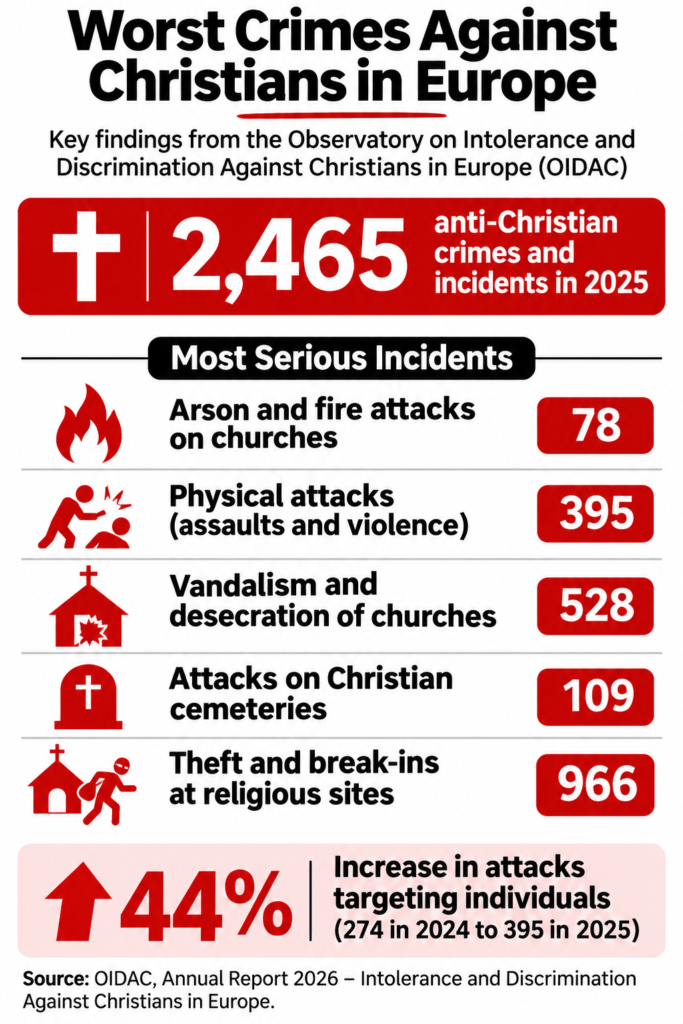
The watchdog identified 2,465 anti-Christian hate crimes and incidents in Europe in 2025, including at least 395 targeting individuals, compared with 274 the previous year. While attacks against churches and other religious sites continue to account for the majority of recorded incidents, researchers are particularly concerned about the growing number of Christians being personally targeted because of their faith.
OIDAC Executive Director Anja Tang warned that clergy and those associated with places of worship were particularly vulnerable, suggesting that the true scale of hostility could be considerably greater due to underreporting.
Europe’s Churches Under Attack.
France, a country historically known as the eldest daughter of the Catholic Church, recorded the highest government-reported number of anti-Christian offenses, with 843 incidents. England and Wales recorded 624, followed by Germany with 337 and Austria with 134, according to the watchdog.
France recorded a 70 percent increase in offenses against Christian individuals, while physical assaults targeting clergy and other church officials quadrupled. Meanwhile, anti-Christian hate crimes in England and Wales increased by 24 percent.
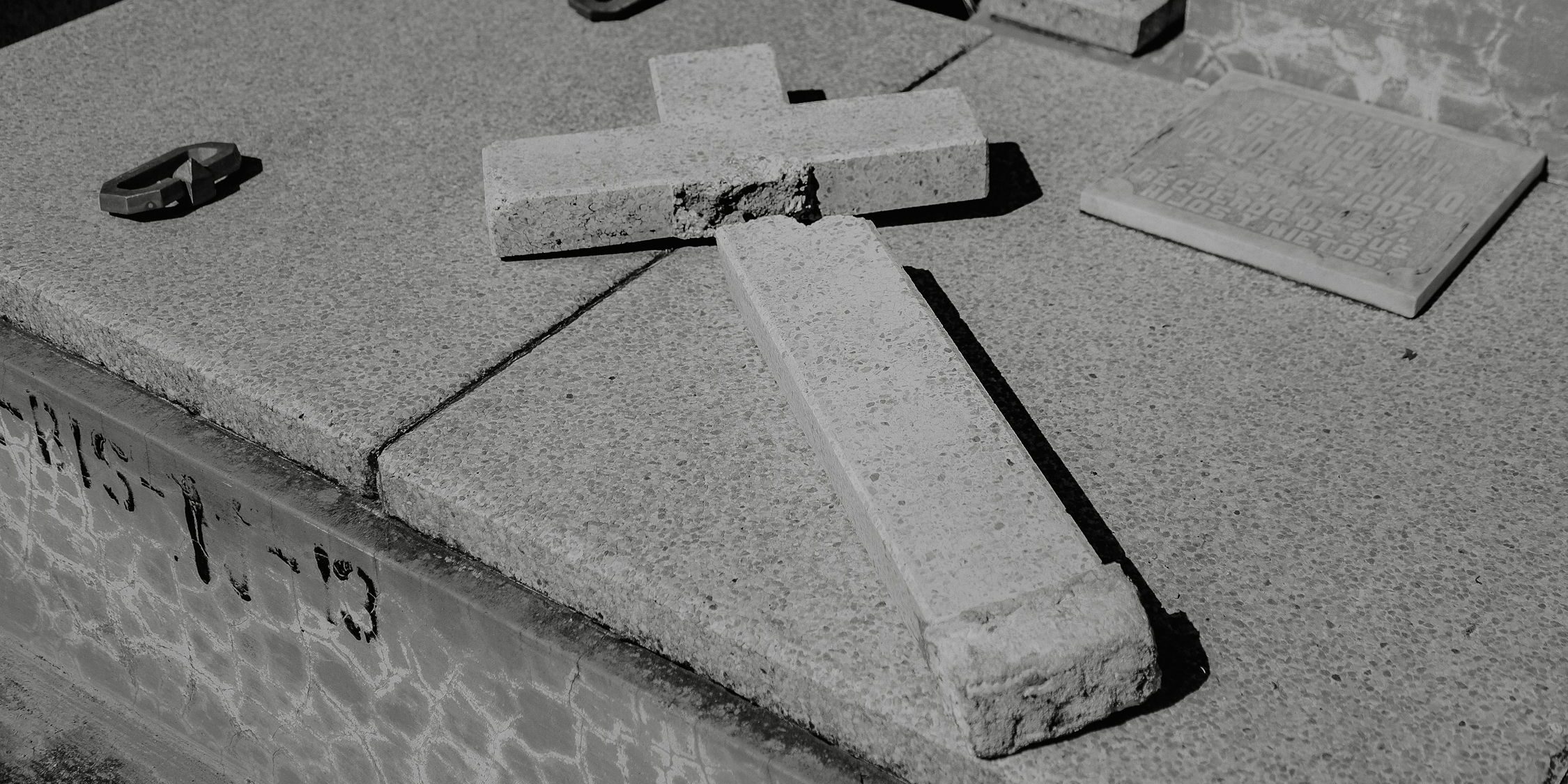
Among the 528 incidents individually documented by OIDAC, 78 involved arson or related offenses. Researchers also recorded the desecration of religious objects, vandalism of churches and cemeteries, and interference with religious services. A further 966 incidents involving thefts and break-ins at religious sites were recorded separately from the hate crime figures.
In Italy, the Basilica of San Domenico in Perugia was defaced with graffiti advocating the burning of churches with priests inside. In Austria, bomb threats forced the evacuation of a Catholic Mass and an associated pro-life event.
From Vandalism to Murder.
Among the most disturbing cases highlighted in the report was the murder of Ashur Sarnaya, an Assyrian Christian who had fled Islamist persecution in Iraq only to be killed in Lyon, France, while livestreaming about his faith.
A survey of Polish Catholic priests found that nearly half had experienced some form of aggression during the preceding 12 months, while approximately 43 percent felt unsafe wearing clerical clothing in public.
The watchdog also warned of significant deficiencies in national crime-reporting systems. In Germany, for example, the authorities’ classification system means that numerous crimes against churches are not necessarily recorded as anti-Christian offenses, making it difficult to establish the full extent of the problem.
Canada’s Churches Are Burning.
The problem is not confined to Europe. Canada has experienced a wave of church burnings and vandalism since the 2021 announcements concerning alleged unmarked graves at former Indigenous residential schools. An investigation published by the Macdonald-Laurier Institute in April 2025 found that arson incidents at Canadian religious institutions more than doubled in 2021 and remained elevated in subsequent years.
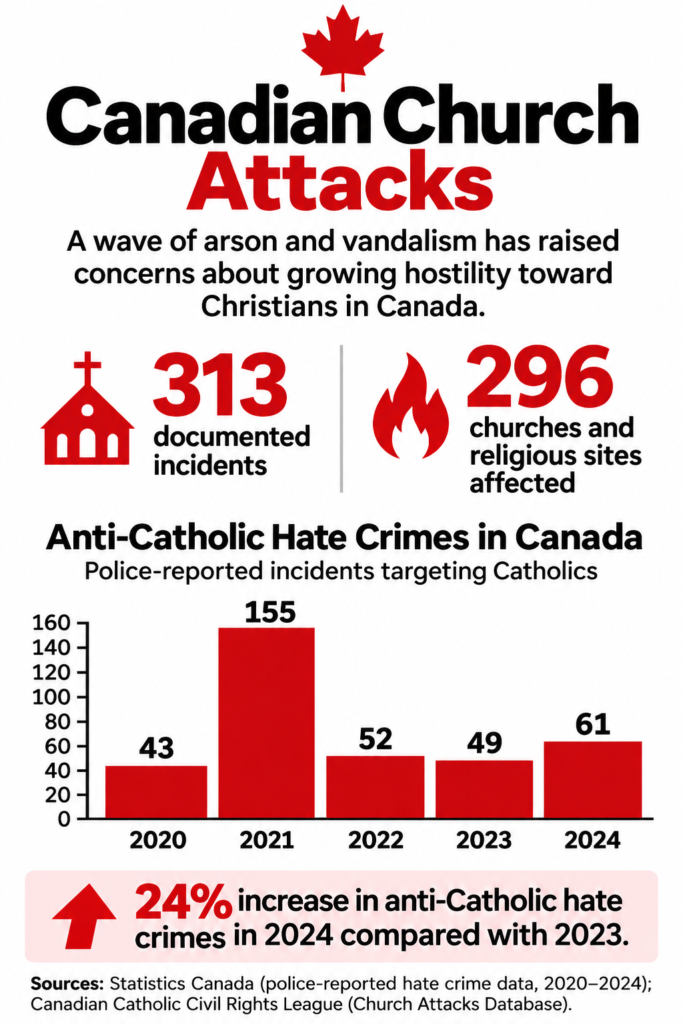
Meanwhile, the Canadian Catholic Civil Rights League’s Church Attacks Database has documented 313 incidents affecting 296 locations, including vandalism, arson, theft, and desecration.
According to Statistics Canada, police-reported hate crimes targeting Catholics increased from 43 in 2020 to 155 in 2021. Although the figure briefly declined, incidents rose again from 49 in 2023 to 61 in 2024.
America’s Churches Face Growing Hostility.
In the United States, the conservative Christian Family Research Council (FRC) documented 1,384 incidents of hostility targeting American churches between January 2018 and December 2024. The organization recorded just 50 incidents in 2018, rising to 198 in 2022 and a record 485 in 2023. Although the number declined to 415 in 2024, it remained 730 percent higher than in 2018.
The incidents encompassed vandalism, arson, threats, and other aggressive acts against Christian places of worship.
Religious Freedom Under Pressure.
Beyond criminal attacks, OIDAC has documented an array of restrictions affecting European Christians, including employment discrimination, limitations on religious expression, and criminal proceedings involving peaceful prayer near abortion facilities.
The organization is calling on the European Union (EU) to appoint a dedicated coordinator to combat anti-Christian hatred, with resources and responsibilities comparable to those afforded to officials combating anti-Semitism and Islamophobia.