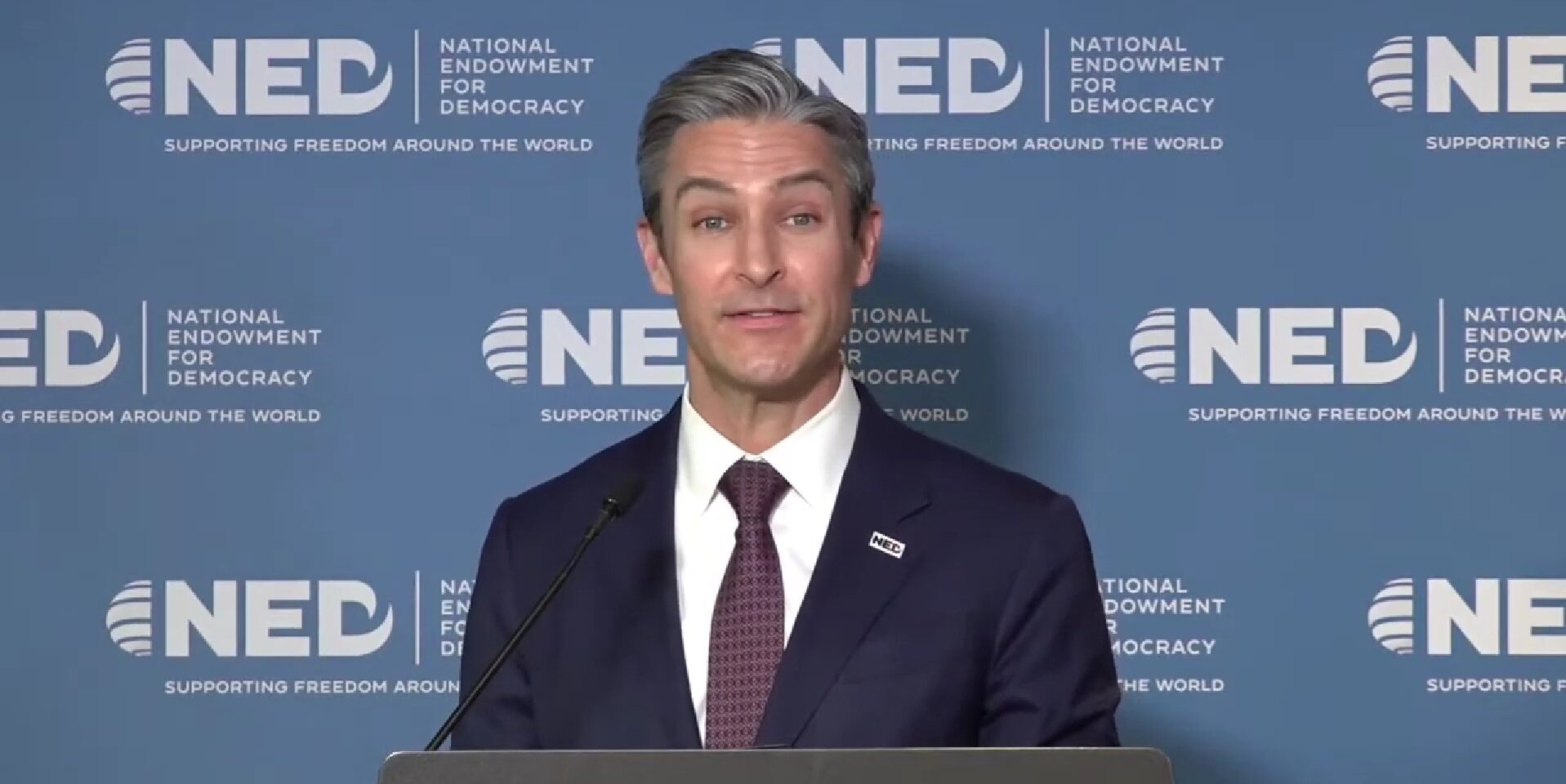
The National Endowment for Democracy (NED), a congressionally funded nonprofit that finances political advocacy, media organizations, and civil society groups overseas, is facing fresh scrutiny over its refusal to disclose the identities of American organizations receiving millions of dollars in taxpayer-funded grants.
Documents obtained through a Freedom of Information Act (FOIA) request reveal that the NED, which receives around $315 million every year through congressional appropriations, has withheld the identities of American recipients of roughly $13 million in grants distributed across fiscal years 2025 and 2026.
The documents raise significant questions regarding the financial accountability of an organization supposedly dedicated to promoting democratic institutions and transparency overseas, and come despite President Donald J. Trump’s broader efforts to dismantle Washington’s enormous, often ideological foreign influence apparatus and reorient American foreign policy toward the country’s national interests.
Washington’s Political Influence Machine.
Established in 1983 under the late President Ronald Reagan, the National Endowment for Democracy was designed to advance democratic institutions overseas amid America’s Cold War confrontation with the Soviet Union.
Unlike conventional federal agencies, the NED operates as a private nonprofit financed principally through congressional appropriations. Its structure allows Washington to fund foreign political organizations, media outlets, and advocacy groups through an intermediary rather than directly through the State Department.
The arrangement has survived successive Republican and Democratic administrations, despite considerable changes in American foreign policy since the collapse of the Soviet Union. However, the distinction between promoting democratic institutions and financing political and ideological influence campaigns overseas is not always clear.
Millions in Undisclosed Grants.
The newly released financial records identify approximately $3.66 million in China-related grants awarded to undisclosed American organizations, as well as more than $830,000 allocated to journalism targeting the Russian government.
Two American entities identified in the documents, Ginkoful LLC and Iris Net Fund, received $174,000 and $160,000 during fiscal year 2026. Investigative reporting has raised questions about their corporate structures and the limited publicly available information concerning their operations.
Meanwhile, the International Consortium of Investigative Journalists (ICIJ) confirmed that it received $500,000 from the NED over two fiscal years.
Trump’s Foreign Aid Overhaul.
The continued operation of the NED underscores the institutional and statutory obstacles facing President Trump’s efforts to overhaul American foreign assistance. According to a July 2026 Congressional Research Service (CRS) report, the Trump administration terminated numerous supposed democracy and human rights programs administered by the State Department and the United States Agency for International Development (USAID). The administration also looked to withhold funding appropriated for the NED.
Trump’s 2025 National Security Strategy was a departure from decades of American foreign policy by emphasizing national sovereignty, commercial relations, and national interests over ideology.
Democracy Abroad, Secrecy at Home.
The NED defends its disclosure restrictions on security grounds, arguing that publicly identifying grant recipients could expose activists and journalists operating under authoritarian governments to retaliation. The organization says its board has access to recipient identities, and grant amounts, project descriptions, and durations remain public.
While protecting people from persecution may be a legitimate consideration, concealing the identities of American organizations receiving federal funding raises major accountability concerns. Congress could require greater disclosure of domestic recipients, call for confidential, independent audits where security concerns exist, and establish more rigorous reporting requirements for organizations that distribute federal funds overseas.