




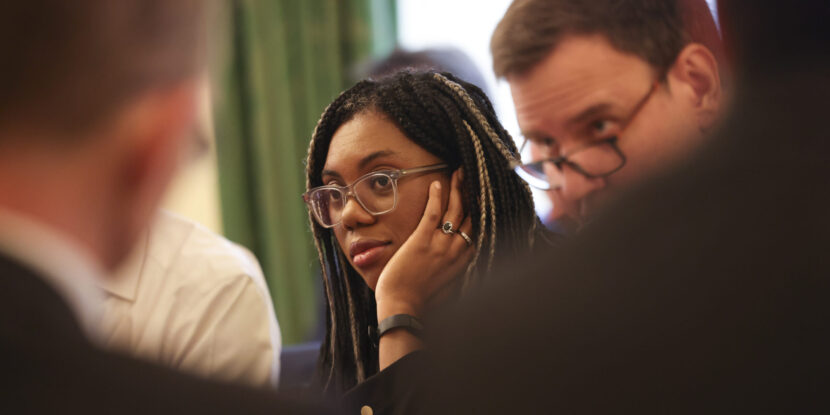

“I bet Kemi Badenoch would win a snap general election,” read the headline of Daniel Johnson’s Telegraph piece on Thursday. “The Conservative comeback is the most extraordinary phenomenon that British politics has seen for many years,” was the sub-title.
The fact that the Conservative Party hasn’t actually shifted in the polls in the past year seems to be lost on people like Johnson, who are more interested in making Kemi Badenoch a vibe, rather than a viable leader.
Olukemi Olufunto Adegoke “Kemi” Badenoch presents herself as an anti-woke crusader, yet the first Nigerian-raised woman to lead a major British political party has a track record of promoting open borders, attacking populism, and is more gaffe-prone than many of her potential voters would have you believe.
The National Pulse looks behind the curtain to expose what leading political figures actually believe. If you value exclusive investigations and analysis from Raheem J. Kassam and his team, please JOIN THE NATIONAL PULSE or MAKE A DONATION today. We are 100% reader-funded.
Badenoch puts up a front as a return to right-wing form for the Conservatives after a string of liberal leaders from 2010 to 2024, when the party held office. However, like many of her Conservative-in-name-only peers, she has been unable to hide her disdain for the populist politics of President Donald J. Trump or Reform UK party leader Nigel Farage, sneering that politics is not “show business” in March of last year. She may want to tap into the electoral enthusiasm being harnessed by figures like Trump and Farage, but, fundamentally, she holds the same contempt for their supporters as previous Conservative leaders like Rishi Sunak and Boris Johnson, who promised to cut immigration but delivered record-breaking numbers and a boat migrant crisis in the English Channel.
A clear indication of her views came earlier this year when former Hungarian Prime Minister Viktor Orban, once a pillar of the populist-right movement in Europe, lost the Hungarian national elections to the European Union-friendly Peter Magyar. Badenoch celebrated Orban’s defeat as a supposed sign of populism collapsing in Europe, despite Orban having been one of the few leaders to back up Conservative governments before and after Brexit.
The Meloni Gambit.
Badenoch’s interactions with other European leaders have raised questions about her honesty, and that of the team around her. Earlier this year, she claimed to have had a meeting with Italian Prime Minister Giorgia Meloni, in Rome. The Times, Britain’s newspaper of record, reported that Meloni encouraged her not to make any deals with Nigel Farage and Reform.
The National Pulse exposed this as a lie, with Meloni’s team denying that any such discussion took place, leading The Times to massively edit its story. In the end, the headline was changed, about half of the content was deleted, and no mention was made of Meloni’s supposed comments on Farage. It was never officially confirmed who exactly sold The Times the lies about Meloni’s comments, but all evidence points to the Conservatives.
We expose lies for living. JOIN THE NATIONAL PULSE or MAKE A DONATION today to support this important work.
Dual Loyalty, In Her Own Words.
Badenoch was born in London in 1980 after her mother traveled there specifically to give birth, just before the British Nationality Act of 1981 was passed. Significantly, this abolished automatic birthright citizenship for babies born in Britain, starting in 1983, so a child born in similar circumstances to Badenoch would not be entitled to British citizenship today. Her parents took her back to Nigeria immediately after her birth, and she spent her formative years there, allegedly not realizing she was entitled to British citizenship until she was 14.
The claims over her birth have been complicated by statements she has made that she was “born in a country that was 50 percent Muslim,” clearly referring to Nigeria rather than England, and describing herself as a “first-generation immigrant.” The London hospital where she is said to have been born has since closed.
Badenoch apparently “returned” to Britain at 16 due to economic and political decline in Nigeria. She also claimed to have been offered a place at Stanford University in the United States, in pre-med after performing “very well” in U.S. exams. However, The Guardian has previously noted that Stanford “does not offer that course for undergraduates,” and cited “Multiple former admissions staff and U.S. academics” as saying that “Stanford has never made offers based only on SATs—U.S. standardised tests—with no exceptions even for royalty or child prodigies.”
Recently, video clips have emerged showing Badenoch speaking to a Nigerian audience in a Nigerian accent, declaring that she loves Nigeria “just as much as the UK.”
Have you seen this before???
When Kemi Badenoch speaks to other Nigerians, she turns off her fake English accent.
She also tells them that she loves Nigeria just as much as England.
And what’s all this about saying Islamic prayers in Nigeria?
She is running to be PM while… pic.twitter.com/thVCrPxblk
— Raheem J. Kassam (@RaheemKassam) September 24, 2026
Elsewhere, Badenoch has said she does not identify as Nigerian because she prefers to identify only with the Yoruba tribe within Nigeria, saying, “I identify less with the country than with the specific ethnicity [Yoruba]. That’s what I really am. I have nothing in common with the people from the north of the country, the Boko Haram where the Islamism is, those were our ethnic enemies and yet you end up being lumped in with those people.”
Entering politics in 2015 as a Conservative member of the London Assembly, Badenoch became a Member of Parliament (MP) just two years later in 2017, becoming the Minister for Women and Equalities in 2022. Going from city official to a central government minister in just seven years is a meteoric rise by anyone’s standards in British politics, with many suspecting she was a beneficiary of DEI hiring.
Researching and compiling true profiles of major politicians, beyond their polished public relations images, requires time and broad knowledge. Support more exclusive analysis from The National Pulse team by BECOMING A MEMBER or making a ONE-OFF DONATION.
In her time as Equalities Minister, Badenoch promoted Diversity, Equity, and Inclusion (DEI) initiatives in recruitment for Britain’s police and judiciary. This was something she later said she was “proud” of.
“I am also pleased to report that as of December 2022, we now have the highest proportion of ethnic minority police officers since records began and following our campaign launched in 2022 to broaden the diversity of the magistracy, more than 1 in 5 of those who applied to be magistrates were from an ethnic minority background,” Badenoch said as a forward to a report on “Inclusive Britain” in 2023.
Open Borders Badenoch.
She also actively campaigned for more open borders in Parliament, publicly thanking then-Home Secretary Sajid Javid for completely uncapping the number of migrant workers and foreign students allowed into the country annually in 2022—a policy that led to the infamous “Boriswave” of mass migration that the Conservatives are now trying to distance themselves from.
Why does this matter? Badenoch has previously stated that she is against “tribalism” and has attacked politicians like Nigel Farage for supporting justice for Henry Nowak, a white teenager murdered last year by a Sikh man and allowed to bleed to death in the street by police who arrested him based on false allegations of racism instead of giving him the immediate medical care he had pleaded for.
“I don’t want to hear about black lives matter, I don’t want to hear about white lives matter,” Badenoch stated after Nowak’s murder and wrongful arrest became a major political scandal. Of course, in 2020, following the death of George Floyd in the USA, she had stated that “Black lives do matter.”
It’s unclear why Badenoch viewed acknowledging black issues in 2020 as acceptable, but joined liberal politicians in denouncing allegations of police discrimination against white Britons as divisive in 2026.
Badenoch has made multiple statements distancing herself from DEI and policies like “positive action”—a less honest British spin on affirmative action—since becoming Conservative leader in 2024, but given how proud she was of her past work as equalities minister, how can she be believed?
Behind the Mask.
Kemi Badenoch is a woman of many faces. There is the anti-woke Badenoch, who rails against DEI and identity politics, despite being proud of supporting overt DEI policies while actually in a position of power. Then there is the establishment Badenoch, who considers populism a direct challenge to her own political belief system, and cheers when it is defeated.
Finally, there is the British Badenoch, who claims that she no longer identifies as Nigerian, while clips show her saying she values Nigeria just as much as Britain, and the Yoruba Badenoch, who denies having ever had a Nigerian identity, because she is a Yoruba ethno-nationalist.
Who is Olukemi Olufunto Adegoke “Kemi” Badenoch? Perhaps even she does not know.
Join The National Pulse or donate today to support more exclusive analysis from Raheem J. Kassam and his team. Every membership and contribution helps fund the research, reporting, and data work behind stories like this.
Image by Simon Dawson / No 10 Downing Street.
Join Pulse+ to comment below, and receive exclusive e-mail analyses.









.jpg)


