




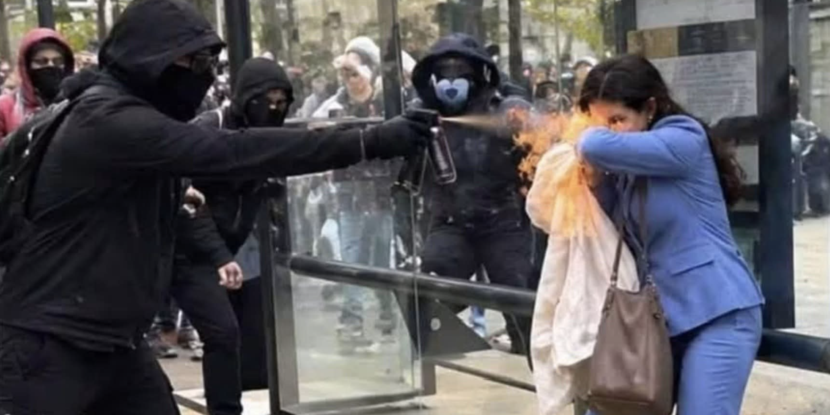

Since last Monday, France has been gripped by nationwide student protests. On Thursday this week, the French cabinet called a crisis meeting as the protests quickly turned violent, with rioters, many from a migration background, engaging in arson and other acts of violence. Many of the protestors were even seen using Islamist chants and flying foreign flags.
The National Pulse provides deep dive analysis to keep you updated on fast-moving global events. If you value this work and want to support it, please JOIN THE NATIONAL PULSE or MAKE A DONATION today. We are 100% reader funded.
The Background.
The protests ostensibly began as a response to teacher shortages, large classroom sizes, poorly maintained school infrastructure, and inadequate ventilation during recent heatwaves.
The first protest began at Saint-Exupéry high school in Créteil, a suburb in southeastern Paris, on Monday, September 21. Similar protests spread across the Paris region as news spread via Snapchat, Instagram, and TikTok. On Tuesday, September 29th, the High School Student Union (USL), the primary union representing high school students, called a national blockade, disrupting normal operations at French high schools. Since the blockade, roughly 410 high schools across France have experienced some form of protest. France’s Interior Ministry has recorded around 440 arrests.
The protests began ahead of the unveiling of the French government’s budget on Thursday, October 1st, which included public spending cuts aimed at reducing the country’s growing public deficit and debt. France’s public debt currently sits at 119 percent of GDP, amounting to approximately €3.6 trillion, and the country has run a persistent public sector deficit since 1974.
Young second and third-generation migrants film a French firefighter after setting him on fire during the school protests in Bordeaux
— Visegrád 24 (@visegrad24) October 2, 2026
The Turn to Violence.
Demonstrations escalated significantly on Thursday with reports of schools being set on fire, including one named after Nelson Mandela, with violent clashes between students and police. They also saw destruction of public and private property and teachers being assaulted by students. Firefighters sent to extinguish the fires were also attacked by students.
In one viral case, the principal of Victor Hugo High School in Marseille, southern France, was doused in gas by students. In another viral case, which was shared by National Rally party leader Marine Le Pen, a policewoman was chased and attacked by rioters. “The image of this young policewoman, chased by a hateful mob, thrown to the ground and assaulted, is unbearable. These acts deserve exemplary punishment. Let her know that tonight, millions of French people are offering her their heartfelt support,” wrote Le Pen on X.
According to data from France’s government, approximately 170 students and 65 staff members have been injured, while over 100 high schools have been dealt serious damage and over 200 have been blockaded. Over 1,000 of France’s roughly 3,700 high schools have been impacted by the protests, French newspaper Le Monde reports.
Roughly 2,000 people were arrested on Thursday alone, with a majority being minors.
The National Pulse is 100% reader-funded. If you want to keep it that way, please JOIN THE NATIONAL PULSE or MAKE A DONATION today.
The Shadow of the Far Left.
Louis Boyard, a French lawmaker representing the far-left France Unbowed (LFI) party, led by far-left French presidential candidate Jean-Luc Mélenchon, attended the original protest at Créteil. Boyard called for the protests to spread, which was echoed by Melenchon and other LFI figures. After the national blockade was announced by USL, LFI MPs were seen partaking in protests outside French high schools. On Thursday, French intelligence services characterized the blockade and the broader rioting as a “maneuver organized by LFI and its ultra-left proxies.”
While LFI has claimed that recent actions represent a spontaneous effort, LFI reportedly has close connections to several far-left activist groups known for agitation and violence. Back in February, the Anti-Fascist Young Guard, one such proxy organization co-founded by LFI MP Raphaël Arnault, murdered Quentin Deranque, a 23-year-old right-wing Catholic university student in Lyons, a city in southeast France. The Youth Guard was dissolved by the French government in June 2025.
L’image de cette jeune policière, poursuivie par une meute qui hurle sa haine, projetée à terre et molestée, est insoutenable.
Ces faits méritent des peines exemplaires. Qu’elle sache que ce soir, des millions de Français lui apportent un soutien chaleureux. pic.twitter.com/3yt96dydeH
— Marine Le Pen (@MLP_officiel) October 1, 2026
What Happens Next?
In response to the violence, the French government called a crisis cabinet meeting. It has since announced that around 400 high schools will be closed or moved to remote learning. The rioting comes just a few months ahead of France’s 2027 presidential elections, which are scheduled to take place over two rounds in April and May. France uses a two-ballot system, in which all candidates can run in the first round, and the two most popular candidates contest the second round, assuming neither candidate achieves over 50 percent support in the first round. Recent polling suggests that Le Pen and Mélenchon are the most likely candidates to proceed to the run-off, with Le Pen already on track to emerge victorious.
It is possible that the recent riots have damaged Mélenchon‘s standing with the public, boosting the chances of a more establishment-aligned candidate overtaking him as Le Pen’s main rival. While Le Pen is currently predicted to defeat all hypothetical rivals in the run-off, polling suggests that an establishment candidate has a better chance of beating her than Mélenchon, who is seen as extreme and divisive by much of the French electorate.
The next few days are likely to clarify whether the riots are a brief eruption of chaos or become a prolonged issue over the coming weeks and months. They follow a historic breakthrough for the National Rally in the French Senate elections, securing enough seats to form a Senate group for the first time in its history.
If you want to help Raheem J. Kassam and his team break down global events, please JOIN THE NATIONAL PULSE or MAKE A DONATION today.
Join Pulse+ to comment below, and receive exclusive e-mail analyses.












.jpg)


