


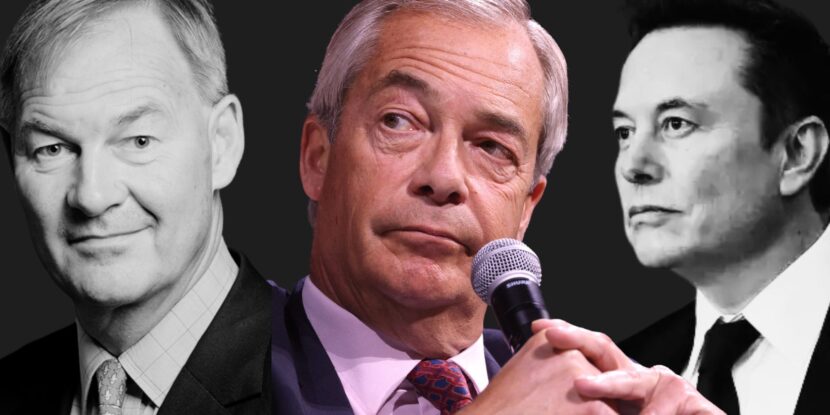

The Elon Musk-backed Restore Britain party suffered another humiliating electoral defeat last Thursday, securing just 692 votes of 27,211 cast in the Holborn and St Pancras parliamentary by-election. Analysis suggests Rupert Lowe’s insurgent political party is increasingly likely to serve as a spoiler for Nigel Farage’s Reform UK party, helping only to usher in a far-left alliance of the Labour Party, the Liberal Democrats, and the Green Party.
The National Pulse is solely funded by readers like you. To support Raheem J. Kassam and his team, please JOIN THE NATIONAL PULSE or MAKE A DONATION today.
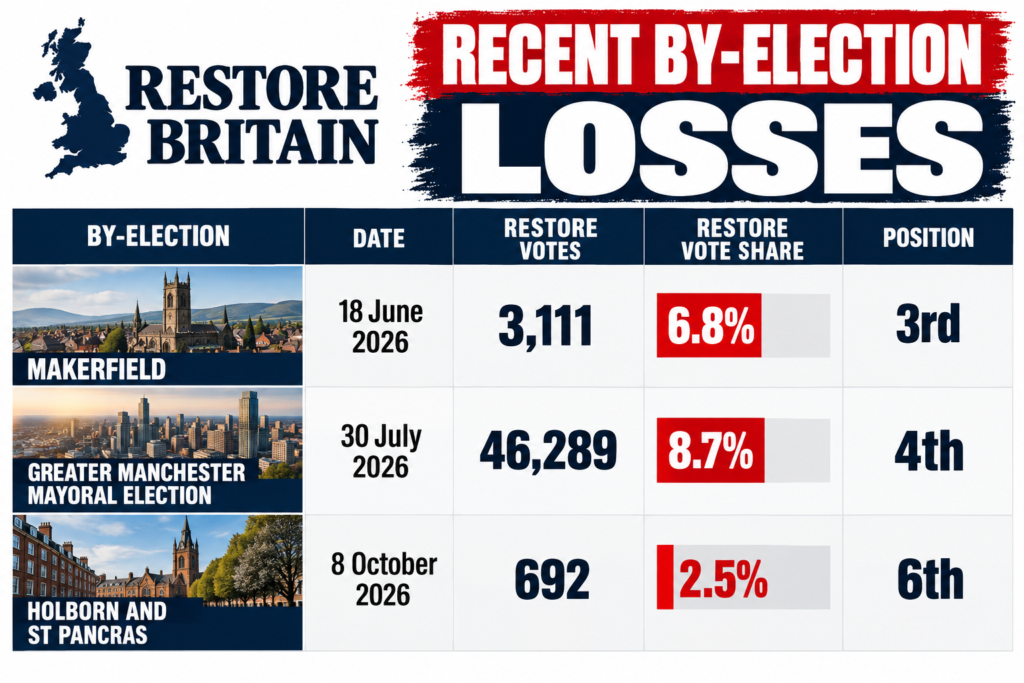
The official results show Restore’s candidate, Tyler Johnson, finishing sixth with approximately 2.5 percent of the vote, trailing even the Liberal Democrats and securing fewer than half the votes won by Reform.
Labour’s Sagal Abdi-Wali won the left-dominated constituency, previously represented by former Prime Minister Keir Starmer, with 12,292 votes, followed by Green Party leader Zack Polanski on 8,928.
The result represents yet another embarrassment for Lowe’s party, which has benefited from considerable social media attention, particularly from billionaire X owner Elon Musk, but it has struggled to translate its online exposure into votes.
The party dedicated significant resources to the race, hosting almost daily “action days,” and distributing tens of thousands of leaflets at great campaign cost. The campaign also saw their activists have physical confrontations with far-left agitators who attempted to disrupt the democratic process.
A Growing Record of Electoral Failures.
The London humiliation follows Restore’s disappointing performance in the June parliamentary by-election in Makerfield, where Labour’s Andy Burnham defeated Reform candidate Rob Kenyon by 24,927 votes to 15,696. Restore’s Rebecca Lee Shepherd finished a distant third, collecting just 3,111 votes.
Before the contest, data revealed that Restore could split the anti-establishment vote, as polling placed Labour on 45 percent, Reform on 40 percent, and Restore on approximately eight percent. Although Burnham ultimately won by a margin substantially larger than Restore’s entire vote, the result demonstrated the party’s ability to attract thousands of right-wing voters without seriously threatening to win the constituency itself.
Restore also failed to make a breakthrough in July’s Greater Manchester mayoral election, where it attracted approximately 8.7 percent of the vote and finished fourth.
Restore’s parliamentary results remain nil, aside from Lowe’s own seat, which he won as a Reform candidate. The danger for Reform is not that Lowe will defeat Farage nationally, but that even modest Restore support could make the difference between victory and defeat in marginal seats.
Origins.
Restore Britain traces its origins to a feud between Lowe and Reform UK.
The former MEP and loathed Southampton FC owner is alleged to have made violent threats towards Zia Yusuf, the party’s shadow home secretary. Shortly after, Lowe briefed establishment news reporters against Farage, stating: “We have to change from being a protest party led by the Messiah.”
At this point in time, March 2025, Reform UK was polling neck-and-neck with the Labour Party. Lowe’s actions since have helped contribute to a decline in Reform’s fortunes, and an uptick for the left-wing Labour Party.
He then established his own political movement in June 2025, eventually transforming it into a registered political party in February 2026.
Restore has faced questions about its political direction and personnel. Restore spokesman Charlie Downes described the organization as an enemy of populism, raising questions about its relationship with the wider anti-establishment movement. Restore claims to represent a more uncompromising alternative to Britain’s political establishment, yet its electoral interventions may make it easier for establishment parties to retain power.
Elon Musk.
One of Restore’s most significant political assets has been the public support of Elon Musk, whose relationship with Farage deteriorated dramatically after the billionaire began criticizing the Reform leader’s suitability to lead Britain’s populist-right movement.
Musk has repeatedly promoted Lowe on X, publicly praised his political positions, and amplified Restore’s messaging to his enormous online audience. Lowe, as a result, has been forced to declare over £100,000 in X payments.
Musk’s political influence and financial resources could theoretically heavily influence Restore’s prospects, but neither his endorsements nor the party’s existing funding have yet produced any sort of parliamentary breakthrough. Instead, the billionaire’s preferred alternative to Farage appears increasingly capable of dividing Britain’s right-wing electorate without building a viable governing coalition of its own.
Restore Could Cost Reform 77 Seats.
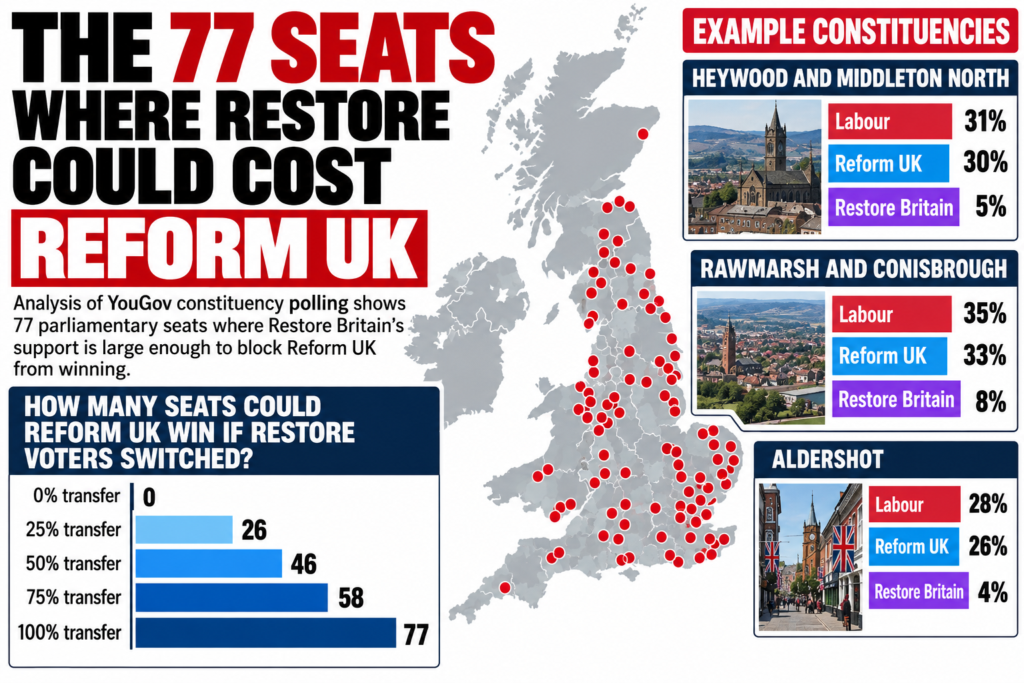
The potential consequences of this division were examined in a September 24 National Pulse analysis, which used constituency-level YouGov MRP polling to identify 77 parliamentary seats where Restore’s projected support was at least as large as Reform’s deficit to the projected winner.
Speaking with former British Prime Minister Liz Truss, The National Pulse Editor-in-Chief Raheem Kassam recently warned that Lowe’s party could inflict substantial electoral damage even without winning constituencies itself. “Seventy-seven seats, which is a significant number of parliamentary seats that they would effectively block Reform from winning,” Kassam explained.
The constituencies at risk include working-class communities, traditional Conservative Party strongholds, and former Labour heartlands where Reform has increasingly challenged the establishment parties.
“You’ve got a lot of East of England, a lot of working-class communities, a lot of old tourist towns, fisheries, and then you have some Red Wall seats in there as well,” Kassam said.
“Restore hasn’t really moved from hovering between six and eight percent since they launched,” he observed, arguing that the splinter party appeared to have reached a relatively firm electoral ceiling. “But that’s all they need to be spoilers,” he added.
If just 25 percent of Restore’s projected supporters transferred to Reform, the latter would move ahead in 19 additional constituencies and draw level in another seven on the rounded polling figures. At a 50 percent transfer, Reform would move ahead or draw level in 46 constituencies, rising to 58 at a 75 percent transfer. Transferring the entire Restore vote would put Reform ahead in 58 seats and level in another 19.
These scenarios illustrate the potential consequences of right-wing vote fragmentation under Britain’s first-past-the-post electoral system. In Heywood and Middleton North, for example, YouGov projected Labour on 31 percent, Reform on 30 percent, and Restore on five percent. Reform would need only one-fifth of Restore’s support to erase Labour’s projected advantage. In Rawmarsh and Conisbrough, Labour’s projected two-point lead over Reform could similarly disappear if just one-quarter of Restore’s eight percent support transferred to Farage’s party.
Kassam also suggested that a substantial portion of Restore’s electorate might eventually be persuaded to back Reform rather than risk another Labour or Conservative victory. “It can be done,” he told Truss, arguing that some Restore supporters were former Reform voters while others might be persuaded by the prospect of preventing an establishment victory.
Restoring Britain, or Saving the Establishment?
Restore Britain’s central electoral problem is becoming more and more apparent. The party has attracted major publicity, the richest man on Earth as a supporter, and its leader sits in Parliament, but its results suggest it is lacking the ability to go any further than a single MP elected on a Reform ticket.
Meanwhile, the potential consequences of its continued participation in competitive races could have a much larger effect on the outcome of the next general election. Farage’s Reform UK is attempting to displace Britain’s established political parties. Lowe’s “Restore Britain,” by contrast, risks dividing the very electorate that could make such a major realignment possible.
For all its promises to restore Britain, Musk’s preferred political project may ultimately be remembered less for the seats it won than for the seats it prevented Reform from winning.
If you want to help Raheem J. Kassam and his team keep bringing you original reporting, please JOIN THE NATIONAL PULSE or MAKE A DONATION today.
Join Pulse+ to comment below, and receive exclusive e-mail analyses.