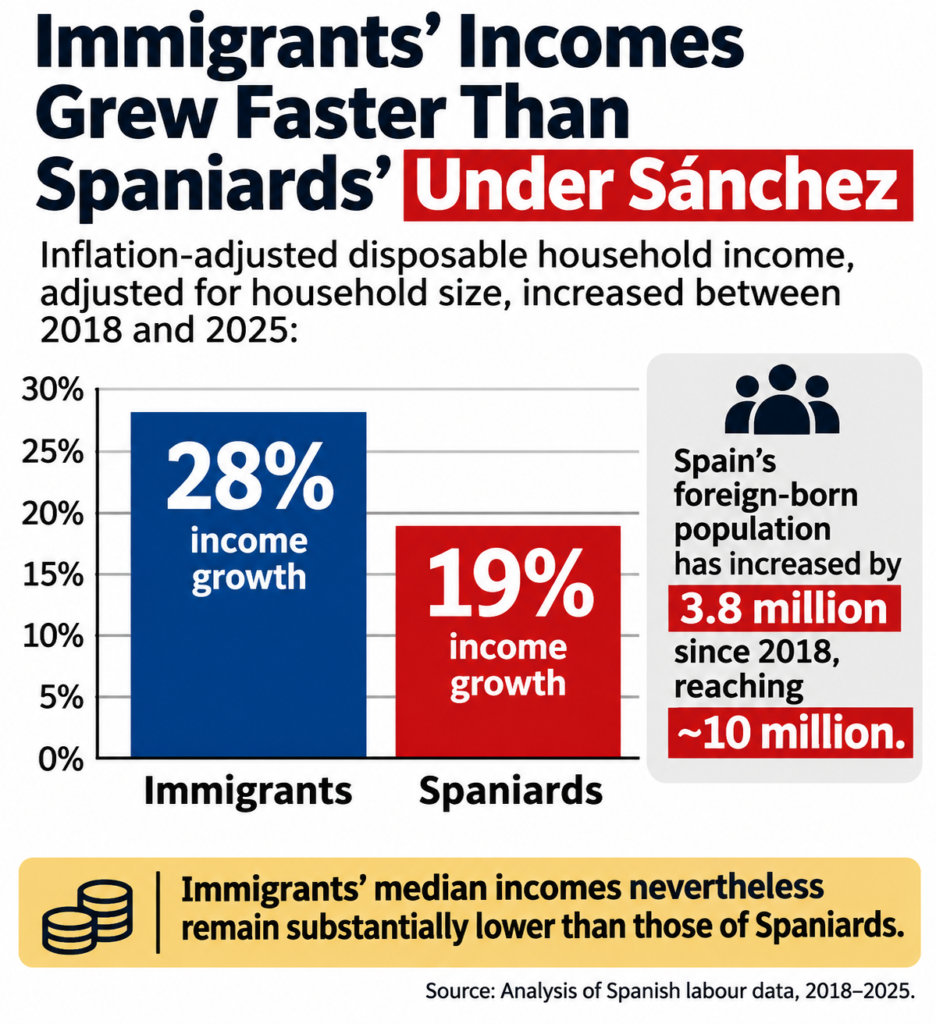
An analysis of Spanish economic data published this week found that inflation-adjusted disposable household income, accounting for household size, increased by 28 percent among immigrants between 2018 and 2025, compared with approximately 19 percent among Spaniards. Spain’s foreign-born population has increased by some 3.8 million since 2018, reaching approximately ten million.
The Economics of Mass Immigration.
Among the policies potentially contributing to the disparity is the Sánchez government’s aggressive expansion of the statutory minimum wage, which increased from €735.90 per month in 2018 to €1,184 in 2025, a nominal increase of nearly 61 percent.
Research by the Organisation for Economic Co-operation and Development (OECD) has identified minimum-wage increases as benefiting categories of workers including those born outside Spain. However, the broader picture for Spanish workers is less impressive. According to OECD employment data, Spanish real hourly wages remained 4.2 percent below their early 2021 levels in the first quarter of 2025.
While importing additional workers can increase the overall size of an economy, gains in gross domestic product (GDP) do not always translate into improvements in productivity, purchasing power, or individual living standards.
Spain’s Housing Crisis.
Perhaps nowhere are the limitations of Spain’s growth model more apparent than in its housing market, where construction has struggled to keep pace with population growth. The Bank of Spain estimated a housing shortfall of approximately 600,000 properties between 2022 and 2025. Between 2022 and 2024, Spanish authorities issued just 345,000 construction permits despite the creation of 604,000 additional households. The OECD identified immigration and increased household formation in urban and tourist areas as major factors driving housing demand, with rents rising faster than the incomes of many lower-income households.
The organization also found that the time required to save for a home had risen above 20 years. Even inflation-adjusted disposable income figures may fail to capture the full extent of the financial pressures confronting Spanish households after paying their rent or mortgage.
Foreign Criminality.
Public safety represents another dimension of Spain’s immigration debate. Official figures published by Spain’s National Statistics Institute in July revealed considerable disparities in criminal conviction rates between Spanish and foreign nationals.
In 2025, the adult criminal conviction rate among foreign nationals stood at 15.3 per 1,000 inhabitants, compared with 6.1 per 1,000 among Spanish nationals, approximately two and a half times higher. Foreign nationals accounted for 29.8 percent of adults convicted during the year.
Meanwhile, across all nationalities, the number of adults convicted of sexual offenses increased by 15.1 percent, despite a decline of 0.2 percent in overall adult convictions.
Sánchez Faces the Electorate.
The economic and social consequences of Spain’s rapid demographic transformation have become prominent issues ahead of Sunday’s general election, with both the conservative People’s Party (PP) and the populist-right Vox advocating tighter immigration restrictions.
The final national polling average, published Tuesday, puts the PP at 31.5 percent, Sánchez’s Socialist Workers’ Party (PSOE) at 29 percent, and Vox at 17.9 percent.
The November 22 GAD3 survey allocates 131 parliamentary seats to the PP, 110 to the Socialists, and 63 to Vox. Spain’s Congress of Deputies comprises 350 seats, with 176 necessary for an absolute majority. Vox secured just 33 seats in the 2023 general election.
Sunday’s election will be a political test of Sánchez’s economic record. For Spanish voters confronting rising housing costs, weak wage growth, and rapid demographic change, the government’s headline economic figures may not be enough to keep the socialist premier in power.