




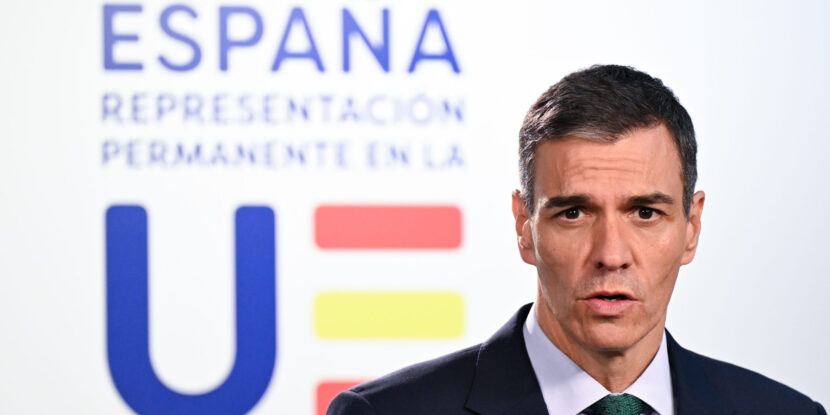

The Socialist Party government of Spain has collapsed, and Prime Minister Pedro Sanchez has called a snap election. Why has Sanchez’s leftist government collapsed, how did Spain get here, and what is likely to happen next?
The National Pulse keeps you updated on global affairs. If you value the work of Raheem J. Kassam and his team, please JOIN THE NATIONAL PULSE or MAKE A DONATION today.
Why Has The Spanish Government Collapsed?
Last week, Spain’s Congress of Deputies, the country’s equivalent of the United States House of Representatives, voted on two emergency housing policy decrees. The measures included extended protections against evictions, regulating temporary and room-by-room rentals, tenants’ rights, and measures to curb speculative pressures. The emergency decrees aimed to combat the country’s housing crisis, caused by rising costs and dwindling supply amid surging immigration.
Both decrees were defeated in the Congress of Deputies after Junts, a center-left party that supports independence for Catalonia, in northeast Spain, voted with the opposition against the government. Junts is one of several parliamentary parties whose support Sánchez needed to pass legislation. Following the 2023 Spanish general election, Sanchez’s party, the left-wing Spanish Socialist Workers’ Party (PSOE), did not secure enough seats to govern alone. As a result, Sánchez struck deals with Junts, the far-left Sumar coalition, and several minor regional parties, allowing him to form a minority government. This allowed PSOE to enter government even though the People’s Party (PP), Spain’s establishment center-right party, won the largest number of seats at the last election.
The Many Failures and Scandals of the Sánchez Government.
The defeat of the Spanish government’s proposed emergency decrees follows a series of high-profile controversies and policy failures. The first major controversy revolved around PSOE’s decision to grant amnesty to Catalan activists prosecuted for organizing an unconstitutional secession referendum and declaring independence in 2017. The decision was one of the concessions offered in exchange for support in the Congress of Deputies, leading many Spaniards to view PSOE as surrendering to forces intent on breaking apart the Spanish state just to preserve its own power.
Despite the deal between PSOE and smaller parties, Sánchez’s government has failed to pass a new national budget since the 2023 budget was approved in late 2022.
The Sánchez government has also been hit by a series of corruption scandals, including allegations surrounding pandemic-era procurement. Koldo García, an adviser and close associate of former Transport Minister José Luis Ábalos, was investigated over alleged kickbacks linked to Covid-era contracts for masks and medical equipment.
The investigation subsequently expanded to include senior PSOE figures, including Santos Cerdán, PSOE’s former organizational secretary and one of Sánchez’s closest allies and key parliamentary negotiators. Cerdán resigned in June 2025 after being implicated in an investigation into alleged commissions linked to public-works contracts, while denying any wrongdoing.
In June 2026, Spain’s Supreme Court convicted Ábalos and Koldo García over the corruption scheme, sentencing them to 24 years and three months and 19 years and eight months in prison, respectively.
Spain, SocioMétrica poll:
PP-EPP: 33% (-1)
PSOE-S&D: 27% (+1)
VOX-PfE: 18% (+1)
Sumar-LEFT|G/EFA: 5% (-1)
Podemos-LEFT: 3%
ERC-G/EFA: 2%
SALF-NI: 2%
EH Bildu-LEFT: 1%
Junts-NI: 1% (-1)
EAJ PNV-RE: 1%
BNG-G/EFA: 1%
CC-RE: 1%
UPN-*: 0%+/- vs. 05-06 August 2026
Fieldwork: 01-03… pic.twitter.com/za5YUNilA2
— Europe Elects (@EuropeElects) October 5, 2026
Family Business.
Even members of Sánchez’s family have been accused of corruption. In 2024, Begoña Gómez, Sánchez’s wife, was alleged to have used her position to obtain sponsorship and business support for a university program she directed. Gómez denied wrongdoing. In June 2026, she was called to stand trial, although the charges of alleged business corruption and misappropriation of funds were dropped, leaving her to face charges of influence peddling and embezzlement.
Also in 2024, David Sánchez, the Prime Minister’s brother, was investigated over allegations that he obtained a public sector position through nepotism. He also denied wrongdoing. In July this year, he was convicted of administrative prevarication (misconduct) and has since been barred from holding public office for nine years.
Putting Foreign Nationals First.
Since the Socialists came to power, the cost of rent in Spain has skyrocketed. As of October 2026, the cost of rent has reached roughly 99 percent of the average Spanish young person’s salary, according to Spain’s Youth Council.
Yet in April earlier this year, the Sanchez government approved a plan to grant amnesty to approximately 500,000 illegal migrants in the country. This was despite warnings from civil servants that the policy would overwhelm municipal government services. The actual number of migrants admitted under the scheme surpassed one million by the application deadline in late June.
Then in late July, tens of thousands of illegal migrants from Morocco rushed the border of Ceuta, a Spanish exclave a few miles from the European mainland on the coast of North Africa. The Ceuta crisis caused several European Union (EU) countries to suspend their free movement agreements with Spain and significantly damaged the Sanchez government’s credibility on border security, inviting criticism from around the world, including from the United States. It was followed by boat migrant landings on the coast of mainland Spain.
The National Pulse is 100% reader-funded. If you want to keep it that way, please JOIN THE NATIONAL PULSE or MAKE A DONATION today.
An Early General Election.
Deprived of a working majority in the House of Deputies, Sanchez called an early general election on Monday. It has been scheduled for November 29. According to SocioMétrica, a Spanish polling firm, PP is expected to secure 33 percent of the vote, roughly what it received in the last general election, while PSOE’s vote share will decline to 27 percent from the 32 percent it achieved in 2023. Early polling suggests that Vox, the eurosceptic, anti-mass migration populist party led by Santiago Abascal, is on track to significantly increase its vote share to 18 percent, having secured 12 percent at the last general election. Support for the Socialists’ Sumar allies has plummeted from the 12 percent it secured in 2023 to approximately five percent.
A poll by Sigma Dos, another Spanish polling firm, showed similar results. If trends hold, PP will secure 140 seats in the Congress of Deputies, up three from the last election. Meanwhile, PSOE is projected to secure 103 seats, down 18. Vox is projected to win 63 seats, almost doubling the 33 seats it won at the last election. Sumar is on track to lose most of its seats, plummeting to just nine, down 22 from the last general election. In order to wield a majority in the Congress of Delegates, a party requires 176 seats. Therefore, speculation is likely to grow regarding whether PP will seek an agreement with Vox or attempt to govern alone. While PP has historically preferred to govern without Vox at the national level, much as the establishment right shuts out the populist AfD in Germany, the two parties have increasingly cooperated at the regional level.
In June, PP leader Alberto Núñez Feijóo stated he would be prepared to form a coalition with Vox if the results required it.
🇪🇸 España · Encuesta elecciones generales
🟦 PP 32,6% (140)
🟥 PSOE 25,6% (103)
🟩 VOX 18,3% (63)
🟥 SUMAR 6,6% (9)
🟪 PODEMOS 3,3% (2)✅ Mayoría: 176
📊 Sigma Dos
📰 El Mundohttps://t.co/GbsIG5k6Ij— Electogrāfica (@electografica) October 4, 2026
If you want to help Raheem J. Kassam and his team keep you informed about Europe’s shifting political landscape, please JOIN THE NATIONAL PULSE or MAKE A DONATION today.
Image © European Union, 1998 – 2026.
Join Pulse+ to comment below, and receive exclusive e-mail analyses.












.jpg)


.jpg)


