Britain’s Prime Minister Andy Burnham has told the Labour Party’s annual conference that a return to full European Union membership is back on the table. “We could go all the way,” he said, alleging that Brexit had done “more harm than good.” Full EU membership means a return to the EU’s Free Movement migration regime, in which virtually any EU citizen can move to any EU country with almost no restrictions or vetting. The National Pulse has modeled the likely impact of this on immigration, and the results are staggering across high, middle, and low EU immigration scenarios.
The National Pulse built this immigration model using published assumptions and official baselines to give you a full picture of the potential consequences of reversing Brexit. This work takes time; to support it, please JOIN THE NATIONAL PULSE or MAKE A ONE-OFF DONATION.
The Starting Point.
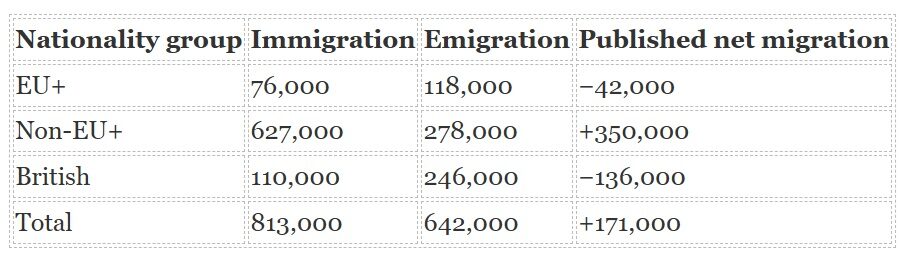
Significantly, the immigration status quo is already unmanageable, even after the unprecedented inflows of the “Boriswave” years under the former Conservative Party government. For the year ending December 2025, the Office for National Statistics (ONS) provisionally recorded 813,000 long-term arrivals and net immigration of 171,000. Non-EU+ nationals account for almost all of the inflow at present, with net negative migration from the EU+ (the EU plus Norway, Iceland, Liechtenstein, and Switzerland, which are also party to the Free Movement migration regime).
Compared with staying outside the EU, modeling suggests that, in a middle EU immigration scenario, Britain would take in an extra 82,000 migrants a year by year five, net, if it rejoined the bloc. Over ten years, the additional inflow totals 714,000. The high-immigration scenario is larger still: 200,000 extra migrants a year by year five, and 1.76 million extra over a decade.
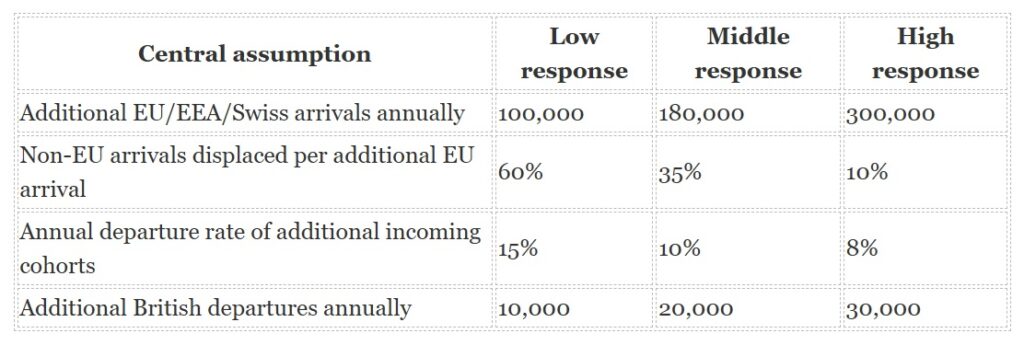
This means moves by Germany to naturalize migrants, and the pathway to citizenship created by Spain’s amnesty for illegal immigrants, for instance, could open up Britain to significant additional immigration of EU migrants who were originally from countries outside the bloc.
The Numbers.
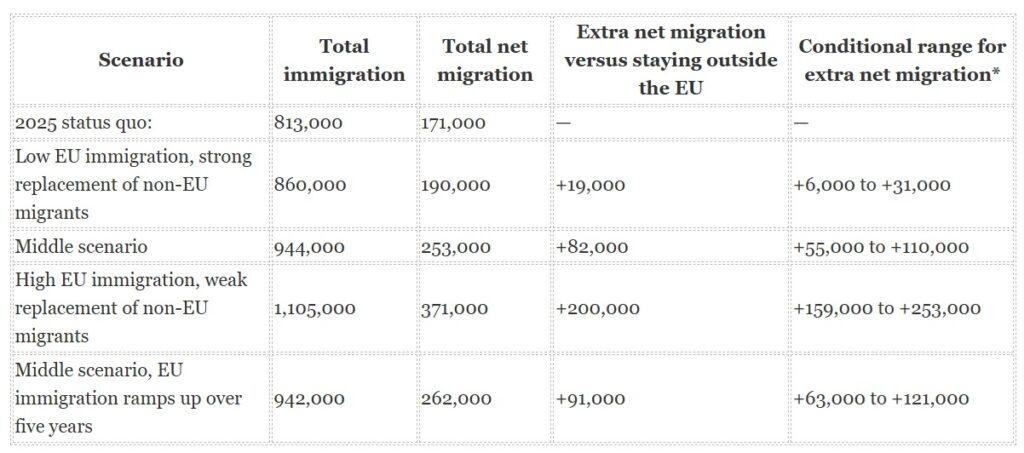
*Ranges span the middle 80 percent of 20,000 modeled simulations. They are not statistical confidence intervals.
The middle scenario may be the most important to consider. It shows total immigration climbing toward 944,000, with net immigration hitting 253,000. That is the “reasonable center” for Britain back in the EU, not an extreme scenario.
The high scenario—and immigration to Britain is usually significantly higher than projected—shows more than 1.1 million arrivals in a single year, with net immigration hitting 371,000, an extra 200,000 people a year against Britain’s baseline outside the EU.
Easier availability of EU migrant workers may result in the number of non-EU migrant workers falling, as accounted for in the low EU immigration, strong replacement of non-EU migrants scenario. However, if employers keep hiring from outside Europe at today’s pace and regain easy access to a large EU labor pool, the two streams will stack. That is how a country already taking in 627,000 non-EU immigrants a year ends up facing seven-figure inflows.
Importantly, there is scant evidence of increases in EU immigration causing non-EU immigration to fall in the years prior to the Brexit referendum, with an increase in EU immigration from roughly 201,000 to 284,000 from 2013 to 2016 being accompanied by a rise in non-EU immigration from 248,000 to 289,000 over the same period.
The National Pulse provides the public with original immigration and election analysis without billionaire backers or political patrons. If you want to keep this work radically independent, please JOIN THE NATIONAL PULSE or MAKE A DONATION. We are 100% reader-funded.