President Donald J. Trump is making moves to tie congressional representation to the total number of citizens and legal immigrants living in each state, with illegal aliens discounted. New polling data reveals that a majority of Democrat voters are in favor of changing the current system.
Under the current system, the number of seats in the House of Representatives for each state is determined by the state’s population, including not just citizens and legal immigrants, but also illegal aliens. Crucially, this gives extra seats to states with high concentrations of illegals and noncitizens, which are often centered in Democrat sanctuary cities.
A new Census Bureau proposal, released on September 10, seeks to radically change the existing structure by counting only citizens and lawful permanent residents when determining a state’s population for the purpose of congressional apportionment in the next census in 2030.
President Trump has been arguing for changes to the system since his first term, noting in 2020 that the current system essentially encourages and rewards states that allow violations of U.S. immigration law by counting illegal aliens in the census and increasing their power in Congress.
Under the 14th Amendment, congressional seats are detemined by the “whole number of persons in each State” but, the Trump administration has consistently argued that while in practice that has counted noncitizens and illegals, the amendment itself “does not specifically define which persons must be included for the purposes of apportionment and requires only that Representatives be apportioned according to what has long been understood to mean the ‘inhabitants’ of each State.”
Even Democrat Voters Support the Change.
Polling released on September 30 by McLaughlin & Associates reveals that of 1,000 likely voters, 65 percent support President Trump’s proposed changes to the congressional apportionment base. The highest support, 80 percent, comes from Republicans, but even a majority of Democrats, 54 percent, agree with the changes.
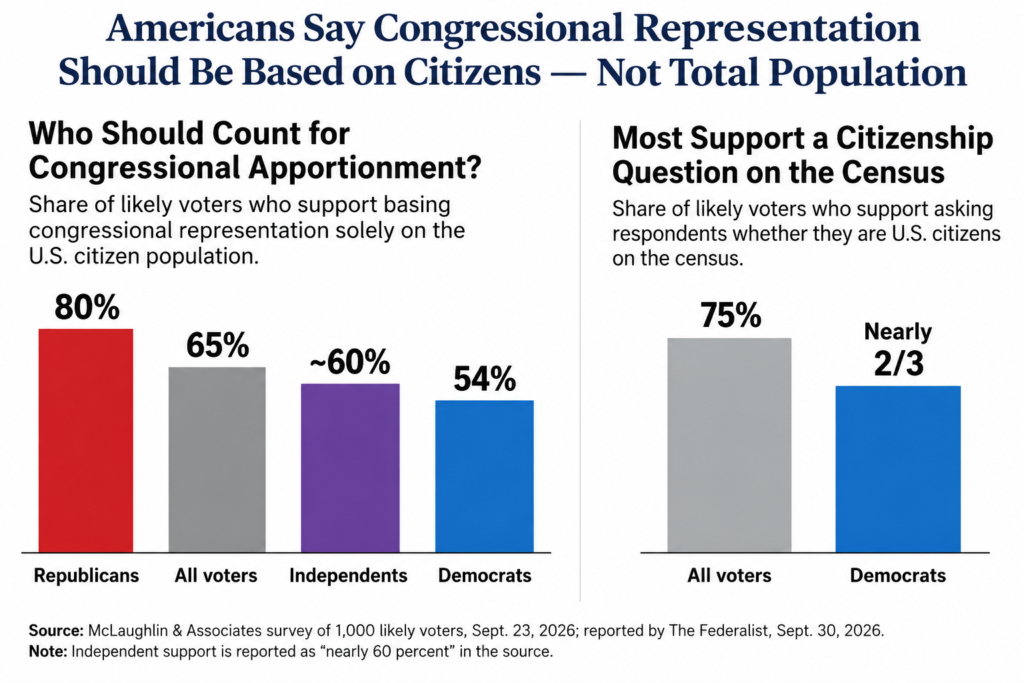
The results of the polling also revealed that 75 percent of voters believe that those responding to the census should indicate whether or not they are citizens of the United States, a question that would make it much easier to allocate congressional seats under Trump’s proposed changes.
Democrat Politicians Admit Counting Illegals Benefits Them.
Some Democrat politicians have been quite open and frank about how counting illegal aliens in their areas benefits them in the form of redistricting.
In 2021, Democratic New York Rep. Yvette Clarke made a case for resettling Haitian migrants in her district, saying, “I need more people in my district, but just for redistricting purposes,” during a meeting of the House Foreign Affairs Committee.
Democrat Yvette Clarke said the quiet part out loud. They want to flood our country with illegals just for redistricting. This is why they want open borders! pic.twitter.com/VxtRoe23Yw
— Heritage Action (@Heritage_Action) April 19, 2026
How Trump’s Reform Could Affect the States.
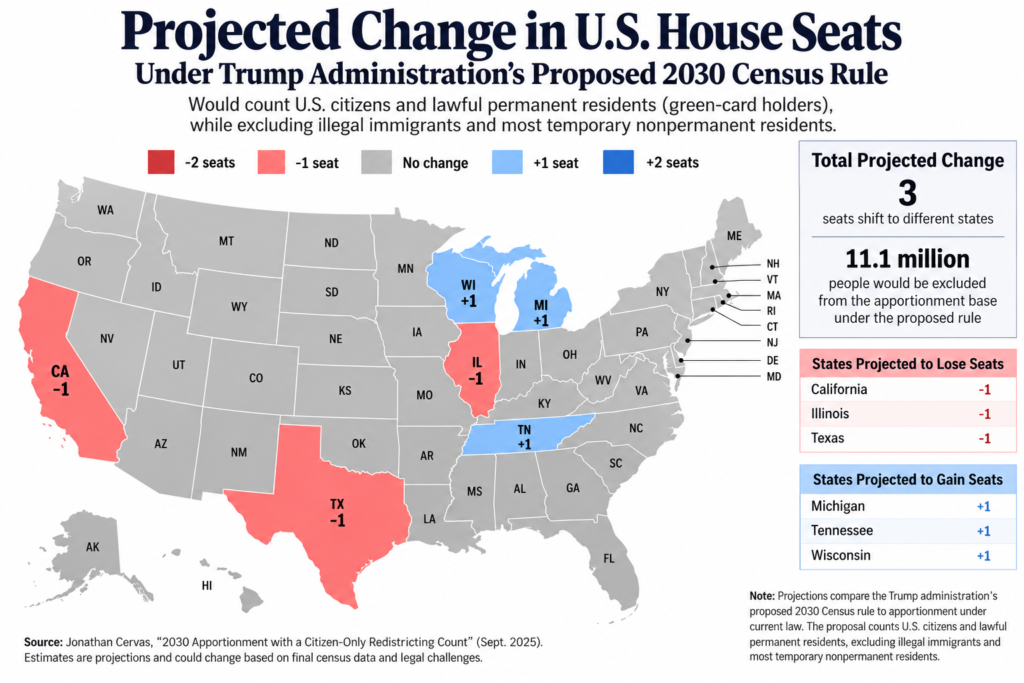
Given that the changes will only be made to the 2030 census, Trump’s policy will have no immediate effect on Congress and will have no impact on the upcoming midterm elections in November. However, projections have been estimated by redistricting researcher Jonathan Cervas, who published an independent study suggesting that California, Illinois, and Texas would each lose a seat, while Michigan, Tennessee, and Wisconsin would each gain a seat.
Cervas states that overall, the policy would likely benefit Republicans, as the seats gained are in states that voted for President Trump in 2024, even though, because of its high population of illegal aliens, the Republican stronghold of Texas would lose a seat. California, projected to lose a seat according to Cervas’s projections, was already set to lose seats by 2030 due to population trends, with many leaving the state in recent years due to high taxes, housing costs, and a generally high cost of living.
A citizen-only policy, which goes beyond the Trump administration’s proposal to apportion seats based on citizens and legally resident foreigners, would have far different results, and give Republicans a far clearer advantage, according to projections from the American Redistricting Project.
Under a citizen-only counting system, blue states would lose the most seats, with California losing six seats instead of one, New York losing two, Illinois losing one, and New Jersey and Rhode Island each losing one. Florida and Texas would gain two seats, and Ohio, North Carolina, Tennessee, Georgia, Idaho, Utah, and Arizona would all gain a seat each.