




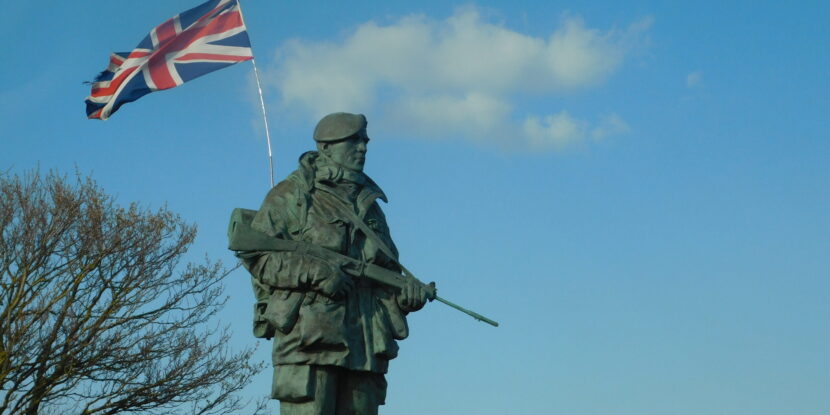

The Falkland Islands are British. They have been British for 260 years. Yet this has not stopped successive governments in Argentina from repeatedly claiming sovereignty of the southern Atlantic islands. President Javier Milei has become just the latest Argentine leader to claim the islands, referred to as “Las Malvinas” in Argentina, at the latest United Nations General Assembly in Manhattan.
The National Pulse publishes original international analysis to help you understand the political landscape worldwide. If you value this work, please JOIN THE NATIONAL PULSE or MAKE A DONATION today. We are 100% reader-funded.
Milei’s newest claim to the islands includes threats of international legal action over the development of an offshore oilfield named Sea Lion, which lies north of the islands and nowhere near Argentina’s national waters, more than 400 miles from the Argentine coast. Discovered in 2010, the oilfields are currently being developed, with extractions of around 50,000 barrels of oil per day scheduled to begin in 2028.
“If in 2 weeks the United Kingdom does not halt the illegitimate exploitation, we will go to the International Tribunal for the Law of the Sea. THE MALVINAS ARE ARGENTINE, and they are defended with facts, not words,” Milei wrote on X on September 28.
Yet despite Milei’s claims, the history of the Falklands, from the first European to discover them until today, shows they are fundamentally British in character.
Found By an Englishman and Named By an Englishman, After An Englishman.
English navigator John Davis is widely considered the first European to ever set eyes on the Falklands in 1592, although it was not until nearly a hundred years later, in 1690, that English captain John Strong actually landed on the remote islands. Strong was the one to name them the Falklands, after Anthony Cary, the 5th Viscount Falkland, who served as a Member of Parliament at the time.
Settlements on the island were not established until the latter part of the 18th century, with France establishing Port Louis on East Falkland in 1764. Britain asserted possession of West Falkland for King George III in 1765, establishing Port Egmont a year later. France later gave up its settlements in the Falklands, handing them over to Spain, which managed to briefly expel the British in 1770. The British returned shortly after, but left again in 1774 due to economic issues.
Argentina, during this time, did not exist as an independent state, and was still part of the enormous Spanish Empire in Latin America. Spain abandoned the Falklands in 1811, and Colonel David Jewett, an American-born mercenary, claimed them for the United Provinces of the River Plate in 1820. The United Provinces included modern-day Argentina, but it was not an exact predecessor state, including portions of other modern-day countries, including all of Uruguay and southern Bolivia.
Britain maintained that the Falklands remained British and sent a warship to the islands in 1833, expelling the Argentine military garrison that had been placed there a year prior. Argentina has claimed that Britain also expelled civilians, but British sources indicate that the majority of the just 30 or so people living in the Falklands at the time stayed there.
An agreement was signed by both Argentina and Britain in 1850 settling the differences between the two nations over issues like the Falklands. This peace was to last nearly a hundred years, with only one diplomatic complaint by Argentina about the islands in 1888. Britain’s rule was unquestioned, and virtually the entire resident population of the Falklands was British.
A Failing State Declares a Hopeless War.
After the Second World War, aside from giving refuge to some of the most notorious members of Hitler’s Third Reich, Argentina became plagued with government instability. This occurred particularly following the death of President Juan Peron in 1974. Peron, who is still seen as a major political figure in Argentina and a source of inspiration for many of its presidents, had been overthrown in 1955, but returned to power in 1973 after almost two decades in exile, only to die a year later.
By the 1980s, the country was no longer ruled by a charismatic strongman like Peron, but a military junta of assorted generals and admirals who had overthrown Peron’s wife, Isabel Peron, in 1976. Under the junta, Argentina’s economy deteriorated sharply, with runaway inflation and a severe recession in 1981.
On April 2, 1982, seeking to shore of support, the junta decided to invade the Falkland Islands.
The National Pulse is RADICALLY INDEPENDENT, bringing you original news and analysis free of corporate influence. To keep our work independent, please JOIN THE NATIONAL PULSE or MAKE A DONATION today.
The Royal Navy Sails to Victory.
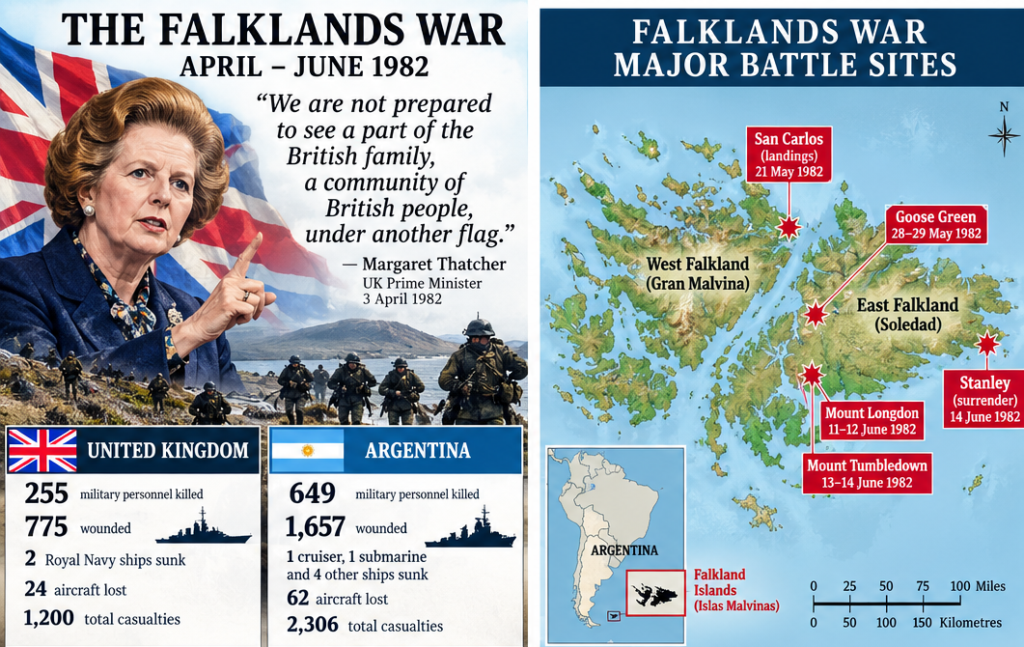
Shortly after the Argentine invasion, the United Nations Security Council passed Resolution 502, demanding that Argentina leave the islands. When this was ignored, British Prime Minister Margaret Thatcher dispatched a large naval task force on a voyage of around 8,000 miles. The British declared an exclusion zone around the islands, warning the Argentine navy to stay out of it.
On May 2, the British nuclear-powered submarine HMS Conqueror fired three Mark 8 torpedoes at the Argentinian cruiser ARA Belgrano, a former American naval vessel from the Second World War. Two struck the ship, sinking her and killing 323 sailors on board, a full half of Argentina’s total military deaths during the conflict. While some argued that the ship had not been in the exclusion zone, the British navy countered, saying the Belgrano had been part of a pincer movement against British forces. Regardless, the sinking led to Argentina removing nearly all of its surface fleet from the theatre for the remainder of the war. In retaliation, the Argentinians sank the British destroyer HMS Sheffield on May 10, using French-made Exocet missile systems. Twenty British sailors died.
British forces finally landed on the Falklands proper later in May, making amphibious landings from May 21 to 25. On May 28, British forces fought a decisive battle at Goose Green, and later surrounded the Falklands’ occupied capital, Port Stanley, on June 11. Just days later, on June 14, Argentine forces surrendered, returning the islands to Britain and liberating the local population.
On July 3, 1982, Prime Minister Thatcher addressed the victory, saying:
When we started out, there were the waverers and the fainthearts. The people who thought that Britain could no longer seize the initiative for herself.
The people who thought we could no longer do the great things which we once did. Those who believed that our decline was irreversible—that we could never again be what we were.
There were those who would not admit it—even perhaps some here today—people who would have strenuously denied the suggestion but—in their heart of hearts—they too had their secret fears that it was true: that Britain was no longer the nation that had built an Empire and ruled a quarter of the world.
Well they were wrong. The lesson of the Falklands is that Britain has not changed and that this nation still has those sterling qualities which shine through our history.
The Men (and Women) Who Cry ‘Malvinas.’
Since the British victory in the Falklands War, multiple Presidents of Argentina have addressed the Falkland Islands and their sovereignty. This tends to occur when Argentina faces severe domestic problems, such as hyperinflation or a recession. Former President Cristina Fernández de Kirchner is the best-known, claiming the Falklands were a “colonialist enclave” in 2012. Fernández went even further in 2011, convincing other Mercosur (a trading bloc of South American nations) members to refuse to allow vessels with the Falkland Islands flag into their ports.
The escalation from President Kirchner was the greatest since the buildup to the Falklands War, and in response, Britain took steps to put an end to the question of sovereignty: they asked the Falklanders what they wanted.
The Falklanders Choose Britain.
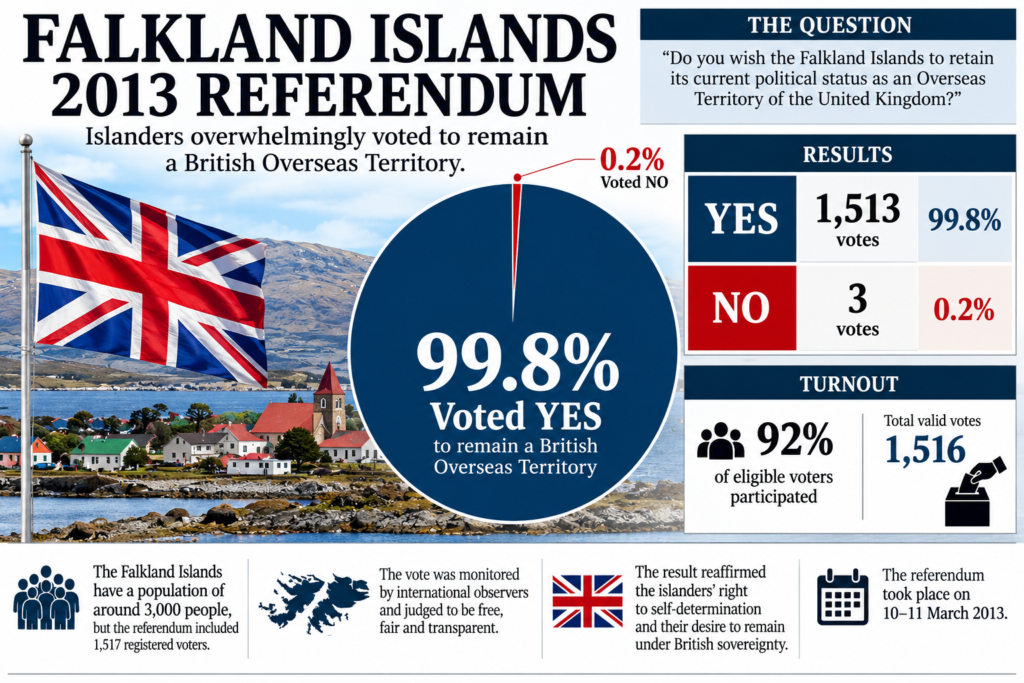
In March 2013, the Falkland Islands held a vote on whether the residents wanted to remain part of Britain as an Overseas Territory. With a turnout of 92 percent, the vote was 1,513 to three. This 99.8 percent vote to remain British remains one of the most lopsided votes on such a question in the 21st century.
“I’m very happy. Everyone has come together to express ourselves. I think this is massively significant. It’s important to show how much we want to stay British,” Falklander Kyle Buiggs said at the time. Another local resident, Barry Nielsen from Stanely, said, “We are British and that’s the way we want to stay.”
Argie Bargie.
In response to the referendum vote, President Kirchner at the time simply said that the views of the island residents did not matter. The current President, Javier Milei, believes the same thing, and has explicitly stated the vote does not count, accusing the Falklanders of being colonists.
As with the junta, Milei’s rallying cry of “Las Malvinas” comes amid economic crisis and declining popularity at home. For Milei, like so many other Argentinian leaders, the islands are just a distraction from failure.
If you want to help Raheem J. Kassam and his team deliver high-quality analysis from around the world, please JOIN THE NATIONAL PULSE or MAKE A DONATION today.
Join Pulse+ to comment below, and receive exclusive e-mail analyses.














.jpg)


