




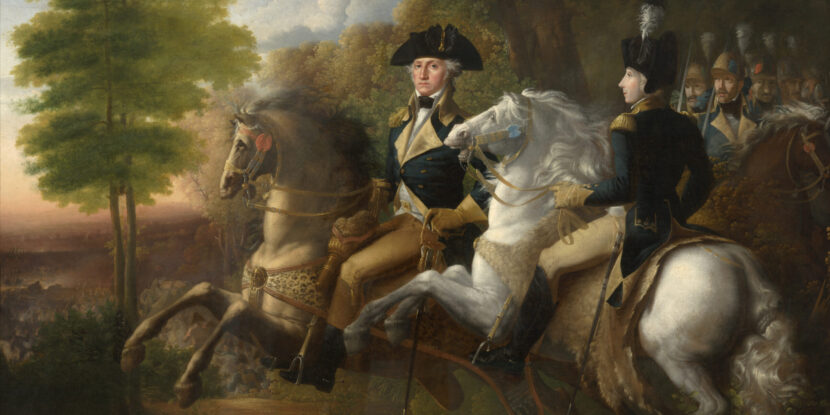

As the United States celebrates its semiquincentennial, popular memory naturally turns toward the triumphant moments in the Revolutionary War—moments like George Washington crossing the Delaware, the British surrender at Saratoga, and the decisive victory at Yorktown. Yet some of the greatest chapters in the story of America are not the Patriots’ victories, but the survival of their fragile experiment in the dark autumns of the late 1770s.
The National Pulse publishes original work on the history and culture of the West, as well as politics and current affairs. If you value it, please JOIN THE NATIONAL PULSE or MAKE A DONATION today. We are 100% reader-funded.
Yesterday, for instance, was the anniversary of some of the lowest moments of the Revolution in 1776 and 1777, marked by crises of faith and governance. One saw Washington in despair, the other saw the physical eviction of the Continental Congress from its capital. Yet these low moments became the catalysts that forced a fractured alliance of thirteen colonies to organize their fledgling country under its very first constitution.
September 30, 1776: Washington Hits Rock Bottom.
By the final day of September 1776, General Washington was trapped in a nightmare. In the preceding weeks, the British had smashed the Continental Army at Long Island, seized Manhattan, and sent the Americans into a disorganized, demoralized retreat. Raw militia forces were panicking and fleeing the field at the mere sight of the redcoats. Supplies were virtually exhausted, and the army was on the verge of melting away as winter approached.
Pushed to his limits, Washington sat down on September 30, 1776, to write a deeply candid, private letter to his cousin, Mount Vernon estate manager Lund Washington. “In confidence I tell you that I was never in such an unhappy, divided state since I was born,” he wrote, confessing that he was “wearied to death all day with a variety of perplexing circumstances.” The Commander-in-Chief feared his reputation would be ruined by an army incapable of standing its ground, yet he knew he could not resign: “If I fall, I shall fall with a property that will give me no respectability… and yet, if I do not satisfy the public expectation, I must expect to be the scapegoat,” he said.
The general turned the remainder of his letter to providing meticulous instructions on how to repair the fireplaces and chimneys at Mount Vernon, an escape for a man who genuinely believed he might be facing the ruin of his cause.
September 30, 1777: The Continental Congress Is Exiled.
A year on, the crisis had reached through the military front lines and into the halls of government. Following a crushing victory at the Battle of Brandywine, the British Army under General William Howe successfully outmaneuvered Washington and marched into Philadelphia.
The capital had fallen. The delegates of the Continental Congress were forced to pack their legislative papers onto wagons and flee into the countryside in the dead of night. On September 30, after days of exhausting travel, the fugitive delegates crossed the Susquehanna River and reassembled in the small, frontier town of York, Pennsylvania. Gathering in the modest brick courthouse, they declared York the temporary capital of the United States. They were a government in exile, isolated and operating entirely on a handshake agreement between thirteen separate, sovereign states.
The National Pulse publishes original political, economic, and data analysis alongside historical retrospectives. If you value the work of Raheem J. Kassam and his team, please JOIN THE NATIONAL PULSE or MAKE A DONATION today.
The Articles of Confederation.
It was the sense of fragility created by this flight into exile, perhaps reinforced by the memory of Washington’s near-collapse a year prior, that altered the mindset of the delegates in York. For more than a year, Congress had bickered and stalled over how to formally bind the colonies together. Big states argued with small states over voting power; Northern merchants clashed with Southern planters over taxation and Western land claims.
But as the delegates looked around their cramped, temporary quarters in York, resolve hardened. They realized that a loose association of independent states could not survive a war against a global empire. They needed foreign alliances—specifically with France—and European powers would not sign treaties or lend millions to a rogue committee of politicians in hiding. They needed a legitimate, legally recognized government.
Spurred by the desperation of their situation, Congress threw themselves into the stalled draft of a national constitution. Working through the bitter cold of that autumn in York, the delegates compromised on state sovereignty, representation, and war powers.
Less than two months after arriving as fugitives, on November 15, 1777, the Congress officially adopted the Articles of Confederation and Perpetual Union.
The Legacy of the Dark Autumn.
The Articles of Confederation were imperfect. To avoid creating a new tyranny like the British monarchy, the writers created a central government that was unable to levy taxes directly or easily enforce national laws. A decade later, it would be replaced by the current U.S. Constitution.
Nevertheless, the Articles were an enormous step forward out of the dark autumns of 1776 and 1777. They legally transformed a rebellious colonial alliance into a singular political entity recognized by international law. They provided the legal framework that kept the army funded, secured the French alliance, and guided the nation to victory at Yorktown.
The United States was not forged in a moment of easy triumph. It was hammered out in a drafty courthouse by fleeing politicians, under the protection of a Commander-in-Chief who was wearied to death, but refused to give up.
If you value the work of Raheem J. Kassam and his team, please JOIN THE NATIONAL PULSE or MAKE A DONATION today. We are 100% reader-funded.
Join Pulse+ to comment below, and receive exclusive e-mail analyses.























.jpg)


