




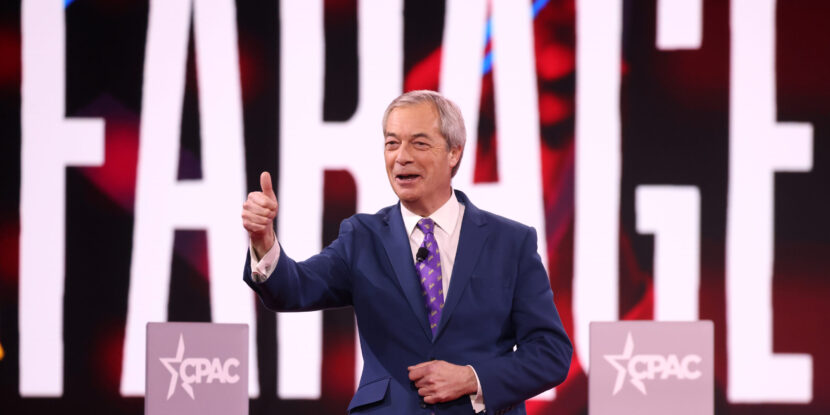

For over a quarter of a century, the political establishment and the corporate media have tried to convince the public, and themselves, that Nigel Farage is a temporary anomaly. Yet time and again, the undisputed godfather of Brexit and British populism has defied their expectations.
The National Pulse brings you deeply researched news and analysis from around the world with no corporate or government backing. If you want to help keep us RADICALLY INDEPENDENT, please JOIN THE NATIONAL PULSE or MAKE A DONATION today.
Here are seven times Nigel Farage rewrote the rules of Western politics:
2009: Breaking the Two-Party Monopoly.
Before the 2009 European Parliament elections, the conventional wisdom dictated that third parties in the United Kingdom were relegated to perpetual protest status. Operating within a tightly controlled media environment, the UK Independence Party (UKIP) under Farage weaponized the European stage to bypass the Westminster gatekeepers.
Earning 13 Members of the European Parliament (MEPs), Farage achieved a historic first and pushed then-Prime Minister Gordon Brown’s governing Labour Party into a humiliating third place. It was a tremendous breakthrough; just two election cycles prior, UKIP secured just one percent of the national vote. It was the first structural crack in Britain’s century-old Labour-Conservative duopoly, proving that a disciplined populist message could break the establishment’s grip.
2014: The First Nationwide Victory for an Insurgent Party.
If 2009 proved the duopoly could be wounded, 2014 proved they could be beaten outright. Farage marched UKIP into the 2014 European Parliament elections and secured an outright nationwide victory, taking 24 seats and 27.5 percent of the vote.
This was an electoral earthquake. It marked the first time since December 1910 that a party other than Labour or the Conservatives had won the popular vote in a nationwide British election. Farage had taken a fringe independence movement and transformed it into the most potent electoral force in the country, completely upending the institutional calculus in London.
The 2014 By-Elections: Forcing Cameron’s Hand.
The Westminster commentariat insisted that Farage’s success was confined to Brussels and could never translate to the First Past the Post (FPTP) system used to elect national lawmakers to the House of Commons. Farage killed this myth by orchestrating high-profile defections to UKIP by Conservative Members of Parliament (MPs) Douglas Carswell and Mark Reckless.
In the subsequent Clacton and Rochester & Strood by-elections (special elections), Farage’s ground game delivered two devastating blows, securing UKIP’s first-ever parliamentary election victories. Terrified of a total collapse on his right flank as he led a fragile coalition government, Conservative Prime Minister David Cameron was panicked into formally promising the public a referendum on leaving the European Union in his 2015 election platform.
2016: Defeating the Globalists.
On June 23, 2016, Farage achieved his most impossible victory. The campaign to keep Britain inside the European Union deployed the full force of “Project Fear.” Farage faced down the entire British state apparatus, the leadership of every major political party, corporate boardrooms, the BBC, international banking cartels, and even the direct intervention from U.S. President Barack Obama.
Against all odds, the British public voted for Brexit. Farage’s decades-long crusade successfully severed Britain from the bureaucratic clutches of Brussels. Within hours, David Cameron resigned in disgrace, his political career permanently extinguished by the populist wave Farage had spent a lifetime building.
Writing and researching political deep dives takes time and resources. If you value the work of Raheem J. Kassam and his team and want to support it, please JOIN THE NATIONAL PULSE or MAKE A DONATION today.
2019: The Six-Week Resurrection That Saved Brexit.
By 2019, the Westminster “uniparty” had successfully gridlocked the Brexit implementation process, deliberately attempting to dilute and derail the 2016 mandate. Believing Farage was safely retired, Prime Minister Theresa May—who had voted to remain in the EU—assumed Farage, who had retired as UKIP leader after his referendum win, was now a spent force.
She was wrong. In an unprecedented display of political agility, Farage launched the Brexit Party from scratch. Within a staggering six-week window, he built a nationwide infrastructure that wiped the floor with the establishment parties in the 2019 European Parliament elections. The sheer force of this electoral execution shattered the legislative deadlock, forced the near-immediate resignation of Theresa May, and compelled the Conservative Party to finally deliver Brexit.
2024: Cracking the Westminster First-Past-the-Post Barrier.
For years, establishment media figures mocked Farage for failing to win a Westminster seat, relying on the structural biases of Britain’s national elections to keep him out. But in 2024, with the Brexit Party having been transformed into Reform UK, Farage mounted a high-velocity campaign that shattered the Westminster glass ceiling once and for all. In 2019, the Brexit Party had stood down in constituencies held by the Conservatives on a promise that they would “get Brexit done,” even though the Conservatives refused to reciprocate in Labour-held seats where the Brexit Party had the better chance of winning.
Farage was comfortably elected as the MP for Clacton, leading a disciplined vanguard of Reform MPs directly into the House of Commons. By establishing a permanent beachhead inside the palace walls, Farage proved that Reform was not just a pressure group, but could become a legitimate government-in-waiting. The Conservatives, who had delivered a half-measures Brexit and record-breaking immigration, hemorrhaged voters to Farage’s party and suffered their worst defeat in a century.
Post-2024: Toppling Starmer and Topping National Polls.
Following the 2024 elections, which saw Labour return to power on a low turnout after years of Conservative failure on Brexit and immigration, Reform first displaced the centuries-old Conservatives as Britain’s leading right-wing party and then began regularly topping national opinion polls, drawing massive support from both disillusioned working-class Labor voters and abandoned Conservatives.
The tipping point arrived during the English local elections in 2026, where Reform inflicted historic losses on the incumbent Labour Party. Suffering catastrophic losses in former industrial strongholds, the sheer scale of the Reform surge induced an immediate leadership crisis within Labour, ultimately toppling Prime Minister Sir Keir Starmer from power. He was at least the third prime minister to be brought down by Farage; arguably the fourth, including Rishi Sunak in 2019.
The Future.
Farage about to take the stage. Don’t miss this. https://t.co/y5wBcRFN6T
— Raheem J. Kassam (@RaheemKassam) October 1, 2026
Institutional panic over the rise of Reform is palpable, and the establishment’s playbook is becoming increasingly transparent. According to data analyzed by The National Pulse using recent YouGov MRP figures, corporate-backed splinter parties—such as the Rupert Lowe-led, Elon Musk-backed “Restore Britain”—fail to win a single seat of their own in a general election, but threaten to split the right-leaning vote just enough to hand dozens of seats back to the left-leaning uniparty.
Yet history shows that artificial, top-down political experiments can rarely duplicate the organic success of movements like Farage’s. As Britain prepares for its next constitutional turning point, the data makes one thing clear: betting against Nigel Farage is a losing proposition.
To keep independent reporting at The National Pulse alive, we need your support. Please JOIN THE NATIONAL PULSE or MAKE A DONATION today. We are 100% reader-funded.
Join Pulse+ to comment below, and receive exclusive e-mail analyses.












.jpg)


