




Spain could be on the verge of a dramatic reversal of its mass immigration policies, with the November 29 general election threatening to bring down Socialist Prime Minister Pedro Sánchez and deliver power to a right-wing coalition determined to dismantle his immigration legacy.
The National Pulse team strives to give you in-depth news and analysis. To help Raheem J. Kassam and his team continue this work, please JOIN THE NATIONAL PULSE or MAKE A DONATION. We are 100% reader-funded.
A new investigation reveals that the right-wing populist Vox party could become a kingmaker following the election, potentially forcing the center-right People’s Party (PP) to adopt sweeping restrictions on immigration, deportations, and access to public services.
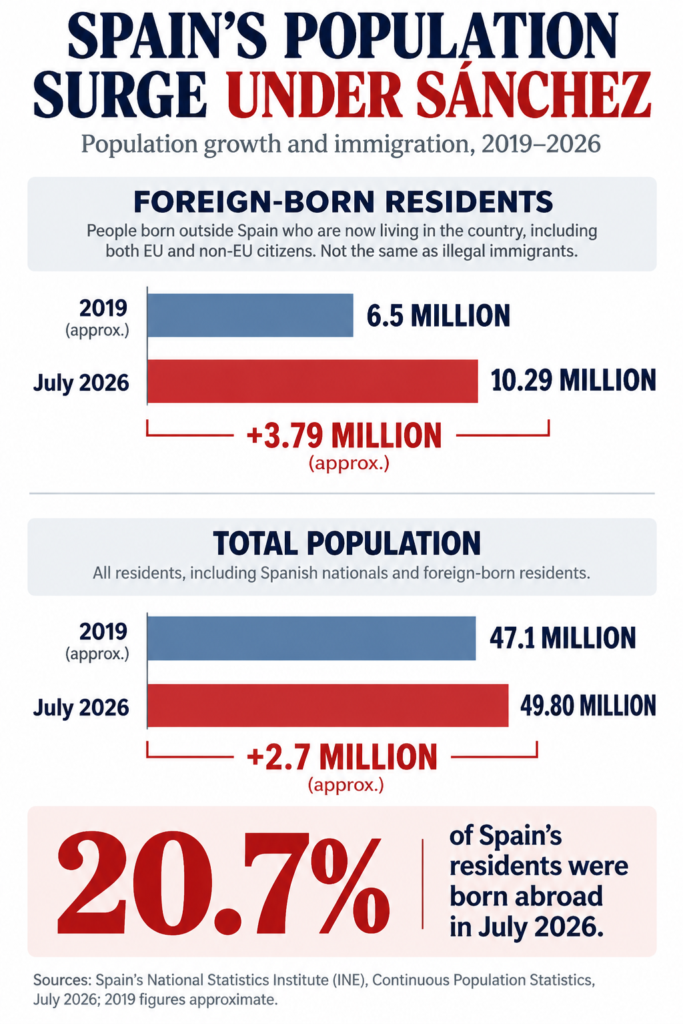
Since 2019, Spain’s foreign-born population has exploded by approximately 3.5 million, reaching more than 10 million. Sánchez has celebrated mass immigration, but critics argue that the influx has worsened an already severe housing crisis and increased pressure on public infrastructure.
Now, Spanish voters could be preparing to reject one of Europe’s most pro-immigration regimes and vote in the most right-wing government in decades.
Nearly a Decade of Continual Mass Migration.
Spain’s demographic transformation under Sánchez has been extraordinary. According to the country’s National Statistics Institute (INE), the foreign-born population surpassed 10 million at the beginning of 2026. By July, approximately 20.7 percent of Spain’s residents had been born in another country.
The Sánchez government has encouraged immigration to address alleged labor shortages, sustain economic expansion, and offset Spain’s aging population and low birth rate.
Its most controversial initiative came in 2026, when the government launched a large-scale amnesty offering residency and work authorization to illegal immigrants already living in Spain. According to official government figures, the program received 1,174,978 applications by its June 30 deadline, more than twice the government’s original expectation of approximately 500,000.
The program generally requires applicants to show that they were present in Spain before January 2026 and had resided there continuously for at least five months. Qualifying applicants could receive one-year residency and work permits.
The Cost of Sánchez’s Economic Growth.
Sánchez has defended his immigration policies by claiming Spain has had a relatively strong economic performance under his reign. Spain’s economy has outperformed several major European competitors, while foreign workers have helped expand employment in hospitality, construction, retail, and other industries.
However, the distinction between total economic growth and improving living standards is increasingly important for Spaniards. A recent economic analysis found that Spain’s GDP had increased approximately 15 percent since late 2021, with annual economic growth running at around 2.5 percent. Yet GDP per capita has grown more slowly as the population has expanded.
Spanish house prices, meanwhile, have increased approximately 26 percent over two years, while social housing represents just 3.4 percent of the market. Residential construction has struggled to accommodate population growth via mass migration, contributing to worsening affordability, particularly for younger Spaniards. Limited construction, planning restrictions, and inadequate investment have also constrained supply.
The government’s argument that immigration benefits public finances is also not the whole picture. Migrant workers may contribute taxes and social security payments, but population growth simultaneously increases demand and costs for healthcare, education, transport, and housing.
Vox Plans to Reverse the Sánchez Era.
The November election could give the right-wing populist Vox party major influence over Spain’s immigration system if they enter a coalition government. According to election analysis, the People’s Party and Vox are the only combination currently projected to command an outright parliamentary majority.
Vox has been polling around 18 percent, while the PP has maintained a lead over Sánchez’s Socialists. Led by firebrand Santiago Abascal, Vox is demanding mass deportations, stricter immigration enforcement, and policies prioritizing Spanish citizens’ access to certain public services. The party also wants to examine whether the legal status granted through Sánchez’s regularization program could be revoked, undoing the mass amnesty.
Vox has already used its influence in regional governments to advance policies favoring residents with longstanding ties to their areas, something that could carry over to the national level.
However, a conservative coalition government would face considerable obstacles in attempting to reverse the Sánchez disaster. People who have already acquired lawful residency possess legal protections, while deportations require individual procedures and cooperation from receiving countries. Constitutional equality guarantees and European law could also constrain attempts to restrict access to public services.
A PP–Vox coalition could tighten future immigration, restrict eligibility for residency, and pursue more deportations. Reversing the demographic changes of recent years would be considerably harder due to judicial pressures and the European Union.
A New Spain for the Old Spaniards is Possible.
Spain’s election is becoming a referendum on whether mass migration has actually helped the average Spaniard, rather than just a larger GDP number.
Prime Minister Sánchez’s opponents argue that any economic achievements mean little if housing becomes unaffordable and public infrastructure cannot keep pace with population growth due to mass migration.
A conservative victory, meanwhile, could represent one of Europe’s most significant immigration policy reversals in years. But even if Spaniards vote to end the Sánchez experiment on November 29, the consequences of seven years of demographic transformation will not disappear overnight. Spaniards who want to undo the damage caused by the left may be able to start with a single election, but it would only be the beginning of a long battle, not unlike the famous Reconquista.
To help Raheem J. Kassam and his team continue to get you the details behind the world’s important stories, please JOIN THE NATIONAL PULSE or MAKE A DONATION today.
Join Pulse+ to comment below, and receive exclusive e-mail analyses.