




Net zero is making electricity prohibitively expensive, according to a new report from Britain’s energy industry, raising new questions about the severe economic consequences of the green agenda and the role of the Conservative and Labour governments who have implemented it.
The National Pulse gives you original analysis of trends across the globe. To help support Raheem J. Kassam and his team continue this work, please JOIN THE NATIONAL PULSE or MAKE A DONATION today. We are 100% reader-funded.
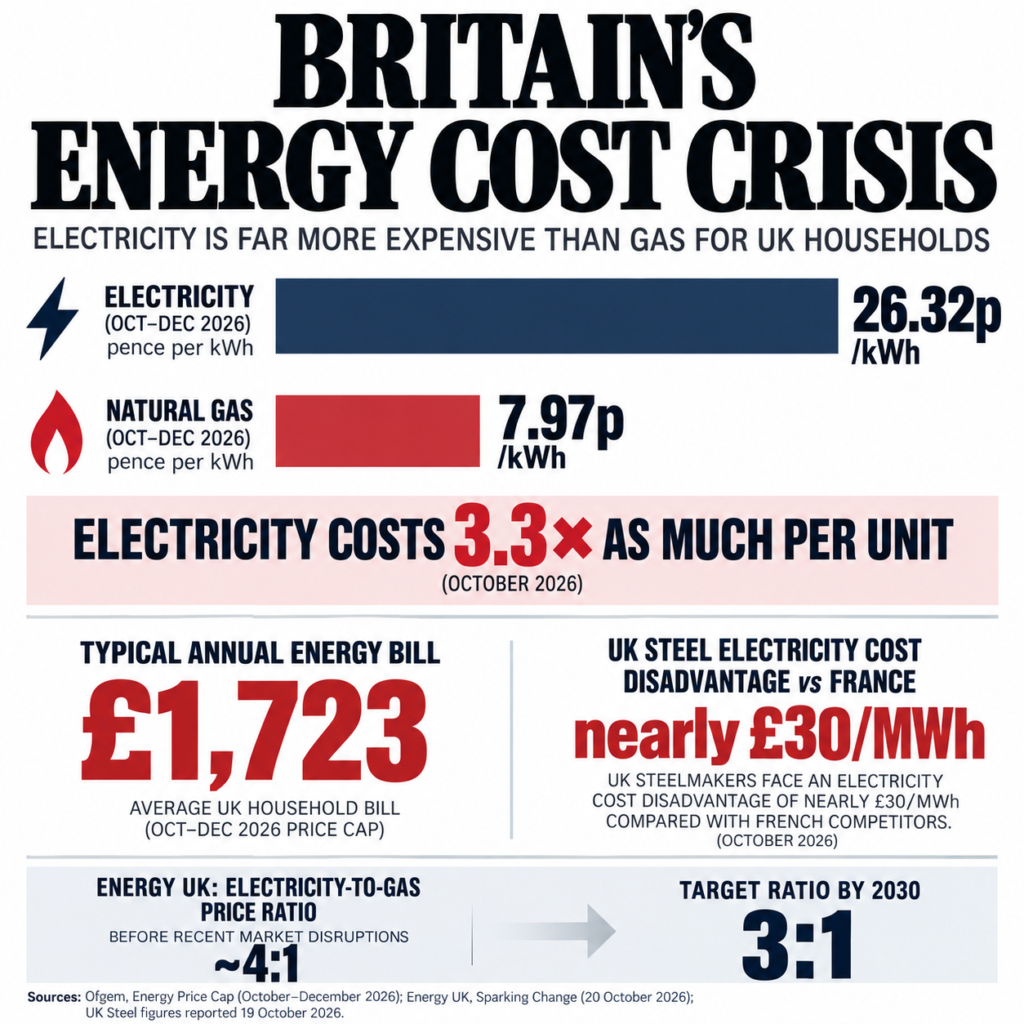
A report published this week by Energy UK reveals that electricity has been approximately four times more expensive than natural gas per unit, with government-imposed policy costs contributing to the enormous disparity.
The findings come as British manufacturers struggle with some of the highest electricity prices in the Western world, while Reform UK leader Nigel Farage and his deputy, Richard Tice, are promising to dismantle the country’s net zero agenda and deliver substantial reductions in household energy bills.
British governments have spent years encouraging households and businesses to abandon gas in favor of electricity, while imposing costs that make electricity considerably more expensive, amid a cost-of-living crisis.
Labour and the Tories have gutted Britain's industry, leaving areas like Redcar behind.
Reform will scrap net zero, reindustrialise Britain and bring thousands of good jobs back into local areas. pic.twitter.com/38RbFDXWol
— Nigel Farage (@Nigel_Farage) October 5, 2026
The Hidden Costs of Britain’s Net Zero Agenda.
Energy UK’s October 20 report, Sparking Change: How to Make Clean Heat Cheaper and Accelerate Electrification, acknowledges that Britain’s approach to financing decarbonization and social programs through electricity bills has made electricity artificially expensive compared with gas.
These costs include the Renewables Obligation, a subsidy scheme supporting renewable electricity generators, as well as other government programs financed through household and commercial energy bills.
Carbon pricing policies, including the UK Emissions Trading Scheme, impose an additional cost on electricity generated from fossil fuels. Meanwhile, substantial investment in the electricity network and the costs of balancing intermittent renewable generation contribute to the overall price of power.
Energy UK’s findings reveal that government policy has helped create a system in which electricity is considerably more expensive than the fuel consumers are being encouraged to switch to for the sake of the environment.
The report estimates that transferring remaining domestic electricity policy costs to general taxation would require approximately $3.34 billion annually in additional government spending. Combined with changes to gas standing charges, the reforms could reduce the electricity-to-gas price ratio from approximately four-to-one to three-to-one.
British Industry Is Being Crushed.
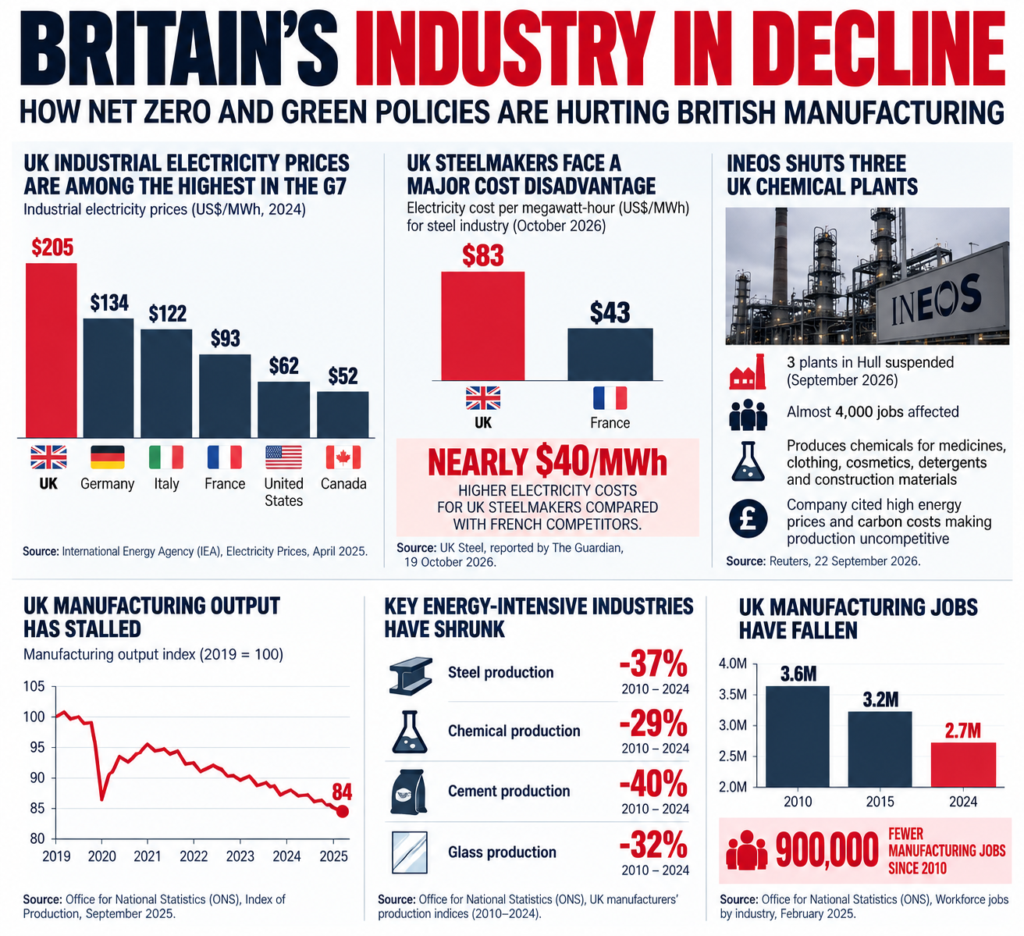
Energy UK reports that non-domestic electricity prices in Great Britain are around 50 percent higher than the median among G7 economies, crippling British business competitiveness on the global stage.
Energy-intensive manufacturers, including steelmakers, chemical producers, and heavy industrial businesses, are in the worst position, as they depend on low energy prices to keep their own costs down. Other countries are in much better positions, like France, which benefits from an extensive nuclear power industry, while American manufacturers enjoy access to comparatively cheap natural gas and electricity.
Britain, meanwhile, has pursued increasingly inane and self-harming decarbonization targets while maintaining a system in which wholesale electricity prices frequently reflect the cost of gas-fired generation.
An October report examining British steelmakers highlighted an electricity cost disadvantage of nearly $40 per megawatt-hour compared with French competitors. For companies consuming enormous quantities of electricity, such differences can translate into millions of dollars in additional annual operating expenses.
Major British Industrialist’s Warning of Impending Doom.
The growing industrial crisis was highlighted in September when billionaire industrialist Sir Jim Ratcliffe’s chemical giant INEOS announced it was suspending operations at three chemical plants in Hull. The company blamed high European natural gas prices, which have made chemical production increasingly uncompetitive against manufacturers in the United States and China.
The three plants collectively employ almost 4,000 people and produce chemicals used in pharmaceuticals, clothing, cosmetics, detergents, and construction materials. Ratcliffe warned that European manufacturers were being undermined by a combination of high energy prices and carbon taxation.
He claimed that European natural gas prices had reached approximately 12 times those in the United States and eight times those in China. The industrialist’s warning illustrates a wider danger facing Britain: businesses may relocate production overseas rather than continue operating under an increasingly expensive domestic energy system.
Closures can destroy skilled manufacturing jobs and weaken Britain’s industrial supply chains without even having much of an impact on global emissions, particularly when production shifts to countries with more carbon-intensive industries. The INEOS decision provides a clear example of what happens when environmental targets take precedence over industrial competitiveness.
Reform UK Promises to Scrap Net Zero and Cut Energy Bills.
Nigel Farage’s Reform UK is proposing a radically different approach to Britain’s energy crisis, promising to reverse the net zero policies pursued by successive Conservative and Labour governments. Under its official energy platform, Reform pledges to cut average household energy bills by approximately $334 annually within its first 100 days in government.
The party intends to achieve this by removing government-imposed policy costs from energy bills, transferring renewable subsidy obligations to the Treasury, and pursuing the renegotiation or termination of contracts it considers unfair to consumers.
Unlike Labour, which remains committed to the Green agenda, no matter the cost to Britons, Reform argues that the immediate priority should be reducing costs for households and businesses. The party has also pledged to scrap net zero policies it believes are undermining Britain’s economic competitiveness, while supporting nuclear generation and expanding domestic energy production.
Its proposals would mark a massive departure from the climate policies maintained by the Conservatives during their 14 years in government and subsequently embraced by Labour.
Reform deputy leader Richard Tice has made the party’s energy commitments a personal political test. In an October 1 speech in Doncaster, Tice pledged to resign if a Reform government failed to reduce average annual household energy bills by approximately $334 within its first 100 days.
Tice also accused Foreign Secretary Ed Miliband of failing to deliver promised energy savings when he served as Energy Secretary from 2024 to 2026, arguing that Britain’s green agenda had become an obstacle to economic prosperity.
Reform UK advocates increasing domestic oil and gas production, reducing dependence on foreign energy suppliers, and supporting nuclear power as a reliable source of electricity. It also favors reversing policies that discourage investment in Britain’s remaining fossil fuel resources.
For energy-intensive manufacturers, these measures could potentially reduce regulatory costs and improve confidence in long-term domestic energy supplies. Reform’s platform represents one of the only direct challenges to the assumption that Britain’s energy future must be organized primarily around achieving net zero, which is shared by nearly all of the establishment political parties in the country.
Britain’s Energy Future Requires Major Changes.
Energy UK’s latest findings are a late admission that net-zero policies are harming regular people. Even an organization committed to expanding clean electricity acknowledges that government policy costs have contributed to making electricity artificially expensive.
Its proposed solution is to restructure those costs and accelerate electrification. Reform UK, by contrast, wants to dismantle substantial parts of the net zero framework itself.
The Conservative governments that established and expanded Britain’s net zero commitments, and the Labour government now pursuing them, are finally starting to realize that their Green Agenda dreams are hurting their voters, but they still show no sign of changing course
For Farage and Reform UK, the situation is simple: cheaper energy, domestic production, and industrial competitiveness should take precedence over dubiously effective climate goals that are damaging people’s lives in the name of ideology.
I’ve said for many years that British manufacturing is being destroyed by net zero.
Now people are finally waking up and smelling the coffee.
We need a Reform government before it’s too late. pic.twitter.com/ccQ9mNFdNh
— Nigel Farage (@Nigel_Farage) June 11, 2026
To help Raheem J. Kassam and his team provide you with more of the original reporting and analysis you deserve, please JOIN THE NATIONAL PULSE or MAKE A DONATION today.
Join Pulse+ to comment below, and receive exclusive e-mail analyses.