




New data from the Centers for Disease Control and Prevention (CDC) reveal a dramatic decline in the number of young American teenagers identifying as lesbian, gay, or bisexual, raising questions about whether a cultural phenomenon that expanded rapidly over the past two decades has reached a turning point.
The National Pulse brings you the latest research on current events. To support Raheem J. Kassam and his team, please JOIN THE NATIONAL PULSE or MAKE A DONATION today. We are 100% reader-funded.
According to the research, the proportion of ninth-grade girls identifying as lesbian or bisexual fell from 30 percent in 2021 to just 17 percent in 2025, an overall decline of 43 percent. The percentage identifying specifically as bisexual was cut in half, falling from 26 percent to 13 percent over the same period. Jean Twenge, a psychology professor at San Diego State University who analyzed the CDC figures, described the decline as a “free fall.”
The figures emerge amid other developments challenging assumptions about younger generations across the West, including increased support for populist-right parties among sections of Europe’s youth and an unexpected surge in young people converting to Catholicism in colleges across the country, suggesting that the progressive cultural consensus that shaped much of the 2010s has begun to lose its influence over the next generation.
LGBT Ideology Became Mainstream.
By the early 21st century, the LGBT movement had achieved several major legal victories in the U.S., culminating in the 2015 Supreme Court decision recognizing same-sex marriage nationwide. The following decade saw LGBT ideology become increasingly promoted in schools, universities, major corporations, entertainment, and political institutions. Pride campaigns exploded into the mainstream, while discussions of gender identity and sexual orientation became commonplace, especially among young people.
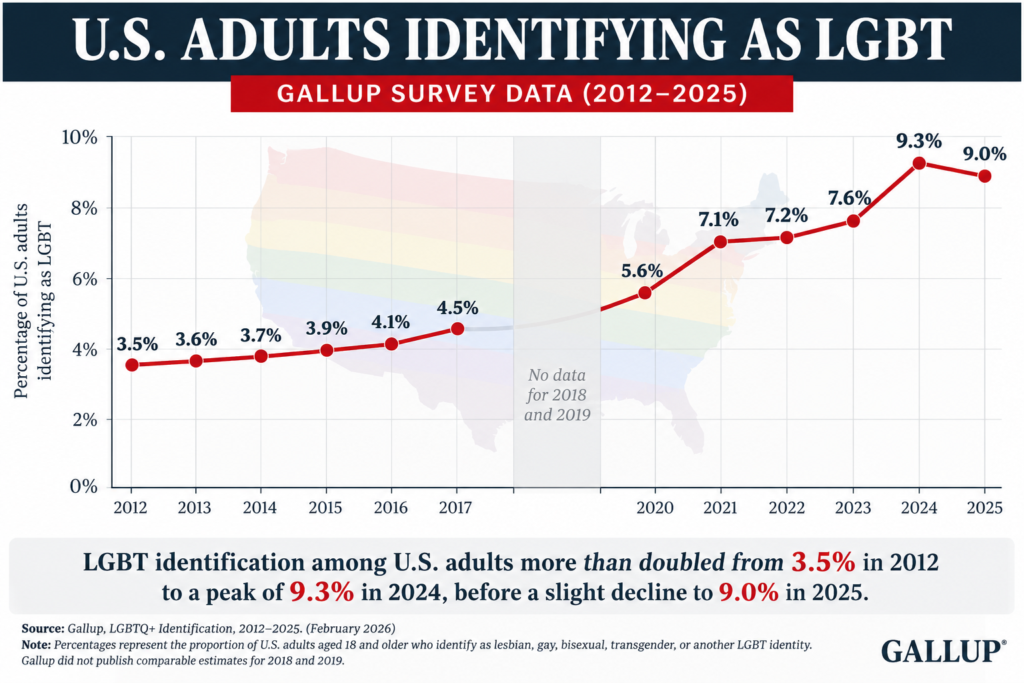
According to Gallup’s historical polling, just 3.5 percent of American adults identified as LGBT in 2012. That figure rose to 7.1 percent in 2021 and reached 9.3 percent in 2024. Among Generation Z adults, the numbers were enormous, with 23.1 percent identifying as LGBT in 2024.
The Post-Pandemic Reversal.
The CDC data examined by Professor Twenge indicate that the most dramatic changes have occurred among younger teenage girls, particularly those identifying as bisexual. The proportion of ninth-grade girls identifying as lesbian or bisexual declined by 13 percent between 2021 and 2025. Among high school girls overall, the proportion identifying as lesbian, gay, or bisexual declined from approximately 27 percent in 2021 to 22 percent in 2025.
The pattern was notably different among boys, whose identification rates have remained mostly the same. Older teenage girls also experienced much smaller changes, with their identification rates remaining above pre-pandemic levels. The findings raise questions about the massive growth in bisexual identification among teenage girls during and immediately following the COVID-19 pandemic.
Conservatives have pointed to changing political attitudes and opposition to progressive gender policies as possible explanations. Terry Schilling, president of the American Principles Project, responded to the figures by crediting changes under President Donald J. Trump’s administration.
Meanwhile, Gallup reported that adult LGBT identification declined slightly to nine percent in 2025, compared with 9.3 percent in 2024.
The Battle Over Gender Ideology in Schools.
Many young people are shaped by their education, and the ongoing battles by parents and lawmakers over gender ideology may also be playing a part in the decline of young people identifying as LGBT.
Conservative parents and advocacy organizations have challenged school policies permitting students to adopt different names or pronouns without parental notification, the inclusion of gender identity concepts in classroom materials, and the participation of transgender students in sex-segregated sports.
These disputes have increasingly shaped state legislation, school-board elections, and national education policy. In January 2025, President Trump signed an executive order titled “Ending Radical Indoctrination in K-12 Schooling”.
The order directed federal agencies to develop strategies for eliminating federal support for certain gender identity and DEI-related programs in schools, while strengthening enforcement of existing parental rights protections. It specifically addressed school policies involving the social transition of minors without parental involvement.
The Trump administration subsequently directed the Department of Education to ensure federal education funding complied with its interpretation of federal anti-discrimination law and policies concerning gender identity.
The Decline of Woke.
The latest teenage identification figures do not establish that homosexuality is declining or that LGBT identities are disappearing from American society. Gallup’s adult figures remain more than twice their 2012 level, while the sharpest teenage decline is concentrated among younger girls rather than appearing uniformly across all demographic groups.
However, the changing figures coincide with a significant transformation in the institutional environment surrounding progressive social policies.
Major corporations that once enthusiastically embraced gender ideology and woke DEI initiatives are retreating from some of those commitments. Public schools face mounting disputes over gender ideology and parental authority. The Trump administration has made reversing progressive identity-based policies a central feature of its domestic agenda.
The figures suggest that the rapid growth in sexual-identity labeling among younger teenagers during the early 2020s was not necessarily permanent and may have just been a passing trend.
To help Raheem J. Kassam and his team keep giving you the best news and analysis, please JOIN THE NATIONAL PULSE or MAKE A DONATION today.
Join Pulse+ to comment below, and receive exclusive e-mail analyses.